Monday, September 8th 2025

NVIDIA GeForce RTX 5090 Gets 128 GB VRAM Capacity Mod
NVIDIA's GeForce RTX 5090 GPU comes with 32 GB of GDDR7 memory by default. However, Chinese modders have experimented with equipping large memory capacities before, especially with the last-generation RTX 4090, which comes in at 96 GB of GDDR6X. This time, the current-generation top-end "Blackwell" consumer GPU, the RTX 5090, gets not double, not triple, but quadruple the memory capacity in the latest mod. According to @I_Leak_VN, the GPU has an astonishing 128 GB of GDDR7 memory and is priced at $13,200. That is over six times the MSRP, for a four times memory increase.
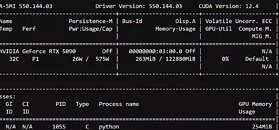
The big-picture question is what is done to the GPU to support this much memory. Currently, no GDDR7 memory modules are surpassing 24 Gbit, or about 3 GB per module, with the smaller capacity ones coming at 16 Gbit, or 2 GB per module. The largest configuration that a dual-sided, sandwiched approach to the PCB modding could support is 96 GB. That is exactly how NVIDIA's ProViz RTX PRO 6000 Blackwell GPU gets its 96 GB GDDR7 capacity. However, given that there are no 4 GB GDDR7 modules, we can only assume that some serious PCB modification was made to accommodate all the modules. Most likely, a PCB riser, tucked away somewhere, or any other interesting solution could be at play. You can take a look at NVIDIA-SMI output, which clearly shows the 128 GB capacity below.
Source:
@I_Leak_VN
The big-picture question is what is done to the GPU to support this much memory. Currently, no GDDR7 memory modules are surpassing 24 Gbit, or about 3 GB per module, with the smaller capacity ones coming at 16 Gbit, or 2 GB per module. The largest configuration that a dual-sided, sandwiched approach to the PCB modding could support is 96 GB. That is exactly how NVIDIA's ProViz RTX PRO 6000 Blackwell GPU gets its 96 GB GDDR7 capacity. However, given that there are no 4 GB GDDR7 modules, we can only assume that some serious PCB modification was made to accommodate all the modules. Most likely, a PCB riser, tucked away somewhere, or any other interesting solution could be at play. You can take a look at NVIDIA-SMI output, which clearly shows the 128 GB capacity below.


27 Comments on NVIDIA GeForce RTX 5090 Gets 128 GB VRAM Capacity Mod
The ncurses Screenshot shows 122880 Mib.
Mibibytes are 1024 and not base 1000.
120 multiplieer of base 1024 equal 1228800 MiB. The same value as shown on the picture. Which should be 120 Gib.
simple.wikipedia.org/wiki/MebibyteI wrote on purpose 1024 and not 2^10
e.g. lact for my 7800xt.
I am well aware of people are using the wrong units. Still it is wrong.
16GB means 16000MB.
I am well aware of that powercolor uses the wrong units on the paper box of the 7800xt hellhound.
"128 GB" is either 128000 MB or 131072 MB depending on whether it's binary MB (a.k.a MiB) or decimal MB. RAM usually is counted in binary units.
122880 MB also coincides with the binary units, so it's actually 120 GB, not 128 GB.
I don't know what that screenshot means, maybe the 120 GB are what is allocated to the program, or maybe to the OS or the virtual machine (but the 5090 doesn't have SR-IOV, unless that was hacked).
The same is happening on AMD, but here the difference is just a few MB. GPU-Z accounts for this and reports the truly installed physical VRAM capacity
What I'm not understanding is how did they get their hands on 32 Gbit ICs required to make this happen. If it's real at all, the device must be using engineering samples of very high density, next generation GDDR7 memory chips. The maximum density ICs currently offered by SK Hynix, Micron and Samsung have 24 Gbit capacity, that translates to 3 gigabytes per chip and will result in a 96 GB configuration when 32 are installed (16 on each side), maxing out the 512-bit memory interface and this is what Nvidia uses for the RTX Pro 6000 Blackwell. It's currently the highest per-device memory density achievable without the use of HBM.
I am cautious regarding this information
Have one on pre-order?? ;)