Wednesday, September 10th 2025

Intel Confirms "Arrow Lake Refresh" Next Year, "Nova Lake" Scheduled for Late 2026
At the Goldman Sachs Technology conference, Intel confirmed its plan to release an "Arrow Lake Refresh" in 2026, and providing reassurance that the next-generation "Nova Lake" desktop processors will arrive in late 2026. According to John Pitzer, Intel's Corporate Vice President of Corporate Planning & Investor Relations, he reassures that Intel's desktop product portfolio is strong and will remain so as the roadmap materializes. "We've got a couple of holes we've got to fill on the desktop front. But quite frankly, we feel confident in the road map," stated John Pitzer. On Arrow Lake Refresh and Nova Lake, he confirmed that "We'll have a refresh of Arrow Lake next year, which will help start the process on the desktop side, and then we'll conclude that with Nova Lake when we launch late next year into 2027."
The plan for Arrow Lake Refresh isn't currently clear. These desktop CPUs will arrive with the same core count, but supposedly tweaked frequency to extract maximum performance. Initial rumors suggested features like an upgraded NPU, but these were later discarded. For now, all we have to hope for is something similar to the Intel IPO, applied out of the box for Arrow Lake Refresh. This includes fine-tuning the P-core and E-core frequencies, ring-bus speeds, the UPI interconnect, D2D links between tiles, and both PL1 and PL2 power limits. For RAM, IPO raises transfer rates and tightens timings, pushing modules beyond their factory XMP or EXPO profiles, thereby elevating overall performance. If these settings are included out of the box, Intel could justify a refresh without significantly changing the silicon configuration. However, we are yet to see what the company plans as we head into 2026.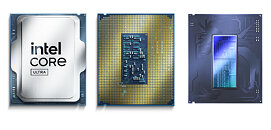
Source:
Intel at Goldman Sachs Conference
The plan for Arrow Lake Refresh isn't currently clear. These desktop CPUs will arrive with the same core count, but supposedly tweaked frequency to extract maximum performance. Initial rumors suggested features like an upgraded NPU, but these were later discarded. For now, all we have to hope for is something similar to the Intel IPO, applied out of the box for Arrow Lake Refresh. This includes fine-tuning the P-core and E-core frequencies, ring-bus speeds, the UPI interconnect, D2D links between tiles, and both PL1 and PL2 power limits. For RAM, IPO raises transfer rates and tightens timings, pushing modules beyond their factory XMP or EXPO profiles, thereby elevating overall performance. If these settings are included out of the box, Intel could justify a refresh without significantly changing the silicon configuration. However, we are yet to see what the company plans as we head into 2026.

82 Comments on Intel Confirms "Arrow Lake Refresh" Next Year, "Nova Lake" Scheduled for Late 2026
You say you could sell it to recoup a large portion of the new CPU's cost.
But relative to the competition today it should cost at most $200, and that's being very lenient.
And it would still be in production (at that lower retail price) after Zen6 launches.
So used (with no warranty or shorter warranty) it has to sell for less than a new one with longer warranty.
Meaning you won't get that much for it.
Say you're upgrading to a 10700X at the very least, that has to be what $300-350? I don't see it going for less than 300. So at best you're getting half the money back in this example.
And who would upgrade to a 9700X? Someone with a 7600X? Maybe.
The uplift would be less than going from a 245K to a 270K, in both apps and gaming, but I suppose it's still a valid option for some (they could keep using the same cooler so truly just a CPU swap).
Because buying a used 9700X makes sense for someone that's already on board the AM5 train.
Otherwise if they're upgrading to the AM5 platform and they want to buy used from the start they will need mobo and RAM too. Meaning they might skip an offer just for the CPU.Ehh just to be able to upgrade yes, but getting into specifics there will be bottlenecks, the full potential of the new CPUs won't be achieved.
Very likely that Zen6 will raise the RAM speed sweetspot from the current 6000. What happens then for the people that have 6000 at the most?
Some will overclock and close that gap but it will be halfway most likely.
And having older mobos with perhaps less features (no PCI-E Gen5 etc.) is another drawback.
You're telling me that's ideal, pairing mobos from 2023 with CPUs from 2027?
AMD's Kool-Aid might be better than the 3D V-cache.
Look having the choice is definitely a plus but let's look at it for what it really is, it's not ideal, unless you got on board later and/or got a strong board from the start. Also a healthy amount of RAM to keep you satisfied for several CPU installs. And not just healthy amount but perhaps good specs as well. Otherwise there will be potential left on the table.
It's easy to spin the upgrade path as God's gift to man, when in reality it has its drawbacks, you truly get what you pay for, and in this case if you're saving money you're getting... well less than ideal. Overall compared to Intel, yeah it is better money wise but performance wise, if those people go with a new Nova Lake platform that has everything cutting edge they will have better performance for more money. Price/perf ratio will be lower than with "recycled" AM5 but performance and feature wise they will have the upper hand. There's no free lunch, and if there is the upgrade path ain't it.
I had no problem selling my 3800X (Zen 2) despite the fact that a faster Zen 3 had been out at that point for ~1,5 years and even X3D came along.
I got 165€ for it. The buyer paid for the shipping.
3800X MSRP was 399€, but i got it for a bit over 300€ (tray) back in 2019.
5800X3D was expensive initially and cost 550€. Thanks to the 165€ i essentially paid net 385€ for it one month after launch (May, 2022).
It was expensive at the time, but looking back it was money well spent. I could probably easily sell it for 385€ today if i was to move to AM5 (im not).Might also be someone on 8000 series like 8400F for example. 9700X is noticeably faster and has an iGPU that matters to some people.
If the price is right then someone will buy it.When was this ever the case? Older AM4 boards did not limit newer Zen 3 performance. Unless there was something seriously wrong with their design such as anemic VRM etc. I very much doubt older AM5 boards will limit Zen 6 performance either.What should happen to them? The limiting factor is not the motherboard. Certainly not at 6000-8000 speeds.
Limiting factor is the RAM. We already saw this on AM4 when newer generations supported faster speeds.
People didn't run out to buy new board and RAM. Some enthusiasts might have done that, but most didn't.
And with increased caches across the board with Zen 6 (not just L3) the need for memory access is even less.There's very few relevant features to even justify newer boards. PCIe 5.0 is relatively useless for most people unless you're doing daily sequential transfers on your PC between two Gen5 drives. USB4 is limited by the lack of external drives and cables supporting this speed.
Wi-Fi 7 is also limited by the device support.
There is no new must have feature on newer boards. There are some nice to have speed ups assuming you have relevant internal or external devices to take advantage of that and some mechanical improvements like toolless M.2 and Wi-Fi antenna connectors. Perhaps the 64MB BIOS too, but only for network driver inclusion.Yes. Why not? B650 with PCIe 4.0, USB3.2 20Gbps and Wi-Fi 6E is still perfectly viable for most people.
And thanks to the initial 32MB BIOS support it doesn't face the same microcode storage issues that initial B350 boards faced on AM4.
AM5 initial boards will age much more gracefully.That remains to be seen. If Intel once again goes with their initial release+refresh support on LGA1954, then Nova Lake's supposed victory will be short lived just as Intel's CPU's from the AM4 era locked to a dead socket. 7700K was the recommendation at the time against 1700X.
Years later it didn't matter because 1700X users were able to upgrade to a much faster CPU on their board and RAM where as Intel users were stuck with what they had.
However if Intel publicly commits to 3 generations on LGA1954 (including one brand new one, not just a refresh) then they might have a shot.
I meant the whole platform. The advantage of the upgrade path was just the CPU swap. But if the RAM then becomes the weak link, at least on occasion, then we have to be honest about it.Yeah the RAM, which is part of the platform and which was supposed to be fire and forget (regardless of this crisis, although this makes changing the RAM an expensive hassle).
If we talk capacity, which has priority, if that is still sufficient relative to one's needs then the performance level is largely maintained.
But for the performance chasers, like I said if the Zen6 memory sweetspot is raised it means some performance will be left on the table for these users.If that will be the case, then it will truly be praiseworthy.I was actually hinting at the GPU (sorry for not being specific).
I agree that for M.2s Gen5 doesn't make sense (not just now but also before the crisis) except as a primary drive in a cutting edge system. And that's only valid for a top tier one like this:
www.techpowerup.com/review/corsair-mp700-pro-xt-2-tb/18.html
Based on TPU's testing even a 5090 is perfectly fine until you start going below PCIe 4.0 x8: www.techpowerup.com/review/nvidia-geforce-rtx-5090-pci-express-scaling/29.html
Other cards are all slower and show an even smaller difference.
That's what I'm saying, that in the end 90 maybe 95% (depending on the starting config) is the ceiling with this approach.
Price/perf is definitely great and is a major advantage for AMD.Most likely they will. They certainly got the message now after their science class experiment (LGA1851).
Just because you can get lucky and find someone (not well informed) that will buy a part from you for more than it's actually worth it doesn't mean it's guaranteed every time, hence the luck factor.
That means you can't just expect beforehand that you will surely pay back x amount of the new CPU's cost. Especially before the new gens launch and influence the price of the older gens still produced and subsequently older gens on the used market.
Like the saying goes: Never sell the bear's skin before one has killed the beast.