Sunday, September 21st 2025

Flashing XT BIOS on AMD Radeon RX 9070 Yields up to 25% Performance Boost
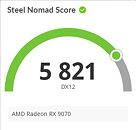
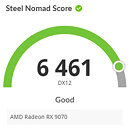
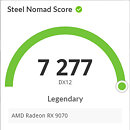
Flashing BIOS of a higher-end GPU onto a less powerful SKU from the same GPU family is not a novel concept. However, it can enable massive performance uplift thanks to the more relaxed approach to power and frequency. This is exactly what u/noVa_realiZe did and posted on r/Radeon subreddit. According to the post, the user flashed AMD Radeon RX 9070 XT BIOS onto his PowerColor RX 9070 non-XT SKU. This has yielded a considerable performance increase, driving the 3DMark Steel Nomad benchmark from 5,821 points at stock, non-flashed GPU to 6,461 points, which is approximately an 11% increase. With additional tweaks and settings, such as increasing the power limit with the XT BIOS and adjusting memory configurations, the user achieved a score of up to 7,277 points in the same benchmark. This represents a remarkable 25% increase over the base result, with the non-XT card achieving nearly a quarter of its performance improvement through a few tweaks.
In real-world gaming, the card only managed to gain roughly 8-12% uplift over the stock SKU, showing the decoupling from the synthetic tests. It is very likely that the longer-term thermal stress from the prolonged gaming sessions is causing this lower performance increase, sustaining lower clocks compared to the relatively short-term load from synthetic benchmarks. The entire cause of this FPS increase is the enhanced power limit, which increases the non-XT 220 W board power to as much as 300 W, representing a roughly 36% power increase on its own. No additional cores/ROPs/TMUs are unlocked by flashing the XT BIOS. In fact, the entire process is very inefficient when comparing the power/performance of the stock non-XT SKU. However, if you are looking to extract the maximum performance from your GPU, this may be a viable option, provided you consider all the risks associated with running your GPU at its non-default settings. Sustained higher power settings can result in GPU degradation over time, and BIOS flashing is always a risky endeavor.
Source:
r/Radeon
In real-world gaming, the card only managed to gain roughly 8-12% uplift over the stock SKU, showing the decoupling from the synthetic tests. It is very likely that the longer-term thermal stress from the prolonged gaming sessions is causing this lower performance increase, sustaining lower clocks compared to the relatively short-term load from synthetic benchmarks. The entire cause of this FPS increase is the enhanced power limit, which increases the non-XT 220 W board power to as much as 300 W, representing a roughly 36% power increase on its own. No additional cores/ROPs/TMUs are unlocked by flashing the XT BIOS. In fact, the entire process is very inefficient when comparing the power/performance of the stock non-XT SKU. However, if you are looking to extract the maximum performance from your GPU, this may be a viable option, provided you consider all the risks associated with running your GPU at its non-default settings. Sustained higher power settings can result in GPU degradation over time, and BIOS flashing is always a risky endeavor.


32 Comments on Flashing XT BIOS on AMD Radeon RX 9070 Yields up to 25% Performance Boost
Do the 9070 non-XT versions have the same VRM's, PCB traces and so on like the XT-versions to support this extra power draw for a longer period?
Nice that it is possible, but as stated in the article; is it worth the risks?
Investing in a more powerful graphics card seems to be wiser :p , but can't deny experimenting is fun also :D.
This story isn't new, the exact same story was published on TPU in April (www.techpowerup.com/forums/threads/amd-radeon-rx-9070-can-be-flashed-with-rx-9070-xt-bios-to-increase-power-limits-and-clocks.335141/)
Does the dead internet theory start to check out ?
I do not know why someone wants to update GOP on a 7000 Radeon Series card.Adrenalin is of no use to me at all.
I expect we will soon see posts from new members. It's often the same pattern: a first-time poster with a fried graphics card, seeking help after attempting something without understanding the underlying electronics.
Until I understand the entire process and see a credible method demonstrated outside of Windows for how to read and write to these chips—including the necessary cables, adapters, how to extract the HEX file from the official firmware, and then perform a one-to-one comparison with the bits on the chips—I'm going to leave it alone.
These kind of mods made (a lot of) sense when they actually unlocked shaders (like in 6950 to 6970). If all they do is increase the power limit, just save yourselves the hassle and do it in your original BIOS with whatever software you like.
If and only if you want to tinker AND have already maxed out the available margin feel free to shunt mod. But understand the implications, you probably should improve power phase cooling and/or power connectors. I have seen a considerable number of dead gpus in northwestrepair and similar channels because people fail to understand why some limits are put in place by the OEMs.Exactly. So that means that the difference between the AVERAGE overclocked and optimized non-bios-modded GPU and the one of the article is within margin of error.
This will only get more uninformed customers bricking their GPUs for no real reason.
I think you should mention author of this modded AMD tool, who made this possible.
In the past he also patched previous version for RDNA3.
www.overclock.net/threads/amdvbflash-modded.1817620/
Instead of someone, who actually did nothing special.
Without @Benik3 it would still be a hardware oriented mod.
I paid significantly less for non-XT model, difference was aprox. 200 USD, between my unit (ASUS Prime) and cheapest possible XT model (like PowerColor Reaper for example).
I compare brand new cards from typical online shop.
So I think it was a decent deal after all.
You can double-check this in the fact that the overclocked modded card gets similar scores than the average unmodded overclocked card.
a Clu3D that Law-II helped me unbrick that i unlocked to a 6970 later using the good advice i got here, the 9800 i had was unlocked to Pro and flashed for a PowerMac G4 quicksilver (2001) ;)
Gotta upsell to the 9070XT.
Reminds me of the good ol' day where I flashed a 7970GHz and 280X bios on my og 7970 Lightning cards.
In practice it's not really worth it though, power efficiency goes out of the window and the cooler is typically not designed to handle such loads making them insanely loud.
But young me didn't pay for power and number go up = wow.