Sunday, September 21st 2025

Flashing XT BIOS on AMD Radeon RX 9070 Yields up to 25% Performance Boost
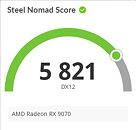
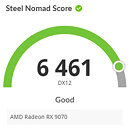
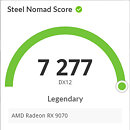
Flashing BIOS of a higher-end GPU onto a less powerful SKU from the same GPU family is not a novel concept. However, it can enable massive performance uplift thanks to the more relaxed approach to power and frequency. This is exactly what u/noVa_realiZe did and posted on r/Radeon subreddit. According to the post, the user flashed AMD Radeon RX 9070 XT BIOS onto his PowerColor RX 9070 non-XT SKU. This has yielded a considerable performance increase, driving the 3DMark Steel Nomad benchmark from 5,821 points at stock, non-flashed GPU to 6,461 points, which is approximately an 11% increase. With additional tweaks and settings, such as increasing the power limit with the XT BIOS and adjusting memory configurations, the user achieved a score of up to 7,277 points in the same benchmark. This represents a remarkable 25% increase over the base result, with the non-XT card achieving nearly a quarter of its performance improvement through a few tweaks.
In real-world gaming, the card only managed to gain roughly 8-12% uplift over the stock SKU, showing the decoupling from the synthetic tests. It is very likely that the longer-term thermal stress from the prolonged gaming sessions is causing this lower performance increase, sustaining lower clocks compared to the relatively short-term load from synthetic benchmarks. The entire cause of this FPS increase is the enhanced power limit, which increases the non-XT 220 W board power to as much as 300 W, representing a roughly 36% power increase on its own. No additional cores/ROPs/TMUs are unlocked by flashing the XT BIOS. In fact, the entire process is very inefficient when comparing the power/performance of the stock non-XT SKU. However, if you are looking to extract the maximum performance from your GPU, this may be a viable option, provided you consider all the risks associated with running your GPU at its non-default settings. Sustained higher power settings can result in GPU degradation over time, and BIOS flashing is always a risky endeavor.
Source:
r/Radeon
In real-world gaming, the card only managed to gain roughly 8-12% uplift over the stock SKU, showing the decoupling from the synthetic tests. It is very likely that the longer-term thermal stress from the prolonged gaming sessions is causing this lower performance increase, sustaining lower clocks compared to the relatively short-term load from synthetic benchmarks. The entire cause of this FPS increase is the enhanced power limit, which increases the non-XT 220 W board power to as much as 300 W, representing a roughly 36% power increase on its own. No additional cores/ROPs/TMUs are unlocked by flashing the XT BIOS. In fact, the entire process is very inefficient when comparing the power/performance of the stock non-XT SKU. However, if you are looking to extract the maximum performance from your GPU, this may be a viable option, provided you consider all the risks associated with running your GPU at its non-default settings. Sustained higher power settings can result in GPU degradation over time, and BIOS flashing is always a risky endeavor.


32 Comments on Flashing XT BIOS on AMD Radeon RX 9070 Yields up to 25% Performance Boost
Yes, I too wish for better but it is what it is.
I was able to achieve +6% perf. boost just by undervolting my RX 9070 XT. Now add +100W power limit to that and there you go.
RX 9070 has roughly 95W less TDP than RX 9070 XT (comparing Sapphire Pulse models).
Anyhow, that flashed RX 9070 must be shitting bricks with 2-3 heatpipes cooling solution, apart from voiding warranty.
Yes, RX 9070 has (mostly) different cooling solution and weight multiple hundreds of grams less.
Stock fan curves are why so many GPUs die. Crappy tolerances, crappy paste, then 40% fan while it hits 100C+ and ram goes to 95+ burning it out, too.
Well in that case, sure. It's not like RDNA4's V/F curves are getting very steep at 2.x GHz.
It was more the Firmware of antoher Radeon Card could be flashed. We had some people asking for details. Some people wanted to make some sort of spreadsheet to list down which lower graphic card was successfully flashed with another firmware.
Free performance gains but the card still has the same calculation units, however you name those. Should be named compute units and "ROP
counts".