Thursday, September 25th 2025
HighPoint Technologies Introduces Rocket 7638D, Industry's First Hardware Architecture for GPU-Direct NVMe Storage
HighPoint Technologies, a leader in high-performance storage solutions, has announced the launch of the Rocket 7638D, a revolutionary PCIe Gen 5 switch adapter engineered to solve the most critical bottleneck in modern AI/ML workflows: data starvation. The adapter's groundbreaking hardware architecture provides a foundational platform for GPU-Direct NVMe storage, enabling NVIDIA GPUs to directly access massive datasets without the performance penalties of CPU bottlenecks. The Rocket 7638D is designed to help AI professionals maximize their return on investment by ensuring their GPUs are always at full utilization, accelerating model training, inference, and data preprocessing to unprecedented speeds.
The Paradigm Shift: From Conventional to Direct
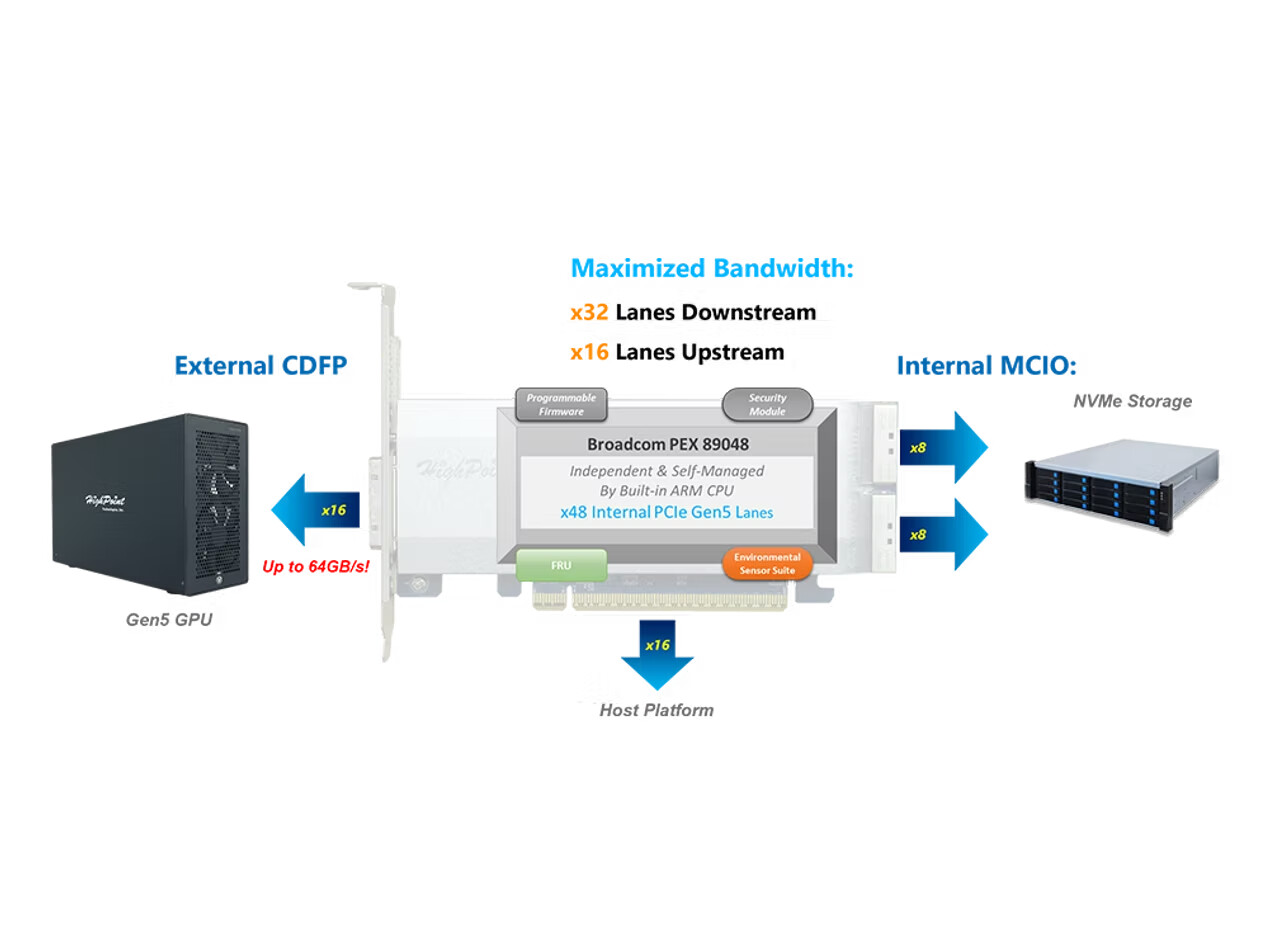
For decades, the path from storage to compute has been a bottleneck. Data has had to travel from an NVMe drive, through the host CPU, and into the GPU's memory—a slow, inefficient process that wastes valuable compute cycles. The Rocket 7638D shatters this conventional model. It is the first 48-lane Gen 5 PCIe switch adapter engineered with a dedicated x16 Gen 5 pathway for both an external GPU and NVMe storage from a single slot. This architecture creates a direct, peer-to-peer data channel that bypasses the host CPU entirely.
 The result is a transformative leap in performance. By eliminating latency and reducing CPU overhead, the Rocket 7638D ensures that precious GPU compute cycles are no longer wasted on I/O. HighPoint's innovative hardware architecture provides a direct data path that, when paired with a compatible third-party software solution, enables a full GPU Direct Storage (GDS) stack. For deep learning, this translates directly to faster epochs, reduced model training time, and a significant boost in inference throughput, providing a competitive edge for any data-intensive application.
This ensures that powerful GPUs and other accelerators are not sitting idle, but are constantly processing data at their maximum potential, dramatically accelerating workflows and increasing overall system efficiency.
Simple, Intuitive, and Professional
Despite its advanced capabilities, the Rocket 7638D has been engineered to streamline installation, deployment and field service. The hardware is natively supported by all major operating system platforms, eliminating the need for additional software or complex driver installation. This plug-and-play functionality allows AI/ML, HPC, and Scientific Imaging professionals to quickly install the card and begin building a GPU-accelerated storage solution. For peace of mind, HighPoint's user-friendly MPT utility enables administrators to quickly view firmware information, monitor PCIe bus speed, and check the health of the adapter's switch chipset in real time.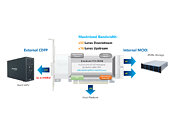 Key Innovations at a Glance
In essence, the Rocket 7638D is the missing link for any NVIDIA-accelerated workflow. It's innovative hardware architecture fundamentally changes the relationship between compute and storage. By unlocking the full potential of your GPU hardware and enabling the fastest possible data pipelines, the Rocket 7638D ensures your ROI is fully realized.
Source:
HighPoint
The Paradigm Shift: From Conventional to Direct
For decades, the path from storage to compute has been a bottleneck. Data has had to travel from an NVMe drive, through the host CPU, and into the GPU's memory—a slow, inefficient process that wastes valuable compute cycles. The Rocket 7638D shatters this conventional model. It is the first 48-lane Gen 5 PCIe switch adapter engineered with a dedicated x16 Gen 5 pathway for both an external GPU and NVMe storage from a single slot. This architecture creates a direct, peer-to-peer data channel that bypasses the host CPU entirely.


This ensures that powerful GPUs and other accelerators are not sitting idle, but are constantly processing data at their maximum potential, dramatically accelerating workflows and increasing overall system efficiency.
Simple, Intuitive, and Professional
Despite its advanced capabilities, the Rocket 7638D has been engineered to streamline installation, deployment and field service. The hardware is natively supported by all major operating system platforms, eliminating the need for additional software or complex driver installation. This plug-and-play functionality allows AI/ML, HPC, and Scientific Imaging professionals to quickly install the card and begin building a GPU-accelerated storage solution. For peace of mind, HighPoint's user-friendly MPT utility enables administrators to quickly view firmware information, monitor PCIe bus speed, and check the health of the adapter's switch chipset in real time.
- Revolutionary Hardware Architecture: The Rocket 7638D is the first PCIe Gen 5 switch adapter to provides the foundational hardware for a GPU-direct NVMe storage solution.
- Dedicated Bandwidth for Maximum GPU Utilization: Our proven PCIe Switching Technology dynamically allocates 48 lanes of Gen 5 bandwidth, guaranteeing dedicated x16 pathways to both the GPU and NVMe storage. This eliminates the I/O bottleneck, ensuring your GPU is never starved for data.
- Uncompromised CDFP-CopprLink Connectivity: Ensures reliable, high-bandwidth GPU-to-host data transfers, supporting NVIDIA's most powerful GPUs and external enclosures for flexible deployment.
- Flexible Dual-MCIO 8i Ports: The Rocket 7638D dual MCIO 8i ports are capable of supporting up to 16 NVMe drives for a staggering 2 Petabytes of storage. This high-density adapter is purpose-built to handle the largest AI datasets, from petabytes of scientific imaging data to vast training sets for large language models (LLMs).
- Broad Platform Compatibility: Works with Intel, AMD, and Arm platforms
- Optimized for AI Workflows: Provides a hardware platform for GPU Direct Storage (GDS), reducing CPU overhead, lowering latency, and accelerating data preprocessing.
- FRU (Field Replaceable Unit): VPD stored by each adapter enables service providers to easily procure replacements with the correct firmware/hardware combination.
In essence, the Rocket 7638D is the missing link for any NVIDIA-accelerated workflow. It's innovative hardware architecture fundamentally changes the relationship between compute and storage. By unlocking the full potential of your GPU hardware and enabling the fastest possible data pipelines, the Rocket 7638D ensures your ROI is fully realized.

16 Comments on HighPoint Technologies Introduces Rocket 7638D, Industry's First Hardware Architecture for GPU-Direct NVMe Storage
Maybe connecting the external GPU to a NVMe storage node? That seems kind of narrow. In any case it's an interesting device.
Then there is the fact it has a broadcom chip it, if ever there was a company that does NOT deserve any of anyone's money, its them.
Since this is a storage solution, it's obvious they want 32 downstream lines to feed multiple devices,presumably, from the storage device and not the internal bus.
It is not Host 16x <---> 16x + 8x +8x (GPU + NVME)
Most of the time it works like GPU 16x <---> 2 * 8x NVME
From time to time it connects GPU 16x <--> 16x Host or NVME 16x <---> Host
It stat be interesting when platform provides more 16x PCIe slots.
They even may share lines.
The GPU and lots of NVME drives have 32 lanes of “internal communications” not going through the CPU. Think of it like a networking switch. The GpU can talk to drives directly without the CPU involved and with more PCIe lanes / bandwidth than consumer platforms have (outside of HEDT / rebadged server platforms like Threadripper / pro).
If you are hitting a bottleneck feeding learning data to train a large model this is theoretically for you.
hyte.com/blog/microsoft-directstorage-explained
Version 1.0 of direct storage only provided a high efficiency IO pipeline.
It wasn't until version 1.1 that GPU decompression was introduced and it's optional for developers to use it. They may still choose to use CPU decompression with DirectStorage.
devblogs.microsoft.com/directx/directstorage-1-1-coming-soon/#:~:text=DirectStorage%201.0%20improves%20the%20data%20transfer%20part,in%20load%20times%20by%20up%20to%2040%25.
It's nothing revolutionary but these solutions are usually buried deep inside proprietary hardware and not available for purchase at all by just anyone, so at least having this available on the market is something new.
There is no advantage of using this instead of say m.2 and GPU on the motherboard, the point is it can connect to external rack of high end NVIDIA hardware instead of just having your regular GPU and MCIO are for server grade storage SSDs. Switch will allow GPUs to directly communicate with the storage, without this data stream ever going through your CPU or PC PCIe BUS, leaving it free for doing something else, like data acquisition.
So a nice card, but this PEX chip alone is ~$500, so the card will probably cost about same as 5090... but that's nothing for target users.
You can compare it to an Ethernet switch, which will also send packets between a 2.5Gbit/s and a 100Mbit/s port, for example.
Missed the point.
Point was that the most traffic will be between computing device (GPU) and storage (NVME)
Communication with hosting platform will be there mostly before computing starts (preparing data) and near the end of job (collecting results).
These are not the same technology, and the latter does not copy data to main memory since it uses PCI-express peer-to-peer modes to communicate directly between devices, in this case GPU and NVMe SSDs (or even networked NVMe via RDMA-enabled NICs).
In that case, this card and GPUDirect Storage are designed to be used together. They don't compete with each other.
This card enables a low latency, high bandwidth connection directly between the GPU and storage, keeping a lot of that data going through the card itself. This in turn frees up PCIe bandwidth for other things and creates an ideal operating environment for GPUDirect Storage (or other solutions).
With it, it acts as a PCIe switch, the solution used in most high count GPU nodes now.
As noted in my original post, I fail to see the use case apart from the external connection on the card itself going to an external GPU which is niche to say the least.
One other avenue is the programmability aspect, but the press release is scant on details.
Without the external GPU, which I noted as a possible use case twice now, the data still has to go through the host PCIe bus in order to get to the internal GPUs.
How does it solve multiple PCIe root complexes? With a dual-socket system it still is an issue even with this card.
Latency due to motherboard PCIe routing? This card itself adds far more, due to being an active participant in the bus, than passive traces. A 25cm trace on standard FR4 board adds ~1.5 ns of latency while Broadcom PEX89048 used in this card adds 115ns, so 75 times more.
Since this card has x16 to the host (and internal GPUs) and two x8 links to storage it doesn't add anything of use while in fact providing a detrimental effect on latency, and increased complexity in PCIe handling due to being a switch.