Wednesday, November 26th 2025

Epic Games CEO Dismisses Valve's Generative AI Disclosures
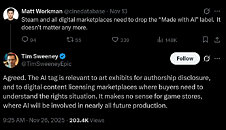
Tim Sweeney, CEO of Epic Games, is somewhat known for being vocal about many topics within the gaming industry, and he is the latest in a long line of game studio CEOs to share his thoughts on generative AI. In a recent post on X, Sweeney commented that the generative AI disclosures that Valve makes developers and publishers display on Steam make "no sense for game stores, where AI will be involved in nearly all future production." Not only is this confirmation that we will likely not see Epic Games Store require developers to disclose the use of generative AI, but it also suggests that generative AI is already being widely used within Epic Games. Curiously, Sketchfab, which has been a part of Epic Games since 2021, recently started requiring a disclosure for creations made using generative AI—although there's a good chance this was simply a legal requirement to help Epic Games avoid copyright and licensing issues.
Both assertion that generative AI will be used in nearly all future game projects and that disclosure is unnecessary were widely met with criticism in the response to Sweeney's comments, with many gamers simply saying they had a right to know, likening it to false advertising messaging and game trailers that have to disclose whether footage used in the trailer is from the game or not. Others went so far as to say that they would like to know when games were made with generative AI, so that they could "spend their money elsewhere." Sweeney's comments come shortly after EA and Krafton pivoted to include more AI in their workflows—sometimes with disastrous results—and the CEO of Take-Two advocated for integrating AI into games in lieu of having voice actors act out all of the dialogue for a game.
Source:
Tim Sweeney on X
Both assertion that generative AI will be used in nearly all future game projects and that disclosure is unnecessary were widely met with criticism in the response to Sweeney's comments, with many gamers simply saying they had a right to know, likening it to false advertising messaging and game trailers that have to disclose whether footage used in the trailer is from the game or not. Others went so far as to say that they would like to know when games were made with generative AI, so that they could "spend their money elsewhere." Sweeney's comments come shortly after EA and Krafton pivoted to include more AI in their workflows—sometimes with disastrous results—and the CEO of Take-Two advocated for integrating AI into games in lieu of having voice actors act out all of the dialogue for a game.


32 Comments on Epic Games CEO Dismisses Valve's Generative AI Disclosures
Seriously, it would've been better if he just flat-out lied. Now, The Investors have to deal w/ PR-blowback :rolleyes:
He is right about 1 thing-
The use of Generative AI in both development and gameplay, is going to become common.
It does need to be disclosed, though. Otherwise, it's a purposeful effort to supplant and push-out indie and corporate devs, alike.
It's a story as old as time. The fat cat gets too fat and doesn't want to play fair anymore. It's similar to the Greek myth of Icarus and how he flew too close to the sun and it was his downfall, even though he was warned and did it anyways.
Lots of companies go under because of unfettered greed. Unfettered greed is the ultimate destroyer...
That the CEO of EPIC doesn't see that, tells me they don't really care about their customers.I'd argue EPIC is neither. When you fail to disclose important information to customers, that hurts all devs. You burn enough customers with low quality games churned out primarily with inspiration-less use of AI, eventually customers will not come back.
:)
Deezer has a radically different stance (French company) than Spotify (US) when it comes to disclosure on 'made with AI'. I don't think it needs explaining, but its crystal clear there is a sharp divide here between the perspective of US Big Tech and the rest of the planet. A divide some have identified a long time ago, and many are still oblivious to.
Sneak peek: the planet will win. The pushback on AI is getting bigger by the day and it has likeness to autonomous driving: every time we discover the AI is trying to fuck with us, we penalize it heavily, and get ever closer to discarding the tech or placing it in the shitty corner. The core concept here: trust is everything. If you can't trust a thing, you won't happily use it.
Rightly so, I might add.
The purpose of AI is not to generate more slop which is evidently what commerce is pushing on to make money. It has to add something to our lives, and we are now at the very moment in time where we can shape that future. We all require AI to be used in the right way and to prevent it from killing human creativity.
The writings on the wall here are immense though... Valve clearly has a much healthier outlook and actual principles when it comes to digital distribution, and EGS is clearly chasing the bottom end of the internet gutter after failing to create a nice storefront: collabs, Fornite > Roblox, and every other trick in the Dark Pattern & easy money book comes out sooner or later. I won't be spending a penny on Sweeney anymore.
Out of all this will emerge a clear divide between companies that are manipulative and those that are customer driven, if it wasn't there already.Precisely. And there will be an internet army chasing the truth for all that non-disclosure, with consequences.
When Valve banned NFT and Crypto games from steam, Sweeny, despite being slightly dismissive of those games in the past, IMMEDIATELY came out to openly welcome them into the EGS. He is also notoriously against linux, which contrasts valve's openness and willingness to invest in linux and open source in general. Anything but actually developing their storefront, a storefront so noncompetitive that even ubisoft connect runs circles around it.
Its a bit like having a game that's barely functional getting released into 1.0, and then following up with a slew of MTX store updates to promote skins, while game is still unplayable. Apparently in some board rooms the conclusion was drawn 'this actually works' however misguided it obviously is. Generative AI fits in the picture perfectly: minimum effort maximum profit, with no regard for the actual end product.
Transparency makes sense to me. I would liken this to ingredients on a package. I would go even further and have them say how much % of the game was made by AI vs actual people.