Thursday, December 4th 2025
Keychron Launches K2 HE All-Wood Special Edition Wireless Mechanical Keyboard
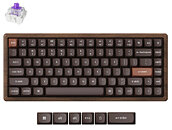
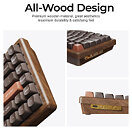
Keychron is expanding its wireless mechanical keyboards lineup with the new K2 HE All-Wood Special Edition, a variant of the K2 HE series (first unveiled at CES 2025 show) that pairs Gateron double-rail magnetic switches with a walnut-wood chassis. The 75% wireless keyboard keeps all the K2 HE series features with adjustable actuation, rapid triggers and 360° input control but replaces the aluminium frame with a full wood body and CNC machined aluminium side panel. Connectivity options include 2.4 GHz wireless, Bluetooth 5.1 and USB-C wired, with a 1000 Hz polling rate on wired / 2.4 GHz and 125 Hz over Bluetooth. The board features north-facing RGB lighting, screw-in PCB stabilizers, NKRO and Keychron web configurator for adjusting actuation points, lighting, and multi-action key mappings.
The All-Wood Edition ships fully assembled, including the PCB, case, aluminium plate, OSA double-shot PBT keycaps for macOS and Windows, and preinstalled Gateron Double-Rail Magnetic Nebula switches. As with the regular K2 HE, this Special Edition supports only the double-rail magnetic switch type, no compatibility with other Gateron magnetic variants. Keychron lists the K2 HE All-Wood Special Edition at $199.99, making it $60 pricier than the previous Special Edition and $70 above the standard model.

Source:
Keychron
The All-Wood Edition ships fully assembled, including the PCB, case, aluminium plate, OSA double-shot PBT keycaps for macOS and Windows, and preinstalled Gateron Double-Rail Magnetic Nebula switches. As with the regular K2 HE, this Special Edition supports only the double-rail magnetic switch type, no compatibility with other Gateron magnetic variants. Keychron lists the K2 HE All-Wood Special Edition at $199.99, making it $60 pricier than the previous Special Edition and $70 above the standard model.


29 Comments on Keychron Launches K2 HE All-Wood Special Edition Wireless Mechanical Keyboard
Can you provide a source on how AES-128 might be broken in hours or minutes? I'm not finding much just using google. Even articles I find that discuss quantum computing don't include estimates that low. Are you just assuming that some countries have bigger quantum computers than they report?
Looking for information on this stuff is annoying. It highlights how bad google has gotten since top results tend to include outdated results. I assume most people search for the answer, find one that looks real and then stop looking. So the algorithm continues to feed that result as popular.
Can you at least answer this:
Is AES-128 crackable within the space of a year using consumer-level computer hardware?
Edit: Found this: bruteforce.bitsnbites.eu/, Used Qwant instead of Google