Sunday, October 25th 2026
Vantex V1 Launches as No-Frills Ergonomic Mechanical Keyboard with Built-in Trackpad
The Vantex V1 is a new mechanical keyboard project that recently launched on Kickstarter. It takes the columnar stagger ergonomic layout found on split keyboards, like the Corne or Silakka54 and builds it into a more manageable aluminium unibody chassis, replete with a central trackpad, for an all-in-one input solution. The Vantex V1 is available in both a tri-mode wireless (2.4 GHz, Bluetooth, and USB-C wired) version, starting at $159 on Kickstarter ($159 MSRP) or in a wired version that starts at $129 on Kickstarter ($259 MSRP).
The Vantex V1 has a fairly compact, but adaptable 60% layout, although it uses only 1u or 1.25u keys for all but the long key under the trackpad, which should make it easy to get used to for newcomers to the ergonomic keyboard space, and it has three shortcut keys above the trackpad for custom mouse keys, navigation, macros, or other user-defined functionality. The central trackpad, arguably the star of the show, is a 45 × 45 mm unit with multitouch gestures, and Vantex says that the keyboard has four programmable layers, one of which can easily be set up as a mouse layer, depending on the included firmware, which has yet to be disclosed.
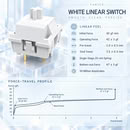
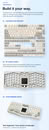 The keyboard itself uses standard-height MX-style mechanical keyboard switches, and the included switch is a semi-custom Vantex White Linear switch, which has a 30-47 gf actuation force, 2 mm of pre-travel, and 3.5 mm of total travel. The keyboard's PCB and plate both support hot-swap switches, and it will ship with a set of retro-themed dye-sublimated PBT keycaps in Cherry profile. The keyboard case will be electrophoretic-coated aluminium, and it will only be available in retro beige, and it features no backlighting, RGB or not.
Source:
Vantex on Kickstarter
The Vantex V1 has a fairly compact, but adaptable 60% layout, although it uses only 1u or 1.25u keys for all but the long key under the trackpad, which should make it easy to get used to for newcomers to the ergonomic keyboard space, and it has three shortcut keys above the trackpad for custom mouse keys, navigation, macros, or other user-defined functionality. The central trackpad, arguably the star of the show, is a 45 × 45 mm unit with multitouch gestures, and Vantex says that the keyboard has four programmable layers, one of which can easily be set up as a mouse layer, depending on the included firmware, which has yet to be disclosed.


8 Comments on Vantex V1 Launches as No-Frills Ergonomic Mechanical Keyboard with Built-in Trackpad
An ergonimic keyboard is, by design, the equivalent of a ballroom dress. Calling it "No-Frills" is so silly I can't stop laughing. :roll:
This has no RGB, no screen, no rotating knobs, isn't wireless, isn't high Hz, and doesn't use fancy TMR or hall-effect switches. So, it's relatively no-frills, orienting around functionality.
- ergonomic
- aluminium unibody chassis
- central trackpad
- tri-mode wireless
- 60% layout
- three shortcut keys above the trackpad for custom mouse keys
- four programmable layers
- MX-style semi-custom Vantex White Linear switch
- hot-swap switches
- retro-themed dye-sublimated PBT keycaps
- case will be electrophoretic-coated aluminium
We're talking about a keyboard with a starting price tag of $130, ten times the amount a real "no-frills" keyboard would cost. The only "no frills" thing about it is the marketing.That will depend on where you draw the line for "ergonomic". The basic keyboard design is ergonomic, if you're going by the pure definition of the term, and if you do an Amazon search for "ergonomic keyboard" you'll get results like these:Are those "ergonomic" enough to fit the common usage of the word? If you say yes then sure, it's a leotard, but if your "ergonomic" looks like this:
That's a ballroom dress, not to be confused with a ball gown dress. One is a very practical, if fancy, piece of clothing and the other one is
an impractical nightmarea marvel of clothing design. :DIt's easy to tell the difference: if half the yearly fabric production of Vietnam isn't enough or if you need 4 assistants just to help you move around without getting yourself killed when wearing it that's ball gown dress and I would never compare it to any kind of device made with practicality in mind. :laugh:
No frills doesn't necessarily mean random e-waste from the 1 dollar thrift store. It can also mean it doesn't really have anything without a clear, practical purpose (looking "nice" isn't one those though). Context matters.
So yes, all things considered, this Vantex board is pretty no frills. And pretty cool too. Would be even cooler with a wider footprint and slightly rotated clusters (and with palm rest areas), but I already mentioned this in my first post.
My "ergonomic" looks like a custom 40 percent Dactyl Manuform fork (possibly wide monoblock with two integrated palm rests and two trackballs) or a Svalboard Lightly, also with two trackballs, possibly on the arm rests of a Herman Miller chair. But at least a split columnar board. Arisu/Alice is "kinda somewhat ergonomic", a good and easy entry point to the world of ergo. And those Amazon boards are just junk. : D
Splitting the alpha cluster (and not necessarily the case as well) is just the first step towards ergonomy. Adequately rotated alpha clusters (meaning the degree of rotation takes the distance of the clusters from each other into account to prevent radial/ulnar deviation, and the distance itself is such that it prevents or at least severly reduces pronation) are the second. Columnar stagger is the third, using sub-60 percent form factor is fourth to further combat radial/ulnar deviation, but sculpted keywell and different tenting options where it really comes together imo. And the pinnacle is the Svalboard, but that really requires a paradigm shift from the user. And very deep pockets, sadly, which is a much bigger problem, but that comes with the very nature of the product. Again, sadly.
(Btw if you refer to the dresses for competitive dancing as "ballroom dress", the leotard is still a much better analogy, because while it's true that ballroom dresses don't impair your ability to move, they have elements purely for aesthetics ("frills"), unlike your typical leotard.)One of the allures of these kinds of boards is that you don't have a fixed, dedicated place for any "key" (function).
tl;dr: You have your enter wherever (and however) you want it be. On this exact model, I'd put it on the first, 1.25u wide button on the right thumb cluster.