Monday, December 8th 2025

Intel Arc "Battlemage" B770 Could Carry a 300 W TDP

As we receive official software confirmation from Intel, shipping manifests are reinforcing the presence of the Arc "Battlemage" B770 GPU. This GPU is expected to have a 300 W TDP, marking Intel's highest-ever rating in the consumer Arc discrete GPU sector. A 300 W board-level rating significantly exceeds Intel's recent mainstream offerings. Previous high-end cards, like the Arc "Alchemist" A770 and several B-series "Battlemage" models, have board power figures ranging from approximately 190 to 225 W. The consistent bracket code across multiple entries indicates that this is an intentional hardware component undergoing testing. Records list a consumer-style part number, N38341-001, and repeatedly describe a "TASDK 300 W GPU BRKT."

Intel also recently confirmed that the BMG-G31 die is now officially supported by the latest VTune Profiler software update. This BMG-G31 "Battlemage" part will be packaged as the B770 SKU, equipped with roughly 32 Xe2 cores and 16 GB of GDDR6 memory on a 256-bit interface. The design is reported to offer a full PCIe 5.0 x16 connection and will be available in multiple SKUs, allowing Intel to cater to both gamers and professional users. A workstation-oriented Arc Pro variant could further expand memory capacity for single-GPU configurations.
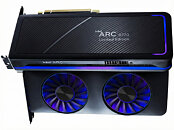
Source: via VideoCardz
Add your own comment

37 Comments on Intel Arc "Battlemage" B770 Could Carry a 300 W TDP

#26
Darmok N Jalad
A couple more thoughts here. One, the rumors at B580 launch was that the B770 failed to hit targets and so the original design was scrapped. At that time, they said it would have to be redesigned and it would take a year to get that design to the market. Here we are a year later and that’s what we appear to be getting. Also during this time, we know they’ve been working on Ce3, so it’s entirely possible that this could be Intel’s RDNA3.5 moment, taking some learned enhancements and dropping them in this redesign.

Second point is that at 300W, they are likely pushing the architecture harder. B580 only saw a 9% power budget increase over A580, but the B770 might be getting a 33% increase. The A770 had 29% more power budget than A580, but the B770 is getting 58% more TDP than B580. Now I know it’s not really reliable to compare so few of Intel generations, but still, the B770 is getting a lot more power budget to work with. The BM architecture seems to be fairly efficient, so I’m guessing we’re going to see not just a big boost in shaders, but probably a big boost in clocks, likely beyond the ideal efficiency curve. So what isn’t overcome with more shaders might be offset by higher clocks.
Posted on Reply
#27
usiname
TheinsanegamerNIf you're concerned about the cost of power, you shouldnt be buying gaming PCs, period. The math never makes sense.

IDK why you're trying to mark your influence as superior to the nebulous "market", boxing ghosts doesnt make your advice better then anyone else's...
What a closed minded statement... If the performance is there you can justify 300W of power, if the performance is in the potato tier then 300W is problem. When AMD had bad power efficient with R9, fury, vega, it was big problem, now when Intel is power inefficient it is no longer problem
Darmok N JaladA couple more thoughts here. One, the rumors at B580 launch was that the B770 failed to hit targets and so the original design was scrapped. At that time, they said it would have to be redesigned and it would take a year to get that design to the market. Here we are a year later and that’s what we appear to be getting. Also during this time, we know they’ve been working on Ce3, so it’s entirely possible that this could be Intel’s RDNA3.5 moment, taking some learned enhancements and dropping them in this redesign.

Second point is that at 300W, they are likely pushing the architecture harder. B580 only saw a 9% power budget increase over A580, but the B770 might be getting a 33% increase. The A770 had 29% more power budget than A580, but the B770 is getting 58% more TDP than B580. Now I know it’s not really reliable to compare so few of Intel generations, but still, the B770 is getting a lot more power budget to work with. The BM architecture seems to be fairly efficient, so I’m guessing we’re going to see not just a big boost in shaders, but probably a big boost in clocks, likely beyond the ideal efficiency curve. So what isn’t overcome with more shaders might be offset by higher clocks.
Hardly they made any architectural changes
B580 is much more power hungry per units, since it is 20 units and A580 is 24 units. 300W for B770 is expected, it has 60% more units than B580
Posted on Reply
#28
docnorth
LastDudeALivePower draw is a bit high for the likely performance, but it's not as big of a problem as people are making it out to be. Ampere was more inefficient than RDNA 2 thanks to Nvidia's node choice, it still outsold it 100x. It's more of a problem for things like laptops, but there's no indication Intel is making discrete laptop GPUs (they absolutely should, but oh well lol).

300W is well within the capacity of any 650W or 750W PSU unless you have an i9-13900K. The performance and price is going to be what matters.

I think Intel is smelling blood in the water with AMD. RDNA 4 has under performed expectations (yes it's done much better than all previous gens combined thus far, but far less than what AMD billed it as). The 5070 being the most popular Blackwell GPU so far shows that ~$500-600, 1440p market is the biggest opportunity right now. If this comes in with competitive performance to the 9070 and a ~$500 price tag, it'll probably take all of the 9070s (small) marketshare.
Mostly agree, but 5070 level seems out of reach, 4070 performance might be possible if it scales linearly. Price, availability and drivers will determine its success, with availability being the biggest question mark. Intel is earning money from the pro cards, RAM is expensive, so why squeeze the price on a gaming oriented GPU?
Posted on Reply
#29
DavidC1
TomorrowIntel just cant seem to catch a break. Their cards come out late at the worst possible time. Alchemist launches after the crypto boom had ended and the market was flooded with cheap alternatives. Battlemage launched ~18 months after the cards it was supposed to fight against (RTX 40 and RDNA3) and less than 6 months before competitors launched RTX 50 and RDNA4 series.
The fault is on them. The product is delayed, and it won't be using Xe3. Leaked roadmaps show they were planning it sometime middle of this year, and now it still hasn't released.

If you read Reddit then some say it was cancelled but restarted again. And there were very early Battlemage leaks with quad tile 640 EUs, or 5x the shader count of A770. We don't know if that was ever meant for consumer but it was in linux patch notes. And for a while the high end Battlemage was said to be a 64 compute unit part with massive 128MB cache on-die, and overall we went through 5 different versions.
TheinsanegamerNIntel's driver division is a bigger mess then AMD's, and they have a long way to go to prove they will bother to support this stuff long term. There is no reason to believe that a company that dropped support for their big APUs after just 2 years should be trusted to provide 6+ years of support for dGPUs that sell a mere fraction as much.
I can't justify Intel GPUs either. For me it has to be a $350 part performing like $500 AMD to at least consider it. Even if I am prepared to go through all the hurdles to make it work, the fact that there's a high chance Intel will give up on dGPUs entirely is another risk.

They just gave up on driver support for 12-14th Gen iGPUs too. The iGPUs in there doesn't have a huge architectural difference from their dGPUs. Nvidia just stopped driver support on the 1000 series GPUs. That's 9 years of support, versus 4 for Intel, and worst foundation at that.

There's a Intel dGPU guy here(on TPU, and a moderator no less. They should be more unbiased) that hates me saying that I always "attack" Intel, but actually I'm just attacking their lack of making a proper product. Make a proper product, and I will praise it. I love their E core team and design. But their dGPU leaves a lot to be desired. Especially their attitude towards it sucked for last 3 decades. How can anyone take them seriously?
Posted on Reply
#30
AusWolf
DavidC1The fault is on them. The product is delayed, and it won't be using Xe3. Leaked roadmaps show they were planning it sometime middle of this year, and now it still hasn't released.

If you read Reddit then some say it was cancelled but restarted again. And there were very early Battlemage leaks with quad tile 640 EUs, or 5x the shader count of A770. We don't know if that was ever meant for consumer but it was in linux patch notes. And for a while the high end Battlemage was said to be a 64 compute unit part with massive 128MB cache on-die, and overall we went through 5 different versions.

I can't justify Intel GPUs either. For me it has to be a $350 part performing like $500 AMD to at least consider it. Even if I am prepared to go through all the hurdles to make it work, the fact that there's a high chance Intel will give up on dGPUs entirely is another risk.

They just gave up on driver support for 12-14th Gen iGPUs too. The iGPUs in there doesn't have a huge architectural difference from their dGPUs. Nvidia just stopped driver support on the 1000 series GPUs. That's 9 years of support, versus 4 for Intel, and worst foundation at that.

There's a Intel dGPU guy here(on TPU, and a moderator no less. They should be more unbiased) that hates me saying that I always "attack" Intel, but actually I'm just attacking their lack of making a proper product. Make a proper product, and I will praise it. I love their E core team and design. But their dGPU leaves a lot to be desired. Especially their attitude towards it sucked for last 3 decades. How can anyone take them seriously?
Intel is the GPU manufacturer that everybody wants to succeed, but nobody buys a single GPU from, ever.
Posted on Reply
#31
Scrizz
AusWolfIntel is the GPU manufacturer that everybody wants to succeed, but nobody buys a single GPU from, ever.
Next they'll complain about Intel leaving the sector. :laugh:
Posted on Reply
#32
Dragokar
TheinsanegamerNIf you're concerned about the cost of power, you shouldnt be buying gaming PCs, period. The math never makes sense.

IDK why you're trying to mark your influence as superior to the nebulous "market", boxing ghosts doesnt make your advice better then anyone else's...
Well if you don't believe in efficiency that is fine, I still prefer a 9070 over a 9070XT e.g., ootb. But it is fine to have different opinions and to talk about it, unless it starts with sandbagging, gaslighting and personal “feelings”. For me, efficiency matters even in gaming, and you can disagree with that, but not claim that your position is right.

on topic:

I really hope for a good €300-330 16 GB offer from Intel. Let's see if they can pull that.
Posted on Reply
#33
AusWolf
ScrizzNext they'll complain about Intel leaving the sector. :laugh:
Yes. It'll be evil AMD/Nvidia's fault. :laugh:
Posted on Reply
#34
DavidC1
ScrizzNext they'll complain about Intel leaving the sector. :laugh:
If they can't make a competitive part, people won't buy from them, it's that simple.

No founder of a company goes into a market thinking people will buy from them because they are the underdog. First and foremost they have to make sure they provide something unique, or they are at least competitive, or better than current solutions. If you can't do this, then you must reconsider whether to enter the market at all or not.

Intel isn't an individual who has fallen on hard times. Actually, many times they acted like a greedy monopoly. Why do you think AMD struggled for so long? What about using force of lawyers to protect their x86 license? They are where they are because they made bad decisions.
Posted on Reply
#35
Scrizz
DavidC1If they can't make a competitive part, people won't buy from them, it's that simple.

No founder of a company goes into a market thinking people will buy from them because they are the underdog. First and foremost they have to make sure they provide something unique, or they are at least competitive, or better than current solutions. If you can't do this, then you must reconsider whether to enter the market at all or not.

Intel isn't an individual who has fallen on hard times. Actually, many times they acted like a greedy monopoly. Why do you think AMD struggled for so long? What about using force of lawyers to protect their x86 license? They are where they are because they made bad decisions.
I don't know why you're replying to me.
Posted on Reply
#36
DavidC1
ScrizzI don't know why you're replying to me.
Because you said this:
Next they'll complain about Intel leaving the sector. :laugh:
They make a subpar product, meaning people don't buy them, so they have to leave the market.
Posted on Reply
#37
Scrizz
DavidC1Because you said this:

They make a subpar product, meaning people don't buy them, so they have to leave the market.
Did you even read the context of my reply? :laugh:
Posted on Reply
Add your own comment
Nov 22nd, 2026 17:45 CST change timezone

New Forum Posts

Popular Reviews

TPU on YouTube

Controversial News Posts