Monday, December 8th 2025

Intel Arc "Battlemage" B770 Could Carry a 300 W TDP
As we receive official software confirmation from Intel, shipping manifests are reinforcing the presence of the Arc "Battlemage" B770 GPU. This GPU is expected to have a 300 W TDP, marking Intel's highest-ever rating in the consumer Arc discrete GPU sector. A 300 W board-level rating significantly exceeds Intel's recent mainstream offerings. Previous high-end cards, like the Arc "Alchemist" A770 and several B-series "Battlemage" models, have board power figures ranging from approximately 190 to 225 W. The consistent bracket code across multiple entries indicates that this is an intentional hardware component undergoing testing. Records list a consumer-style part number, N38341-001, and repeatedly describe a "TASDK 300 W GPU BRKT."
Intel also recently confirmed that the BMG-G31 die is now officially supported by the latest VTune Profiler software update. This BMG-G31 "Battlemage" part will be packaged as the B770 SKU, equipped with roughly 32 Xe2 cores and 16 GB of GDDR6 memory on a 256-bit interface. The design is reported to offer a full PCIe 5.0 x16 connection and will be available in multiple SKUs, allowing Intel to cater to both gamers and professional users. A workstation-oriented Arc Pro variant could further expand memory capacity for single-GPU configurations.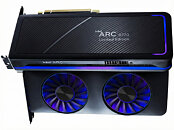
Source:
via VideoCardz
Intel also recently confirmed that the BMG-G31 die is now officially supported by the latest VTune Profiler software update. This BMG-G31 "Battlemage" part will be packaged as the B770 SKU, equipped with roughly 32 Xe2 cores and 16 GB of GDDR6 memory on a 256-bit interface. The design is reported to offer a full PCIe 5.0 x16 connection and will be available in multiple SKUs, allowing Intel to cater to both gamers and professional users. A workstation-oriented Arc Pro variant could further expand memory capacity for single-GPU configurations.

37 Comments on Intel Arc "Battlemage" B770 Could Carry a 300 W TDP
my 9070XT pulls 300W, the 5070Ti pulls 300W, if it draws that much to get 9060 performance, that sure as hell is bound to be a flop (unless it's insanely good at doing something else -AI?- somehow)
With the prices they'll likely be targetting, asking for more than 16gb would probably be too much but that's the bigger point for me, I want a large memory pool.
For comparison organized by smallest size to largest:
5060 Ti 16GB: 181mm², 180W, $429
9060 XT 16GB: 199mm², 160W, $349
B580 12GB: 272mm², 190W, $249
B770 16GB: ~350mm², 300W?, $349?
While i agree that very few people buy based on efficiency (be it power consumption or chip size), it still looks bad in comparison to it's competitors and it's a bigger loss for Intel, because they have to use use more of TSMC silicon at higher power to achieve the same performance, but they cant sell it at a higher price.
I suppose the fact that they use an older 6nm node compared to AMD and Nvidia using a variant of 4nm means they dont have to pay as much for this bigger silicon, but surely it still cuts into their margins for each and every card sold. Im sure this is a problem they would dearly love to solve with Celestial. Especially if they want the higher ups to green lit future series.
Intel just cant seem to catch a break. Their cards come out late at the worst possible time. Alchemist launches after the crypto boom had ended and the market was flooded with cheap alternatives. Battlemage launched ~18 months after the cards it was supposed to fight against (RTX 40 and RDNA3) and less than 6 months before competitors launched RTX 50 and RDNA4 series.
Now B770 if it launches around CES or Q1 2026 will be over 6 months late launching with 16GB in an environment where DRAM/VRAM is rallying higher than the price of Gold. And they cant launch it with only 8GB or they will be buried in reviews about how their higher performing card is hamstrung by 8GB buffer even compared to B580's 12GB. Stuck between a rock and a hard place.
Intel is "out of sync" with it's competitors and constantly playing catchup. Maybe with Celestial they will launch at roughly the same time as RTX 60 and UDNA and this time with top to bottom offerings (tho im not expecting a 6090 competitor). Im not holding my breath tho...
300W is well within the capacity of any 650W or 750W PSU unless you have an i9-13900K. The performance and price is going to be what matters.
I think Intel is smelling blood in the water with AMD. RDNA 4 has under performed expectations (yes it's done much better than all previous gens combined thus far, but far less than what AMD billed it as). The 5070 being the most popular Blackwell GPU so far shows that ~$500-600, 1440p market is the biggest opportunity right now. If this comes in with competitive performance to the 9070 and a ~$500 price tag, it'll probably take all of the 9070s (small) marketshare.
It's a small minority. The vast majority consider price, performance, and features. Power use usually only considers if someone is in a hot climate and cannot afford AC (but can somehow consider $1000 GPUs for some reason).
And most importantly, for most of their generation, you couldnt FIND a rDNA2 card. Stock wasnt readily available for the first ~18 months, as AMD prioritized (correctly) the production of EPYC and Ryzen CPUs. Ampere was available, but was overpriced, resulting in their market dominance.
Intel doesnt have that. XeSS is better then FSR but pales to DLSS4+transformer, has no DLAA or reflex equivelant, and so far has had poor support overall, coming from a company that has really struggled to put out product. Their driver support windows are even shorter then AMD's too, and consumers will consider that.
Power use isnt an issue if there is something to justify it, but Intel is severely lacking in that department.I highly doubt that. There's not a snowball's chance in hell Intel is willing to cut margins to that degree. Their die will likely end up being larger then the 9070xt, and with astronomic RAM prices they'd likely end up losing money on a $500 B770.
It wont be 9070 performance. Or even 5070 performance.
Everything we know so far points at roughly 5060 Ti/9060 XT performance.
And for that it cant be more than $350.
And it would have to be 36-42% faster than B580 which is in on itself a tall order. In order to match 5070 or 9070 it would have to be a whopping 83-102% faster.
I think AMD market share is safe. If a much cheaper B580 has not made a dent then a more expensive B770 wont either.
Which is 3080/4070S/5070/9070 non-XT territory at best. More expected: maybe inches above 4070/5060 Ti/9060 XT territory.
This will not sell well at 420+ USD, unless GPUs catch yet another "2021 disease."
I don't expect anyone but diehard Intel fans buying that. Die Hoffnung stirbt zuletzt and we might see the pushed envelope with Celestial but this B770 ain't gon do nothing to the market whatsoever.
At 1080p and 1440p, the B580 is 19 and 12% slower, respectively. That applies to ~88% of the market according to the problematic Steam stats. So for most consumers, the intel card will be slower then a 9060XT and must be priced accordingly, which means $300 or less. That's rather unrealistic for such a card I feel....
You can believe what you want, but when dGPU owners get left high and dry because intel cant justify continuing to support cards that hardly sold half a decade ago, nobody but you will be surprised. You know, liek owners of the DG1, the dedicated card before Alchemist, which was dropped after 4 years......
www.intel.com/content/www/us/en/support/articles/000101986/graphics.html
Intel's driver division is a bigger mess then AMD's, and they have a long way to go to prove they will bother to support this stuff long term. There is no reason to believe that a company that dropped support for their big APUs after just 2 years should be trusted to provide 6+ years of support for dGPUs that sell a mere fraction as much.
IDK why you're trying to mark your influence as superior to the nebulous "market", boxing ghosts doesnt make your advice better then anyone else's...