Sunday, October 25th 2026

New Linux Tool Brings Resizable BAR to Intel Arc GPUs on Old Motherboards
Intel Arc cards have always leaned heavily on Resizable BAR, to the point where Intel once told Alchemist buyers without it to stick with other vendors, and TechPowerUp's B580 review listed it as required for good performance. As spotted by Videocardz, developer Rod Burlamaqui has now released arc-rebar, a Linux tool that turns it on for Arc GPUs on motherboards that never got a ReBAR option. It runs from the initramfs at every boot, before the GPU driver loads, and doesn't touch the BIOS, kernel, or Intel's drivers. That sets it apart from earlier workarounds like ReBarUEFI, which has to be added to the motherboard's firmware.
The fix targets the PCIe switch built into Arc cards, whose small upstream BAR blocks Linux from enlarging the GPU's memory window. arc-rebar writes the card's ReBAR register, then removes and rescans the root port. Intel engineers have proposed a kernel-level fix for this, though it hasn't been merged yet. On a Supermicro X9DRH-7TF with dual Xeon E5-2670 v2 CPUs and a 2015 BIOS, a B580 went from 256 MiB of CPU-visible VRAM to a 16 GiB window covering all 12 GB. Measured VRAM bandwidth jumped from 15 GB/s to 392 GB/s, and a 4K Vulkan blur that used to stall ran at 39 to 50 FPS.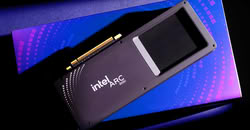
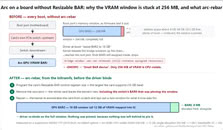 Above 4G Decoding is still needed, and the GPU must sit on its own root port. Only Battlemage has been tested, though the developer expects Alchemist to behave the same way. The tool is built for Debian and Ubuntu, so Windows gamers won't benefit, but it could make Arc a viable option for older servers and workstations.
Sources:
arc-rebar (GitHub), via Videocardz
The fix targets the PCIe switch built into Arc cards, whose small upstream BAR blocks Linux from enlarging the GPU's memory window. arc-rebar writes the card's ReBAR register, then removes and rescans the root port. Intel engineers have proposed a kernel-level fix for this, though it hasn't been merged yet. On a Supermicro X9DRH-7TF with dual Xeon E5-2670 v2 CPUs and a 2015 BIOS, a B580 went from 256 MiB of CPU-visible VRAM to a 16 GiB window covering all 12 GB. Measured VRAM bandwidth jumped from 15 GB/s to 392 GB/s, and a 4K Vulkan blur that used to stall ran at 39 to 50 FPS.


3 Comments on New Linux Tool Brings Resizable BAR to Intel Arc GPUs on Old Motherboards
How many users can write their own initramfs? Or even know what it is?
A bootloader is duplicate software and very often, in teh past also CVE bloatware. I went the initramfs route and got rid of it.
That is the nature of the INITRAMFS to run at every cold boot and warm boot. // Redundant information .. run at bootThat confuses me. Microstar Motherboards call "above 4G Decoding" the uefi option which toggles the RBAR in windows readout software.
I had the impression it was the 4g Decoding thing = RBAR.+does not make any sense to myself. Only explanation, Microstar does not expose correctly the options or the options are merged.
When you know those specifics feel free to share where the Difference is between above 4g decoding, RBAR, and what windows software usually show as RBAR etc. I assume, the only plausible explanation is, there are several options enabled as only one on Microstar uefi.
For example I got:
Above 4G decoding enabled.
ReSize BAR auto
ReSize BAR was added to PCIe spec in version 2.0 or 3.0.
4G decoding just allows mapping 64bit address.
TPUs own GPU-Z can tell you info, like UEFI boot, no csm, 4g, Sam/resizebar