Monday, December 22nd 2025

Steam Client Officially Moves to 64-bit on Windows 11 and Windows 10
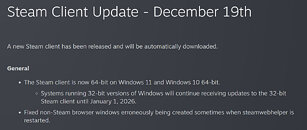
In a December 19 Steam client update, Valve has finally ended support for the 32-bit Steam application on Windows 11 and Windows 10 operating systems. According to the official release notes, updates for the 32-bit Steam client will continue to be provided for systems with 32-bit Windows versions until January 1, 2026. This marks the end of one of the last official 32-bit applications that actively supported the 32-bit versions of Windows. As the software industry continues to phase out 32-bit support, this decision is a natural progression, encouraging consumers to transition to 64-bit operating systems and compatible software.
Valve has been planning this change for some time to simplify software maintenance. However, only a very small number of users will be affected by this decision, as almost no one is still using the outdated 32-bit operating system. Those still on a 32-bit OS will need to upgrade their hardware or reinstall 64-bit OS versions, if their hardware permits, to continue using the official Steam Client. For those planning to stick with 32-bit builds, there is still hope. Enthusiasts frequently create unofficial backports of modern clients. For example, an earlier version of the Steam Client was unofficially backported to Windows 7 SP1 x64 and Windows 8.x x64.
 Running older software presents a security risk, and using unofficial backports can introduce a host of potential issues. For instance, both Windows 7 SP1 x64 and Windows 8.x x64 are platforms that Valve officially stopped supporting in early 2024. This means that any future support will rely entirely on the gaming community. If 32-bit support also receives an unofficial backport, community maintenance will be the only option remaining.
Source:
Steam
Valve has been planning this change for some time to simplify software maintenance. However, only a very small number of users will be affected by this decision, as almost no one is still using the outdated 32-bit operating system. Those still on a 32-bit OS will need to upgrade their hardware or reinstall 64-bit OS versions, if their hardware permits, to continue using the official Steam Client. For those planning to stick with 32-bit builds, there is still hope. Enthusiasts frequently create unofficial backports of modern clients. For example, an earlier version of the Steam Client was unofficially backported to Windows 7 SP1 x64 and Windows 8.x x64.


35 Comments on Steam Client Officially Moves to 64-bit on Windows 11 and Windows 10
But then there is a reason nobody with that attitude works in enterprise IT, at least not for very long. The schadenfreude of watching them getting chewed out after they cause huge disruption by trying to upgrade things only to break them is hard to beat (and I've seen it in person twice).There's also no harm in using 32 bit libraries for software. People act like 32 bit was like IE6, that is a major security hazard and some huge anchor around our necks. Just making something 64 bit doesnt make it better.
My guess is that it's just not a priority; they probably have more important things on their plate, the gains are minimal for code that's not computationally dense, etc. It probably requires a lot of validation to make sure it doesn't break some obscure old games.
Pick the unstable version because the stable version is too old.
ci.appveyor.com/project/otya128/winevdm/
I ran some games (and maybe an app?) with it and they worked perfectly without any bugs or glitches.
Most of them need Visual basic 1 and also 2 I think. You have to get the dlls and extract them somewhere inside the virtual system/windows folder of "winevdm".
I think I have seen this app built for Linux too in a software manager but I might be hallucinating. None the less, I think it could run just fine with WINE.
It doesn't run because similar to WinPE, there's no 32-bit runtime capability on the system and without a LOT of work it stays that way.
There are no hardware issues where I see Steam needing a 64-bit version but in terms of cloud compatibility, this is an easy haul for us.
Unfortunately there's literally zero reason to do this even as a local update node. It's easier to run Steam on whatever client and update.