Tuesday, December 30th 2025

Sapphire AMD Radeon RX 9070 XT Nitro+ Melts Connector After "Almost a Year" in Use
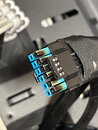
It's no secret that NVIDIA GPUs have had a habit of burning up 12vHPWR and 12V-2x6 connectors, but increasingly, reports are emerging of the same thing happening to AMD's Radeon GPUs running the same connectors. The latest report of such burned connectors come from a user on r/Radeon on Reddit, where user u/divinethreshold posted an image of their burned Sapphire Nitro+ AMD Radeon RX 9070 XT GPU with a burned 12V-2x6 connector on the GPU cable side. According to the account, the GPU had been running in the same system for upwards of a year without issue before it started crashing mysteriously, prompting the redditor to disassemble the system and inspect for hardware issues.
[Editor's note: You can read our in-depth review of the Sapphire AMD Radeon RX 9070 XT Nitro+ graphics card here]
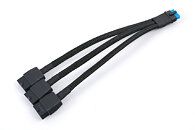
In the comments, the affected user explains that the burned cable was part of an included adaptor that connects the 12V-2x6 connector on the GPU to three 8-pin connectors on the PSU side. As commenters in the thread have also pointed out, these sorts of failures seem to be more common when similar adaptors are used, which makes sense, since most official sources attribute failures to overheating caused by improper contact across one or more pins. Increasing the number of potential failures also increases the likelihood of said failure.
Source:
u/divinethreshold on Reddit
[Editor's note: You can read our in-depth review of the Sapphire AMD Radeon RX 9070 XT Nitro+ graphics card here]
In the comments, the affected user explains that the burned cable was part of an included adaptor that connects the 12V-2x6 connector on the GPU to three 8-pin connectors on the PSU side. As commenters in the thread have also pointed out, these sorts of failures seem to be more common when similar adaptors are used, which makes sense, since most official sources attribute failures to overheating caused by improper contact across one or more pins. Increasing the number of potential failures also increases the likelihood of said failure.


System running 100% for almost a year - and then suddenly random crashes to black screen. BIOS updated, reinstalled windows, drivers and Steam installed only, all BIOS settings stock, EXPO tried on and off. Disconnected every peripheral, every USB device and ran a wired e-waste Dell KB and Mouse. Still crashing.-u/divinethreshold on Reddit
Pulled the entire system apart, and lo and behold, burn marks on GPU cable.
Le sigh. So far appears that GPU connector is fine, but not convinced.
71 Comments on Sapphire AMD Radeon RX 9070 XT Nitro+ Melts Connector After "Almost a Year" in Use
I still don't like the connector, but thankfully for me, it's been perfect. It's even been removed two times in that time for an SSD upgrade and platform change from AM4 to AM5.
Again this is a native cable from my ATX 3.1 PSU so it should be fine with a low power draw GPU like mine so I'm not even bothered.
I'll still be using the same PSU though as it's still a top end model and it works flawlessly, changing the PSU just to get native 12VHPWR is pointless, probably safer having the reliable 8x pins on the PSU side anyway.
'Might be part of the reason why these Nitro card are burning, too.
Both of the ASrock Radeon AI Pro R9700s in the home, *clicked* while there was still clearly further to go.
This behavior was consistent across: The included adapter, a 1KW Seasonic Gold ATX3.0's +12VHPWR, and a 1.2KW Seasonic Gold ATX3.1's native +12V2x6.
Full seating of the +12VHPWR/+12V2x6 took quite a bit of force.
Definitely, more pressure needed to fully seat, vs. any 6/6+2/ or 4/8-pin PCI-e / CPU power input.
Depending on the exact 1st gen card you have, it has the board-level current balancing that is necessary to eliminate the burning risk.
IIRC, all 3090Ti's have per-pin/per-phase active current balancing.
And until it is proven otherwise im assuming it is a problem. I mean what - a new article each month is not proof enough?
Did people who used 8pin for years suddenly forgot how to plug in a connector and all of these cases are user error?
Repair shops have posted videos on how each month they repair melted connectors. You think everyone posts their melted connector on the internet?
For every documented case there are more that go undocumented.
When it was revealed that AsRock and Sapphire were going to use 12pin on two of their models people said it will melt. Despite people like you claiming there is no problem and no connection between how much power the card draws and how likely it is to melt.
People were proven right. Considering the much lower market share of AMD and the lower amount of cards there are already continuous melting of these two models. In Nvida's case you might argue that even a 1000 cases among millions of sold cards is usual failure rate, but im pretty sure AMD has not sold millions of these two specific models. And not a single 8pin 9070 XT has melted thus far despite that fact that there are many more 8pin 9070 XT's out there.8pin has melted in the past? Yes? So?
No one is disputing that. 8pin has been on the market for 15+ years.
Obviously it had to have melted for somebody, at some point.
But unlike 12pin i dont recall there being any investigations, articles and megathreads documenting 8pin problems. Because these were so infrequent.
I also dug up tho megathreads, but like i said above the maintainers just have up. One three years ago and another in April of this year. Or they were locked because they were drawing too much negative attention. Who knows:
nvidia/comments/ydh1mh/16_pins_adapter_megathreadnvidia/comments/1inpox7/rtx_50_series_12vhpwr_megathreadNope. Otherwise we would not have this news. It is less infrequent problem at 350W for example, but not nonexistent.
Plenty of 8-pin failures happend, but all over the span of 15 years, where as for 12-pin that same amount (or more) happend the past 3 years.
So if these continue (which they will) the fail rate will be far far higher eventually. It actually already is far higher due to it being newer.If that's the problem then the connector is still flawed, because 8-Pin adapters where never an issue this bad either.
You can try to defend it all you want, but this connector is a piece of shit. It allows for 600 Watts through a single pin (if 5 others fail), where as 8-Pin is limited to 150 Watts. On top of that the pins are half as small as well, and GPU manufacturers like to save pennies on load-balancing.
We can only hope PSU manufacturers can find a way to add load-balancing to save this connector.
It's fundamentally impossible for a 300 W card to overload the 12V-2x6 connector to the point of burning without what I mentioned or something similar happening.
And they could reduce the power consumption by 25-30% by just lowering the clocks by 7-8% as seen with generic undervolting.
As there is no real DATA any claims it is fine or not fine is kinda not objective.
It's interesting to watch how many cards are being bought and used over the nvidia generations.
I'm sure i saw already over 20 different dead or damaged graphic cards with that connector over the years. Most likely we are over three digits of someone posted a damaged graphic card already
Only thing it could ever possibly do is: "Current in this this one wire is exceeding its capability - Time to shut this whole building down."
Literally only place where load can be balanced is that load itself.3090 was actually the safest implementation because it had some actual basic current monitoring and balancing, which Mr. Leatherjacket then cost cutted:
- First of all it's specified for far lower current than actual maximum rating of the wire/pin.
- And with just three current carrying pins in connector, the absolutely worst case current is just 200% over nominal vs 500%.
Further 8 pin PCIe connector has bigger physical separation between pins, which along with beefier construction makes temperature rise lower for same power loss.[INDENT]That means it's far harder for manufacturing variances, connector wear, incorrect use etc variables to cause situation approaching overheating pin.[/INDENT]
[INDENT]Which, because of very high safety margin, wouldn't be instant and automatic issue for as long as that single remaining pin is making good connection.[/INDENT]
[INDENT]Which actually gives tiny further help, because at lower temperature resistance of conducting materials is lower.[/INDENT]
[INDENT=2]Yes, the hotter the connector becomes, the more heat is generated for same amount of transferred power![/INDENT]
[INDENT]And in long term that lower temperature translates to lower force from thermal cycling trying to work contact loose.[/INDENT]
It's literally similar to laws of physics dictating that your survival chances in head on collision to another car are better than in collision to truck!
That's why despite of long time of existence and hence very high number of cards using the connector and no doubt huge amount of questionable quality PSUs, adapter cables etc, melting of connector hasn't been regular worry needing special instructions and such.Only small percentage of those cards are power hoggiest top models.
Especially with the ever rising prices smaller amount of consumers have been able to afford top cards compared to situation in last decade.Which did absolutely nothing to fact of connector having no real safety margin.
And in fact Nvidia just increased risks by removing the current balancing they had in 3090 from its successors!No!
You're the one claiming that despite of common sense and well established facts, head on collision to truck isn't any more dangerous than head on collision to another car.
It's job of you to prove that claim!
He installed the latest AMD driver and hasn't had a single issue with it.....only issue he does have is Windows 11, but that's a different beast altogether.
1) enough resistance + current at the connector/psu to cause enough heat to reach a critical temperature.
Things that make this more likely are:
- Cards that pull a ton of current
- Cables with cheap connectors/materials that add resistance
- Cables/Connectors with pins that take less heat to melt
- PSU and Cards that don't regulate maximum current sent across a single pin, and can happily pump 300W through one cable/connector.
- Bad connection/ dirty connector / etc.
So with dual 8 pins you had:
- Cards that generally pulled less wattage (250-325W)
- Thicker pins/cables - each 8pin can handle about 40W more (150W vs 110w per 12V pin on 12VHPWR) given the same resistance before generating enough heat to melt plastic.
With 12VHPR you have:
- cards that pull much more wattage (325-600W)
- connectors that take less current, given the same resistance, to generate enough heat.
2x8pin has 6 power connectors - @150W~ each before melting - @325W max
12VHPWR has 6 connectors - @110W~ each before melting - @600W max
Throw in a little user error, dust, cheap cables and it's pretty obvious why cards are melting cables. Theres a ton of ways to fix this, by adding more pins, larger pins, fuses to prevent 100W/10A over a single 12V pin (imperfect solution), temp sensors on the connector, better connectors (ceramic connector + temp sensor) etc. This is just not good engineering - we've basically designed a system that has no way to deal with overheating pins, and use it in a cases where overheating pins are more common than ever before.