Tuesday, January 6th 2026

AMD Zen 6 EPYC "Venice" Introduces a Radical Package Redesign

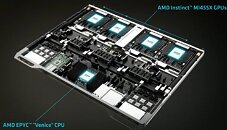
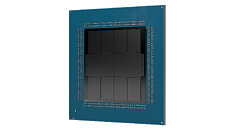
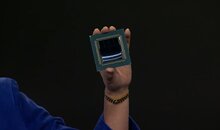
AMD CEO Dr Lisa Su at the company's 2026 International CES event held up the next generation EPYC "Venice" enterprise processor driving the company's 2026 "Helios" AI racks powered by AMD MI455X AI GPUs. Each node in the rack features four MI455X GPUs, and one EPYC "Venice" processor with a 256-core/512-thread configuration. The package features a significantly different layout of chiplets compared to current EPYC chips. It sees two slender, centralized server I/O dies built on the 4 nm node, which are flanked on either sides by no more than eight CCDs, each built on the 2 nm foundry node, and packing 32 "Zen 6" cores.

At this point we don't know if these are full-sized "Zen 6" cores that can sustain high clock speeds, or compacted "Zen 6c" cores that feature identical ISA and IPC, but at lower maximum clock speeds. Each "Venice" package features a 16-channel DDR5 memory interface (32 sub-channels), which explains why AMD probably needed to disaggregate the sIOD into two chips that are joined at the hip using high-speed switching fabric. AMD is also expected to significantly increase the PCIe and CXL lane counts of "Venice" over the current-generation to support those four AI GPUs, DPUs, and 800G NICs.
Add your own comment

18 Comments on AMD Zen 6 EPYC "Venice" Introduces a Radical Package Redesign

#1
Chaitanya
So Zen6 for desktops at Computex in 6 months time.
Posted on Reply
#2
jesdals
WFtech talks about 12 cores pr CCD its interresting to see if we get desktops with single ccds with up to 12 cores in ZEN6
Posted on Reply
#3
Chaitanya
jesdalsWFtech talks about 12 cores pr CCD its interresting to see if we get desktops with single ccds with up to 12 cores in ZEN6
Thats been rumoured for quite sometime now that Zen6 will bump the cores/CCD.
Posted on Reply
#4
ncrs
At this point we don't know if these are full-sized "Zen 6" cores that can sustain high clock speeds, or compacted "Zen 6c" cores that feature identical ISA and IPC, but at lower maximum clock speeds.
We do know. It's Zen 6 as seen during AMD Advancing AI 2025 event, keynote presentation slide 94.
Posted on Reply
#5
kondamin
512 full x86 threads per package lol.
Why bother with arm
Posted on Reply
#6
Punkenjoy
kondamin512 full x86 threads per package lol.
Why bother with arm
The main reason for the Arm Push is to break the duopoly of AMD/Intel on the x86/x64 instruction set. Some actor on the market became really powerful and want to break it. Microsoft seems to want it, Google is already on it and even Steam is looking to have a translator to run x86 games on arm.
jesdalsWFtech talks about 12 cores pr CCD its interresting to see if we get desktops with single ccds with up to 12 cores in ZEN6
That seems to be the actual rumors for the Zen 6 dies. The 32 cores one seems to be Zen6c cores.
Posted on Reply
#7
Redwoodz
PunkenjoyThe main reason for the Arm Push is to break the duopoly of AMD/Intel on the x86/x64 instruction set. Some actor on the market became really powerful and want to break it. Microsoft seems to want it, Google is already on it and even Steam is looking to have a translator to run x86 games on arm.


That seems to be the actual rumors for the Zen 6 dies. The 32 cores one seems to be Zen6c cores.
Nvidia wants to break it up so they can force everyone into the cloud.
Posted on Reply
#8
kondamin
PunkenjoyThe main reason for the Arm Push is to break the duopoly of AMD/Intel on the x86/x64 instruction set. Some actor on the market became really powerful and want to break it. Microsoft seems to want it, Google is already on it and even Steam is looking to have a translator to run x86 games on arm.
The real push was that those companies needed density for their data centres.
Arm with it's energy efficient and back then small cores was a good way to get boatloads of threads at low power costs.

Intel tried getting into that game with their Xeon phi line-up, but pretty much gave up on that when they got it into their heads that they needed it to be a GPU
Posted on Reply
#9
Tek-Check
ncrsWe do know. It's Zen 6 as seen during AMD Advancing AI 2025 event, keynote presentation slide 94.
AMD will, most likely, not differentiate between Zen6 and Zen6c in naming anymore on EPYCs.
This 256 core Venice CPU features what used to be called c cores. One CCD with 32 c cores.

There was also a mention of Venice-X. This could be another SKU with more specific features or dies on it.
Posted on Reply
#10
ncrs
Tek-CheckAMD will, most likely, not differentiate between Zen6 and Zen6c in naming anymore on EPYCs.
This 256 core Venice CPU features what used to be called c cores. One CCD with 32 c cores.

There was also a mention of Venice-X. This could be another SKU with more specific features or dies on it.
Perhaps, but we'll have to see the official specs.
The "-X" SKUs in the past were equipped with 3D V-Cache (X3D) - Milan-X and Geona-X.
Posted on Reply
#11
Tek-Check
ncrsPerhaps, but we'll have to see the official specs.
We know this so far.

It looks like EPYCs with c cores will be the main workhorse in hyperscaler cloud AI systems, whereas 12 big core CCDs might be deployed in Threadripper and some HPC data centre systems.
Posted on Reply
#12
TheinsanegamerN
RedwoodzNvidia wants to break it up so they can force everyone into the cloud.
Please explain how you figure breaking up the x86 stranglehold on the desktop and laptop market, and breaking the duopoly of Intel and AMD, will force everyone onto the cloud.
Posted on Reply
#13
Redwoodz
TheinsanegamerNPlease explain how you figure breaking up the x86 stranglehold on the desktop and laptop market, and breaking the duopoly of Intel and AMD, will force everyone onto the cloud.
AI. They are already halfway there. Nvidia cpu's in the enterprise are just for that. Once they get everyone locked in their ecosystem they force whatever rules they want. Make all pc parts unobtanium and you can game all you want, as long as you use your 5060 to game in the cloud.
Posted on Reply
#14
efikkan
ChaitanyaSo Zen6 for desktops at Computex in 6 months time.
Hopefully it will be shipping in late summer/early fall (probably followed by Nova Lake a few months later).
This is way more interesting than yet another Zen 5 CPU.

If they could be relatively quick to release a Zen 6 Threadripper, that would be great.
PunkenjoyThe main reason for the Arm Push is to break the duopoly of AMD/Intel on the x86/x64 instruction set. Some actor on the market became really powerful and want to break it. Microsoft seems to want it, Google is already on it and even Steam is looking to have a translator to run x86 games on arm.
While the x86 situation isn't ideal, ARM wouldn't make it any better. ARM is designed to be customized, so if it had displaced x86 we should essentially end up with 4-5 companies like Apple; each with their own walled garden (and those with base ARM would suck). The triumph of the "IBM compatible" PC is one of the most fortunate anomalies of the computing history, and has played a key role in making computing universally available and affordable.

Many have forgotten that Zen was intended to be a stop-gap before AMD's planned K12 ARM architecture, luckily those plans changed. Hopefully we'll continue to see AMD's designs evolve, to embrace APX which further widens the gap vs. ARM, and additional contributions from AMD.
Posted on Reply
#15
Aaronage
efikkanHopefully it will be shipping in late summer/early fall (probably followed by Nova Lake a few months later).
This is way more interesting than yet another Zen 5 CPU.

If they could be relatively quick to release a Zen 6 Threadripper, that would be great.


While the x86 situation isn't ideal, ARM wouldn't make it any better. ARM is designed to be customized, so if it had displaced x86 we should essentially end up with 4-5 companies like Apple; each with their own walled garden (and those with base ARM would suck). The triumph of the "IBM compatible" PC is one of the most fortunate anomalies of the computing history, and has played a key role in making computing universally available and affordable.

Many have forgotten that Zen was intended to be a stop-gap before AMD's planned K12 ARM architecture, luckily those plans changed. Hopefully we'll continue to see AMD's designs evolve, to embrace APX which further widens the gap vs. ARM, and additional contributions from AMD.
That is complete nonsense. There is no risk of “walled gardens” with Arm.

Arm is not designed to be customised. Implementations of the Arm ISA (by Apple, Qualcomm, Nvidia etc.) must be fully compliant and proprietary extensions are not permitted. This is actually a better situation than x86 where Intel and AMD have spent decades disagreeing on extensions - that’s how we ended up with things like MMX and 3DNow!, incompatible SSE variations, Bulldozer’s weird mix of unique DOA extensions, a zillion AVX variations etc.

If you compile for ArmV9, the software will run on any ArmV9 design from any vendor (e.g. compile a binary on Apple Silicon and it’ll run on Graviton and X Elite). There’s no drama there.

The K12 cancellation was probably a mix of
1. AMD wasn’t in a position to take a risk on Arm server, going after x86 market share was a safer bet
2. It’s likely K12 was intended for a semi-custom chip for Amazon. The earlier Cortex-based Opteron A1000 chips were developed with Amazon in mind, too (hence the Seattle code name). Amazon ultimately decided against working with AMD and went down a different path (Amazon acquired Annapurna Labs and started developing chips in-house using Arm’s core designs).
Posted on Reply
#16
XeonsNOpterons
Excited to see this competition. Considering Intel's IPC lead with Granite Rapids even against Zen 5 in FP based on my research, Diamond Rapid will likely have about 15% higher IPC still with the new Panther Cove cores. Since the core counts are going to be even closer:

128-core Xeon 6 (technically 132 theoretical maximum) vs 192-core Zen 5c [50% lead by AMD]

192-core Xeon 7 (potentially also 256-core based on some rumors) vs 256-core Zen 6c [33% lead by AMD]

The IPC advantage from Intel and likely similar all-core clocks of ~3.2-3.5 GHz means very tight race for FP performance. Hopefully this competition eventually brings prices down for both teams' workstation chips. $13000 for AMD's Zen 5 flagship and potentially $8300 for Intel's Granite Rapids-WS flagship is insane. Even the W-3175X's $3000 MSRP seems affordable...
Posted on Reply
#17
DarthJedi
efikkanHopefully it will be shipping in late summer/early fall (probably followed by Nova Lake a few months later).
This is way more interesting than yet another Zen 5 CPU.

If they could be relatively quick to release a Zen 6 Threadripper, that would be great.
I don't think we'll see a new Threadripper any time soon considering the contested nature of fab allocations and the cost of memory.
Threadripper 9000 might be the last one in at least 5-6 years actually.
Posted on Reply
#18
Tek-Check
DarthJediI don't think we'll see a new Threadripper any time soon considering the contested nature of fab allocations and the cost of memory.
Threadripper 9000 might be the last one in at least 5-6 years actually.
There is no basis for this gloomy prediction. Institutions, businesses and users who buy TR systems will not have any problem buying memory, considering the benefits from TR systems for their needs.

The only thing is whether Zen6 Threadrippers would arrive on current platforms TRX50/WRX90. If so, only PCIe Gen5 would be supported, where the silicon supports PCIe Gen6. If no, a new platform with Gen6 will be offered.
Posted on Reply
Add your own comment
Nov 29th, 2026 07:06 CST change timezone

New Forum Posts

Popular Reviews

TPU on YouTube

Controversial News Posts