Wednesday, January 28th 2026

Google's Desktop Operating System "Aluminium OS" Has Leaked
Google's return to the desktop has been now cemented with the latest leak of the so-called "Aluminium OS." Accidentally shared by Google, 9to5Google managed to capture some screen recordings of this new creation that Google has been developing behind the scenes. A recent submission to the Google Issue Tracker revealed a Chrome Incognito bug, complete with video evidence from a system running Aluminium OS. Before the video was removed, 9to5Google obtained recordings showing a new Android-powered PC operating system. Running on the latest Android 16 platform, the system is being internally tested on an HP Elite Dragonfly 13.5 Chromebook laptop equipped with 12th Generation Intel "Alder Lake-U" Core processors. As a test unit, this marks a significant shift from the Android OS used on mobile Arm-based systems, as Aluminium OS now operates smoothly on x86 architecture.
Pictured is the new operating system in all its glory. The desktop design resembles a blend of macOS aesthetics and elements from the Gnome desktop environment typical of Linux distributions. It features a taskbar at the bottom, centrally positioned like in the default version of Windows 11. The battery status and Wi-Fi icons are located in the top right corner, alongside a Gemini button for easy AI access. In September 2025, at Qualcomm's 10th annual Snapdragon Summit, Qualcomm CEO Cristiano Amon and Google's head of platforms and devices, Rick Osterloh, discussed this new operating system. Google plans to merge its ChromeOS and Android for PC projects into a single branch, resulting in an Android for PC version called "Aluminium OS." This new OS will incorporate Google's advanced AI technologies from Gemini, running on more powerful mobile designs powered by the latest x86 architecture. It will feature processors with capable NPUs, allowing Google's open-source Gemma models to run locally without any issues.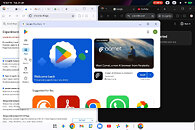
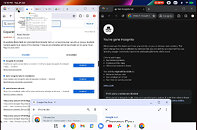
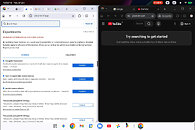 You can check out the screen-recorded YouTube videos below, uploaded by Android Authority.
Source:
9to5Google
Pictured is the new operating system in all its glory. The desktop design resembles a blend of macOS aesthetics and elements from the Gnome desktop environment typical of Linux distributions. It features a taskbar at the bottom, centrally positioned like in the default version of Windows 11. The battery status and Wi-Fi icons are located in the top right corner, alongside a Gemini button for easy AI access. In September 2025, at Qualcomm's 10th annual Snapdragon Summit, Qualcomm CEO Cristiano Amon and Google's head of platforms and devices, Rick Osterloh, discussed this new operating system. Google plans to merge its ChromeOS and Android for PC projects into a single branch, resulting in an Android for PC version called "Aluminium OS." This new OS will incorporate Google's advanced AI technologies from Gemini, running on more powerful mobile designs powered by the latest x86 architecture. It will feature processors with capable NPUs, allowing Google's open-source Gemma models to run locally without any issues.


82 Comments on Google's Desktop Operating System "Aluminium OS" Has Leaked
But it looks like it will be some form of glorified android for laptops.
Anywho if you are in the ecosystem and are fine with google running your life and agentic laptop that helps you organise could be a very cool thing.
But seriously, I would rather stick with Linux, the amount of spyware and useless AI crap in this Google OS is probably even worse than Microslop Windows, and if it's like chrome OS you can't remove any of it.
Android is getting more and more bloated as well
Personally, I would avoid it as much as possible, due to Google being Google, but... nevermind.Microsoft is not interested in software anymore. Microsoft users are pretty much abandonware now. But as for AI push, Google is far worse because Gemini is pushed and promoted even more than Copilot - to the point that you can not use Gmail properly anymore...How come? Google started data hoarding, and they are biggest data hoarders out there... How come anybody could be worse than company tracking your every word and every location? Microsoft does not even have some reach as Google, even if they wanted to...We are already training it all the time due to Android, so... Desktop would not make such a difference :)🫣🤣🤣🤣 Cringe-worthy... Android required account for normal operation for years. No "journalist" talked about it and about privacy issues, yet when Microsoft did the same - internet exploded. You know why? Beacuse Google already mined so much data that they are basically controling the whole narrative out there.
Android collects so much data of its user that Windows is bastion of privacy compared to it... Every call, every mail, every location, every photo, tagged and stored. And Microsoft is user-specific? How come, please explain.
De-Microsofting the Windows actually leaves you with better performing system. De-Googling Android leaves you with bunch of issues and problems that can not be easily solved. So, I wonder which OS spy more...
Plus, with Gemini integration into Desktop, and mobile, Google is going to reach last bits of data unavailable to them.
if we did not enjoy the benefits of late-stage capitalism, Google would be broken into several entities long ago (Microsoft too, but Google is on the first spot by far).
Only thing that saved us from total surveillance on laptop / desktop platform was design of Windows, built long ago before total surveillance was possible (not that Microsoft is not doing his best to change that).
Linux will never be the mainstream, but due to Microsoft mishaps and vibe coding, it started to gain some traction in some fields - even in gaming, thanks to Steam, which was not imaginable just a decade ago. And honestly, I am afraid that Google entrance to OS arena will sideline it again.
Otherwise it would be nice to watch full-out war between Microsoft and Google over PC OS...
Since Aluminium is running on x86 I assume it'll be running the mainline Linux kernel versions now?
Luckily, I became fluent in English and not feeling confused, like I did in much of the 1990s.