Wednesday, March 4th 2026

AMD Ryzen AI 400 Comes With Up to 12 Usable PCIe 4.0 Lanes, GPUs Limited to x8 Connection

On Monday, AMD announced its latest Ryzen AI 400 Series and Ryzen AI PRO 400 Series desktop processors, based on the "Gorgon Point" silicon and powered by the "Zen 5" core configuration. This generation follows the Ryzen 8000G series, known as "Phoenix Point." However, it has been revealed that the Ryzen AI 400 series reduces the number of usable PCIe lanes compared to the previous Ryzen 8000G generation. The new top SKU offers 16 native PCIe 4.0 lanes, but only 12 are available to the rest of the system. Four of these PCIe lanes are used for the chipset link that connects the AM5 socket to the motherboard chipset, leaving fewer lanes for the end-user. Lower-tier chips may provide as few as 10 usable lanes, which is insufficient to run a discrete GPU at its full 16x lanes in the PCIe 4.0 connector on the AM5 motherboard. When a user installs an M.2 PCIe NVMe SSD, only eight lanes remain available for a discrete graphics card, meaning the GPU will operate in x8 mode instead of x16.

Interestingly, AMD hasn't fully utilized the "Gorgon Point" silicon in the desktop Ryzen AI 400G series. For example, the top model—Ryzen AI 7 450G—is configured with four "Zen 5" cores and four "Zen 5c" cores, making up an eight-core configuration. The fully unlocked "Gorgon Point" silicon in laptops has 12 cores in total, with four "Zen 5" and eight "Zen 5c" cores. This is a similar configuration to "Strix Point," but adapted for mobile. It's also worth noting AMD's approach with the iGPU. The top 450G processor model only comes with 8 iGPU compute units, which is half the CUs physically available on the silicon. Most other processor models in the series come with just 4 CUs.
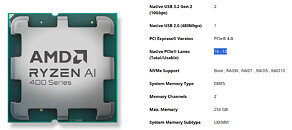
This change seems to reflect AMD's design choice that prioritizes integrated graphics performance and smaller, simpler motherboards. For small form factor builds where space, power consumption, and cost are primary concerns, the Ryzen AI 400 family should offer a good balance of CPU and on-die GPU resources. For users planning to pair a high-end graphics card with multiple high-speed SSDs, older desktop lines that provide more PCIe bandwidth will remain a wiser choice. However, if users are willing to sacrifice a few percentage points by running on a x8 PCIe bus instead of the full x16, the compromise is sensible. For example, in testing with a mid-range graphics card like the GeForce RTX 5060 Ti, using x8 PCIe 4.0 lanes instead of the PCIe 5.0 lanes results in only a 2% drop in FPS at 1080p, and an even smaller 1% drop at 1440p, according to our own testing.
Sources: AMD, via VideoCardz
Add your own comment

30 Comments on AMD Ryzen AI 400 Comes With Up to 12 Usable PCIe 4.0 Lanes, GPUs Limited to x8 Connection

#1
Cheeseball
Not a Potato
This is nothing new for the APUs. Usually eight of the lanes are used up by USB4 PCIe tunnelling and the iGPU, but not counted toward the total.

8700G/Phoenix/Strix Point had 20 lanes, 16 were usable.

AI 7 350 (which 470G 450G seems to be based off of) had 16 lanes, all usable. Not sure why the 470G is 16/12 though.

12 lanes means just one M.2 PCIe 4.0 slot and a one PCIe 4.0 16x (electrically 8x) slot available for the motherboard (aside from the chipset).
Posted on Reply
#2
Kaotik
@AleksandarK Gorgon Point includes both Strix and Krackan refreshes, not just Strix. It's more likely they're just using Krackan-refresh dies instead of Strix dies
Posted on Reply
#3
Bobaganoosh
I remember this as far back as 3400G. I was helping someone try to figure out why their graphics card was never working hard and it came down to XMP not being turned on as well as it only have 8 lanes to work with. Back then, dropping the 8 lanes seemed a bit more impactful.
Posted on Reply
#4
Cheeseball
Not a Potato
BobaganooshI remember this as far back as 3400G. I was helping someone try to figure out why their graphics card was never working hard and it came down to XMP not being turned on as well as it only have 8 lanes to work with. Back then, dropping the 8 lanes seemed a bit more impactful.
Yup I have memories of helping people with the 3400G and 3200G

16 lanes ONLY, so 8x for the PCIe 3.0 16x slot and the two others are M.2 x4s lol
Posted on Reply
#5
maximumterror
I think it’s time to start making it with 512 GB of memory.
Posted on Reply
#6
Squared
I think PCIe x8 for the GPU is acceptable on mobile and wouldn't stop me from buying a Gorgon Point+dGPU laptop. But it's notable that some commenters have lamented the lack of PCIe lanes on the Panther Lake models that aren't meant to have a dGPU (which is the cheapest configuration and the big iGPU configuration), and yet even these have as much PCIe bandwidth as Gorgon Point.
www.techpowerup.com/review/intel-panther-lake-technical-deep-dive/4.html
Posted on Reply
#7
Cheeseball
Not a Potato
SquaredI think PCIe x8 for the GPU is acceptable on mobile and wouldn't stop me from buying a Gorgon Point+dGPU laptop. But it's notable that some commenters have lamented the lack of PCIe lanes on the Panther Lake models that aren't meant to have a dGPU (which is the cheapest configuration and the big iGPU configuration), and yet even these have as much PCIe bandwidth as Gorgon Point.
www.techpowerup.com/review/intel-panther-lake-technical-deep-dive/4.html
358H has 12 PCIe 5.0/4.0 lanes available for use, so similar to this. I don't recall any complaints about that since Panther Lake is currently mobile-only and not meant for desktop use.

If ever Panther Lake would be used by boutique MiniPC OEMs, they should have enough space for either three PCIe 4.0/5.0 M.2 slots, or two M.2 slots and some other peripheral. The TB4 PCIe tunneling is already calculated in the total.
Posted on Reply
#8
Wirko
Cheeseball358H has 12 PCIe 5.0/4.0 lanes available for use, so similar to this. I don't recall any complaints about that since Panther Lake is currently mobile-only and not meant for desktop use.

If ever Panther Lake would be used by boutique MiniPC OEMs, they should have enough space for either three PCIe 4.0/5.0 M.2 slots, or two M.2 slots and some other peripheral. The TB4 PCIe tunneling is already calculated in the total.
For storage, networking and other stuff, bifurcation ability is just as important as bandwidth. In Panther Lake it seems to be excellent. Ark says:
PCI Express Configurations
x4 PCIe5 (1x4,2x2), x4 PCIe4 (1x4, 2x2, 4x1) x4 PCIe4 (1x4, 2x2, 4x1)
AMD of course prefers to keep us in the dark.
Posted on Reply
#9
Tek-Check
SquaredBut it's notable that some commenters have lamented the lack of PCIe lanes on the Panther Lake models that aren't meant to have a dGPU (which is the cheapest configuration and the big iGPU configuration), and yet even these have as much PCIe bandwidth as Gorgon Point.
Those Panther Lake SKUs without extra Gen5 x8 PHY for GPUs have only 12 lanes, which is two lanes less than the lowest AMD desktop APU with 14 lanes.
Cheeseball358H has 12 PCIe 5.0/4.0 lanes available for use, so similar to this. I don't recall any complaints about that since Panther Lake is currently mobile-only and not meant for desktop use.
This.
CheeseballNot sure why the 470G is 16/12 though.
There is no '470G'. The highest desktop SKU is 450G, derived from Krackan. There are 16 lanes baked into the silicon, four of which are used for the chipset link. So, x8 is left for GPU slot and x4 for primary NVMe.
Posted on Reply
#10
Cheeseball
Not a Potato
Tek-CheckThose Panther Lake SKUs without extra Gen5 x8 PHY for GPUs have only 12 lanes, which is two lanes less than the lowest AMD desktop APU with 14 lanes.

This.


There is no '470G'. The highest desktop SKU is 450G, derived from Krackan. There are 16 lanes baked into the silicon, four of which are used for the chipset link. So, x8 is left for GPU slot and x4 for primary NVMe.
Yeah thats a typo. I meant the 450G. It seems to be similar to the current AI 7 350, which is why its weird that its not 16/16.
Posted on Reply
#11
Tek-Check
CheeseballThis is nothing new for the APUs. Usually eight of the lanes are used up by USB4 PCIe tunnelling and the iGPU, but not counted toward the total.
Integrated USB4 and Thunderbolt PCIe lanes are never counted towards the total.

The key issue with this generation of desktop APUs is PCIe degradation, stagnation and waste of integrated USB4 ports on APUs slotted into desktop motherboards. It's insane what AMD has done here. They must correct this on Zen6 generation or stop releasing desktop APU turds.

1. higher SKUs 450G/440G feature x12 usable lanes, four less than 8700G/8600G - degradation
2. lower SKU 435G features x10 usable lanes, the same as 8500G - stagnation, plus x4 link only to GPU slot (4+4+2), without ability to configure it as x8 + x2
3. integrated USB4 will not work on almost all AM5 motherboards, as OEMs do not wire USB-C ports to USB4 PHY beneath the APU. Someone found one single board that supports integrated USB4 on desktop APU. It's ridiculous to waste two USB4 ports on already crippled IO. Total stupidity and lack of good planning for IO.
www.gigabyte.com/Motherboard/B650E-AORUS-ELITE-X-AX-ICE-rev-12/sp
Posted on Reply
#12
Cheeseball
Not a Potato
Tek-CheckIntegrated USB4 and Thunderbolt PCIe lanes are never counted towards the total.

The key issue with this generation of desktop APUs is PCIe degradation, stagnation and waste of integrated USB4 ports on APUs slotted into desktop motherboards. It's insane what AMD has done here. They must correct this on Zen6 generation or stop releasing desktop APU turds.

1. higher SKUs 450G/440G feature x12 usable lanes, four less than 8700G/8600G - degradation
2. lower SKU 435G features x10 usable lanes, the same as 8500G - stagnation, plus x4 link only to GPU slot (4+4+2), without ability to configure it as x8 + x2
3. integrated USB4 will not work on almost all AM5 motherboards, as OEMs do not wire USB-C ports to USB4 PHY beneath the APU. Someone found one single board that supports integrated USB4 on desktop APU. It's ridiculous to waste two USB4 ports on already crippled IO. Total stupidity and lack of good planning for IO.
www.gigabyte.com/Motherboard/B650E-AORUS-ELITE-X-AX-ICE-rev-12/sp
One reason is likely a marketing limit. If they make a powerful APU with all the lanes and a nice iGPU, there would be no point to selling the full desktop CPUs. There's also the physical space limitation as well. They would be big chips to fit all that tech in there.

Its probably the reason why there is no desktop Strix Halo APU. It is literally a TDP-limited 9950X with a better I/O die (e.g. it can idle to less than 10W TDP from my testing). No point in getting a 9900X or lesser CPUs if this existed. Well, that and its 256-bit LPDDR5x bus.

Also, Gigabyte should've made that B650E motherboard in the ITX form factor. It would've been perfect to be paired with any of the Phoenix desktop APUs. The passthrough USB4 feature would've taken advantage of the integrated controller without having to spend extra on an X870-based board.
WirkoFor storage, networking and other stuff, bifurcation ability is just as important as bandwidth. In Panther Lake it seems to be excellent. Ark says:

AMD of course prefers to keep us in the dark.
From my understanding, I think bifurcation would depend on how its implemented on the motherboard side, not on the CPU side. At least for AMD. For example, this Gigabyte board (X870) I saw has two Gen 5 PCIe 5.0 slots, but if you use the other slot it splits it to 8x/8x. I don't know if that's configurable in the BIOS/UEFI though.
Posted on Reply
#13
Wirko
@Tek-Check
Can you update the system diagrams to indicate the possibilities of lane splitting? For example, PTL can also split the other Gen4 x4 port (FIA-3) to x2 or x1, and the Gen5 x4 port to x2, if info on Ark is accurate.
CheeseballFrom my understanding, I think bifurcation would depend on how its implemented on the motherboard side, not on the CPU side. At least for AMD. For example, this Gigabyte board (X870) I saw has two Gen 5 PCIe 5.0 slots, but if you use the other slot it splits it to 8x/8x. I don't know if that's configurable in the BIOS/UEFI though.
Any bifurcation capability must exist in the hardware first, in the PCIe controller on the CPU. Only then can BIOS/UEFI give you (or not give you) an option to enable it, or auto-enable it depending on used slots. Ryzen 7000/9000 can split the x16 port to x4/x4/x4/x4 but Arrow Lake can't, and no motherboard or BIOS can change that. Here is some detailed info for Arrow Lake.
Posted on Reply
#14
Tek-Check
CheeseballOne reason is likely a marketing limit. If they make a powerful APU with all the lanes and a nice iGPU, there would be no point to selling the full desktop CPUs. There's also the physical space limitation as well. They would be big chips to fit all that tech in there.
Not really. Phoenix-based 8700G/8600G already have x20 lanes in total. That's all desktop APU really needs, x4 for the chipset, x8 for GPU slot, and two x4 for NVMe drives. The rest IO on the chipset. They made a terrible mistake to downgrade APUs by x4 lanes. So petty and cheap. Adding one extra x4 PCIe PHY in silicon is nothing.

It looks like they will correct this downgrade on Medusa Point, plus USB4 v2. Preliminary diagram shows x20 lanes. This is really a bare minimum in order to provide two NVMe drives plus other bits.
CheeseballIts probably the reason why there is no desktop Strix Halo APU. It is literally a TDP-limited 9950X with a better I/O die (e.g. it can idle to less than 10W TDP from my testing). No point in getting a 9900X or lesser CPUs if this existed. Well, that and its 256-bit LPDDR5x bus.
Strix Halo is too big for AM5 package. It has 359 extra pins to feed four memory channels. Four channel solution for desktop would only be possible on AM6 platform, if they decide to do it. It's a different class of chip. People would still buy separate CPU+GPU to unlock full performance, and mega-APU would also be popular. It does not really matter if one chip sells better than the other. They constantly monitor sales numbers and adjust production lines for chips that sell more. It's their daily bread.
CheeseballAlso, Gigabyte should've made that B650E motherboard in the ITX form factor. It would've been perfect to be paired with any of the Phoenix desktop APUs. The passthrough USB4 feature would've taken advantage of the integrated controller without having to spend extra on an X870-based board.
Indeed. Even discrete USB4 on X870(E) takes another x4 PCIe PHY, which further cripples desktop APUs that have few PCIe lanes. It's insane.
WirkoCan you update the system diagrams to indicate the possibilities of lane splitting? For example, PTL can also split the other Gen4 x4 port (FIA-3) to x2 or x1, and the Gen5 x4 port to x2, if info on Ark is accurate.
It would not be that useful, it turns out. Intel has a different type of limitation on PCIe lanes, which is the total number of devices. Rules are complex for general public. It varies from one generation to generation, and from one IOD/PCD/PCH to another.

On Panther H484 chipset, there are x20 lanes, but only 8-9 devices are allowed in total. H404 has x12 lanes and 6-7 devices on root ports.


On Arrow Lake H, there are even more lanes, x28, but the hard limit is 8-9 devices. So, it's not intuitive enough. That's why FIA division by x4 and x8 is the most simple and easily readable for the public. In general, all Gen4 lanes should allow down to x1 and Gen5 lanes down to x2, with the caveat of hard limit for the number of devices at any time. Even if you connect nine x1 devices, you can't connect more on remaining lanes.
Posted on Reply
#15
Wirko
CheeseballOne reason is likely a marketing limit. If they make a powerful APU with all the lanes and a nice iGPU, there would be no point to selling the full desktop CPUs.
You set a higher price and that's your "marketing limit" then. The 8700G was very expensive for a long while after launch - and it had half the L3. I expect the same for the "470G" - high price, and it will also come too late.
Posted on Reply
#16
Tek-Check
WirkoAny bifurcation capability must exist in the hardware first, in the PCIe controller on the CPU. Only then can BIOS/UEFI give you (or not give you) an option to enable it, or auto-enable it depending on used slots. Ryzen 7000/9000 can split the x16 port to x4/x4/x4/x4 but Arrow Lake can't, and no motherboard or BIOS can change that. Here is some detailed info for Arrow Lake.
Yes, Arrow Lake has mandatory x8 on the Root Port 13/14.
Have you managed to dig out any AMD's documentation in their technical papers on the portal?
Posted on Reply
#17
Wirko
Tek-CheckIndeed. Even discrete USB4 on X870(E) takes another x4 PCIe PHY, which further cripples desktop APUs that have few PCIe lanes. It's insane.
So what do you do to make the best of the situation? You connect a USB 3 SSD at 20 Gbit/s there and pretend it's internal.
Tek-CheckIntel has a different type of limitation on PCIe lanes, which is the total number of devices.
AMD does too, it's just that they don't want to reveal as much info about Ryzen.
For example, big Epyc can split each x16 port into as many as 9 links (= 9 devices = 9 root ports if I understand correctly). That was in their presentation slides. The AM5 Epyc has 11 root ports - but we don't know how many AM5 Ryzen has, regardless being the same silicon.
Tek-CheckHave you managed to dig out any AMD's documentation in their technical papers on the portal?
Nothing, unfortunately.
Posted on Reply
#18
Cheeseball
Not a Potato
WirkoYou set a higher price and that's your "marketing limit" then. The 8700G was very expensive for a long while after launch - and it had half the L3. I expect the same for the "470G" - high price, and it will also come too late.
It was only $329 on launch, compared to the older 5700G which came out at $359. If ever the 450G hits retail channels, I believe it could be around $300 then may slowly go down to $250 or maybe $220. If ever there was a 470G, maybe that starts at $329 then go down to $300 or maybe takes the current $280 since its technically 12C/24T, so it would hold value higher than 8700G.
Posted on Reply
#19
_roman_
the desktop is about utilising those chips with "possible" defects from the mobile sector. cheaper and partly defect chips.
Interestingly, AMD hasn't fully utilized the "Gorgon Point" silicon in the desktop Ryzen AI 400G series.
Posted on Reply
#20
Kaotik
_roman_the desktop is about utilising those chips with "possible" defects from the mobile sector. cheaper and partly defect chips.
Nah, it's almost 100 % certainly just Krackan refresh rather than Strix refresh chip, they're both under same Gorgon name
Posted on Reply
#21
Youseethis
Someone will delid that cpu and will know if it's the big or small die.

This is an increase of pcie lanes from phoenix 2 at least.

If it's the small die and they have the audacity to call ryzen 7...:roll:
Posted on Reply
#22
TumbleGeorge
Tek-Checklooks like they will correct this downgrade on Medusa Point, plus USB4 v2. Preliminary diagram shows x20 lanes. This is really a bare minimum in order to provide two NVMe drives plus other bits.
I even don't see any PCIe 5 in something that will be realised in future?
Posted on Reply
#23
qcmadness
TumbleGeorgeI even don't see any PCIe 5 in something that will be realised in future?
I would rather get more PCIe lanes.
Posted on Reply
#24
Tomorrow
People buying an APU likely buy them because they're cheap or specifically so they wouldn't have to use a dGPU.
So i doubt x8 4.0 lanes are too big of an issue for most. Besides even if it had 16 lanes to the dGPU then the lower amount of L3 on the APU hurts gaming performance a lot more than 8 less lanes of 4.0.
Posted on Reply
#25
Tek-Check
TumbleGeorgeI even don't see any PCIe 5 in something that will be realised in future?
That's true, but also not essential as yet for thin and light laptops, where everything is about efficiency and less power.

Gen5 SSDs have experienced shockingly low adoption rate on desktop, let alone on laptops. It's almost a non-existent consumer market, super niche, four years after the launch. Even more so now that NAND prices are accelerating through the roof.
YouseethisThis is an increase of pcie lanes from phoenix 2 at least.
Not so fast. There is 435G too.
Posted on Reply
Add your own comment
Nov 18th, 2026 18:22 PST change timezone

New Forum Posts

Popular Reviews

TPU on YouTube

Controversial News Posts