Thursday, March 5th 2026

Apple macOS Tahoe 26.3.1 "Updates" M5 SoC With New "Super Cores"
We reported that Apple's M5 Pro/Max series of SoCs is now incorporating an additional core tier alongside the usual configuration we have been seeing in the company's processors for years. The performance core has been renamed "Super Core," and Apple has introduced a middle-tier design called Performance Core, which is actually a new "M-Core," while the Efficiency Core remains the same. As the regular big P-Core has been renamed to Super-Core, Apple is updating its nomenclature even for the regular M5 SoC with the macOS Tahoe 26.3.1 update. In this update, Apple has renamed the bigger Performance core to Super-Core, meaning that the M5 SoC now has four super cores and six efficiency cores, whereas this was previously called a four performance-core and six efficiency-core design before the update.
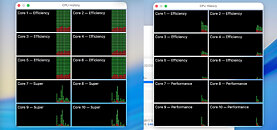
This M5 SoC has no new "M-Cores" variants that sit between the super core and efficiency core, while the M5 Pro and M5 Max have six Super-Cores and 12 M-Cores. The M-Core is a 7-wide out-of-order execution CPU that has roughly 70% of the P-core performance with slightly lower power usage. Interestingly, the efficiency core is completely absent from the new M5 Pro/Max SoCs, resulting in a combination of performance and middle-class cores. This leaves only the regular M5 with the efficiency cores in its CPU package. This macOS software update is only meant for the M5-powered MacBook Pro, which has been shipping with older macOS versions without the Tahoe's v26.3.1 update. For the latest MacBook Air and MacBook Pro equipped with M5, M5 Pro, and M5 Max SoCs, the operating system will likely already show the new naming out of the box, as Apple likely applied all OS updates before shipping. Below are screenshots courtesy of Andrew Cunningham from Ars Technica, showing the new nomenclature on the left, and old way on the right.
Source:
Ars Technica
This M5 SoC has no new "M-Cores" variants that sit between the super core and efficiency core, while the M5 Pro and M5 Max have six Super-Cores and 12 M-Cores. The M-Core is a 7-wide out-of-order execution CPU that has roughly 70% of the P-core performance with slightly lower power usage. Interestingly, the efficiency core is completely absent from the new M5 Pro/Max SoCs, resulting in a combination of performance and middle-class cores. This leaves only the regular M5 with the efficiency cores in its CPU package. This macOS software update is only meant for the M5-powered MacBook Pro, which has been shipping with older macOS versions without the Tahoe's v26.3.1 update. For the latest MacBook Air and MacBook Pro equipped with M5, M5 Pro, and M5 Max SoCs, the operating system will likely already show the new naming out of the box, as Apple likely applied all OS updates before shipping. Below are screenshots courtesy of Andrew Cunningham from Ars Technica, showing the new nomenclature on the left, and old way on the right.


9 Comments on Apple macOS Tahoe 26.3.1 "Updates" M5 SoC With New "Super Cores"
AMD Ryzen (Zen+ZenC)
Apple M-Series (Super+Performance)
Qualcomm Oryon (Prime+Performance)
Intel with their upcoming unified architecture.
ARM naming scheme sucks so I assume its C1-Ultra + C1-Premium
But to be fair to Apple, their “super cores,” die-size wise, are bigger than any other core. People used to compare their performance cores (now called “super”) to ARM performance cores (Pro core, I think), so I understand their need to change the name.
hubweb.cn/apple-silicon/chip-m/
"SUPER" sounds so NVIDIA...
Any given core has to balance power consumption, speed/frequency, Instructions per cycle, die area, latency and cache size. Everything is a tradeoff, you must always compromise.
Computing workloads are not always the same, some benefit from raw speed + IPC, some other benefit from heavy paralellization, and some are very sensitive to cache size + latency; on top of that, you must balance the die area and power consumption according to the budget of your device or target design. You always have to make a tradeoff with existing silicone manufacturing tech and I think apple understands the benefits of having more stratification than just 2 types of cores.
Naming is confusing, but I think this is the correct path for the near future of CPU design.