Thursday, March 12th 2026
Chinese Lisuan LX 7G106 GPU Arrives June 18 with Support for Major AAA Games
Last year, Lisuan Technology introduced its Lisuan LX 7G106 graphics card, one of the most promising GPU technologies for gamers emerging from China. Today, during the AWE 2026 stream on the Chinese BiliBili platform, the company announced that its GPUs will ship on June 18, with pre-orders starting on March 17. The 7G106 GPU is powered by a monolithic die manufactured at TSMC's facilities using the older 6 nm DUV node. This N6 node is approved for Lisuan to utilize TSMC's mature node capacity. Designed for gaming, this GPU accelerates games and 3D applications with broad API support, including DirectX 12, Vulkan 1.3, and OpenGL 4.6. While it supports DirectX 12, it does not include ray tracing, meaning there is no DirectX 12 Ultimate. However, it will support DirectX 12 games, and Lisuan notes that some of these titles include popular games on Steam, such as Cyberpunk 2077, Black Myth: Wukong, and Resident Evil 4 Remake.
Underneath the 7G106 features a SIMD engine capable of running calculations with FP32 and the new INT8 data type. The GPU has a maximum throughput of 24 TeraFLOPS in FP32, placing it high in compute. The primary compute language is OpenCL 3.0. Internally, the SIMD engine is supported by a large raster graphics pipeline, with up to 192 TMUs and 96 ROPs on the silicon. In terms of memory, it offers 12 GB of GDDR6 across a 192-bit wide memory bus, although the company has not yet finalized the exact memory frequencies. The 7G106 is equipped with a modern video acceleration engine, capable of hardware-accelerated AV1 and HEVC decoding at resolutions up to 8K at 60 FPS. It also supports hardware-accelerated AV1 encoding at 4K at 30 FPS and HEVC encoding at 8K at 30 FPS. For monitor connectivity, it includes four DisplayPort 1.4 outputs with support for DSC 1.2b. The GPU does not feature HDMI outputs, likely due to the licensing costs required by the HDMI Consortium for each installed HDMI port.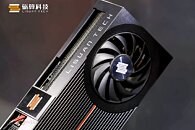

 Interestingly, this seems to be one of the strongest launches from GPU makers in China. Moore Threads is another player, but Lisuan Technologies could offer decent value when the card appears on JD.com. If the pricing and performance are right, we might see this discrete GPU expand into other Asian markets, eventually reaching the Western market, which is dominated by NVIDIA, AMD, and, to a lesser extent, Intel.
Source:
BiliBili
Underneath the 7G106 features a SIMD engine capable of running calculations with FP32 and the new INT8 data type. The GPU has a maximum throughput of 24 TeraFLOPS in FP32, placing it high in compute. The primary compute language is OpenCL 3.0. Internally, the SIMD engine is supported by a large raster graphics pipeline, with up to 192 TMUs and 96 ROPs on the silicon. In terms of memory, it offers 12 GB of GDDR6 across a 192-bit wide memory bus, although the company has not yet finalized the exact memory frequencies. The 7G106 is equipped with a modern video acceleration engine, capable of hardware-accelerated AV1 and HEVC decoding at resolutions up to 8K at 60 FPS. It also supports hardware-accelerated AV1 encoding at 4K at 30 FPS and HEVC encoding at 8K at 30 FPS. For monitor connectivity, it includes four DisplayPort 1.4 outputs with support for DSC 1.2b. The GPU does not feature HDMI outputs, likely due to the licensing costs required by the HDMI Consortium for each installed HDMI port.


23 Comments on Chinese Lisuan LX 7G106 GPU Arrives June 18 with Support for Major AAA Games
www.tsmc.com/english/dedicatedFoundry/technology/platform_DCE_N7_N6
I'm super curious about this.
With INT8 support, I'd be curious to see if FSR4 INT8 works on it, and how the performance penalty is.
Shame they had to use NVIDIA's fire hazard connector though...
There are a ton of patents involved in the industry... so it would be rather interesting to see what happens here
Also, I wonder to what extent it will support XeSS and FSR.
But news like this makes me wonder if NVidia is bringing back cards like the RTX 3060, if it may not just be to "address the shortage of affordable gaming gpus" but also to head off a niche cards like this might have carved out. Intel hasn't built a huge market share with their Arc gpus thus far, and those are pretty legit cards. Drivers are largely stable, game support has reached a critical mass under windows and linux, and an Arc B570/B580 sits in a good spot between AMD and Nvidia offering like the 4060 and 7600 series. It's typically cheaper and often no slower. Where its faster its noticable and can usually be seen as more of a 1440p capable card rather than just a 1080p class card. 10-12gb of vram and a fantastic encoder block really makes it worth considering over an 8gb AMD/Nvidia card.
A lot of chinese graphics IP thus far have failed to surpass this sort of performance tier from what I recall. The (2 year old now) MTT S80 16gb couldn't outperform a 2gb 750 TI from 2014 (maxwell era) while drawing about 100w higher. If they can achieve modern performance it still may come at a high cost. Sure their government can subsidize the monetary cost of a large die on an older node, but physics is physics when it comes to power draw. And I'm sure even Intel has had internal talks about the marketshare they have achieved and the costs associated with getting it...but at least they understand Arc graphics IP will be used in their GPU tiles for the next decade at least. Even when Intel offers Nvidia GPU tiles, there will be Intel cpus still using Arc tiles on other price tiers.
Its going to be insanely expensive for china to even hit 1% marketshare, they may not even want to subsidize double digit marketshare. Niche wins along the way are what you need, and I think Intel managed that. A310/380 are available as great SFF gpu offerings (A310 might even be the best single slot, half height, slot powered, SFF card). B50 Pro has its niche in ai stuff, as well as being a solid dual slot, half height, SFF card for workstations and at under $400 its a great gaming card for its size limits. And you've also got dual gpu versions of the B50 and B60, Nvidia certainly doesnt have any workstation class cards with 48gb of Vram for 1k but Intel has. I think these are the wins Chinese GPUs need. Occupy a niche well enough to justify owning the thing.
I do think they should hire a marketing guy to give it a flashy name though. "Lisuan LX 7G106" doesn't really roll off the tongue and, as sad as it is for me to admit, hearing a Chinese name will instantly put some people off from buying the product.
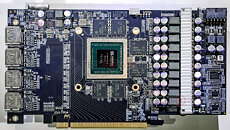
Found a PCB picture of a 5070 model, it has the same orientation with the PCIe and display traces coming in the left side.
At least with this 5070 the silicon is rectangular so possibly rotating it like this might result in better contact with more heatpipes (or something like that)... but the original card is just square, no matter how you rotate it...
They also have a major motivation to meet China's demand for eventually having all domestic PCs sold only using Chinese-built components, and plenty sufficient motivation to also sell abroad as cheaper alternatives to existing low-to-mid-range GPUs in certain markets, which could take part of the floor out from AMD and Intel, who are more vested in those areas currently. True, it will be a few more years before we see them truly competitive, but I welcome more competition into the GPU market.