Monday, March 16th 2026

Micron Announces Mass-Production of HBM4, SOCAMM2 Memory Modules and PCIe Gen 6 SSDs

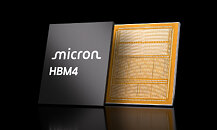
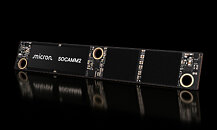
At NVIDIA GTC 2026, Micron announced it is in high-volume production of three products at once, all timed around and designed for the Vera Rubin platform. The headline is HBM4 with the 36 GB 12-high stack started shipping in volume in Q1 2026, built for NVIDIA Vera Rubin. It hits over 11 Gb/s pin speeds for more than 2.8 TB/s of bandwidth, 2.3 times what HBM3E offered, while also improving power efficiency by over 20%. Micron has also shipped early samples of a 16-high 48 GB variant to customers, a 33% capacity bump per HBM placement over the 12H stack. Micron also announced that its 192 GB SOCAMM2 memory modules are now in high-volume production. Designed for Vera Rubin NVL72 systems and standalone Vera CPU platforms, it enables up to 2 TB of memory and 1.2 TB/s of bandwidth per CPU, with the broader SOCAMM2 portfolio spanning from 48 GB to 256 GB.

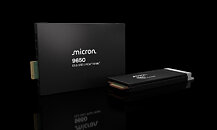
On the storage side, Micron 9650, the industry first PCIe Gen 6 data center SSD designed specifically for NVIDIA BlueField-4 STX architecture, is in mass production as we already reported here. It boasts sequential read speeds of up to 28 GB/s and can handle 5.5 million random read IOPS, essentially doubling the read performance of its Gen 5 predecessor. Furthermore, it offers a performance-per-watt ratio that is twice as efficient.
Source: Micron
Add your own comment

12 Comments on Micron Announces Mass-Production of HBM4, SOCAMM2 Memory Modules and PCIe Gen 6 SSDs

#1
Unregistered
Let me guess, SOCAMM2 will never be inside a laptop - Right?
Posted on Edit | Reply
#2
wNotyarD
IntelJustDieLet me guess, SOCAMM2 will never be inside a laptop - Right?
No. That's for datacenters.
Laptops could use LPCAMM2, if the market could bring itself to use the standard.
Posted on Reply
#3
Unregistered
wNotyarDNo. That's for datacenters.
Laptops could use LPCAMM2, if the market could bring itself to use the standard.
Do you think that in the future Mac book pro will adopt LPCAMM2 as the rest of common laptops?
Posted on Edit | Reply
#4
wNotyarD
IntelJustDieDo you think that in the future Mac book pro will adopt LPCAMM2 as the rest of common laptops?
I'll divide your question in two separate questions:
IntelJustDieDo you think that in the future Mac book pro will adopt LPCAMM2
No, as long as Apple embeds RAM with their M-series SoC's in a single package.
IntelJustDieLPCAMM2 as the rest of common laptops
Not even the rest of common laptops use swappable (SODIMM) memory, much less so LPCAMM2.
Posted on Reply
#5
Unregistered
Stupid me, for a moment I forgot that apple can't use any external ram, because of their unified architecture cpu/ram.
Posted on Edit | Reply
#6
igormp
IntelJustDieStupid me, for a moment I forgot that apple can't use any external ram, because of their unified architecture cpu/ram.
It can, there aren't many drawbacks to using regular soldered RAM instead of packaged ones. But I believe they must get a good deal for packaged stuff and it might simplify their assembly process.
Posted on Reply
#7
Unregistered
igormpIt can, there aren't many drawbacks to using regular soldered RAM instead of packaged ones. But I believe they must get a good deal for packaged stuff and it might simplify their assembly process.
I know, but even LPCAMM2 will add some parasitic inductance and capacitance by making the communication slower if compared to what Apple is currently doing, so yeh, I understand their point and for this reason I was pretty stupid before when I've skipd this detail.
Posted on Edit | Reply
#8
igormp
IntelJustDieI know, but even LPCAMM2 will add some parasitic inductance and capacitance by making the communication slower if compared to what Apple is currently doing, so yeh, I understand their point and for this reason I was pretty stupid before when I've skipd this detail.
In practice it doesn't really slow anything down. Apple is not using anything faster than what's available with regular LPDDR5/X found in other devices. I believe it just boils down to costs and maybe power savings.
Posted on Reply
#9
Unregistered
igormpIn practice it doesn't really slow anything down. Apple is not using anything faster than what's available with regular LPDDR5/X found in other devices. I believe it just boils down to costs and maybe power savings.
No bro, it does, the traces on the PCB sometimes (to be honest: very often) can slow signals, this is because a lot of physical parameters like material permittivity, parasitic capacitance and inductance and the list goes on.
So Apple in this case is basically trying to take the best and shorter way to get better performance.
Posted on Edit | Reply
#10
igormp
IntelJustDieNo bro, it does, the traces on the PCB sometimes (to be honest: very often) can slow signals, this is because a lot of physical parameters like material permittivity, parasitic capacitance and inductance and the list goes on.
That's all true, in theory.
In practice, the M4 used LPDDR5X @ either 7500 or 8533MT/s, same as what's found in many other devices with regular soldered modules.
M1 & M2 & M3 used LPDDR5 6400
The M5 uses LPDDR5X @ 9600, which is even going to be available as LPCAMM2, and also supported by Intel's PTL.
So there's no performance benefit whatsoever.
Posted on Reply
#11
Unregistered
igormpwhatsoever
I can't describe with simple words - how much this <<"whatsoever">> is dubious.
However, I would like to switch on optical fiber anyway to link RAM & CPU, I guess you already understood - why.
Posted on Edit | Reply
#12
igormp
IntelJustDieI can't describe with simple words - how much this <<"whatsoever">> is dubious.
It's not dubious at all. The achieved memory bandwidth and latency numbers from such AS devices is pretty much the same of other devices with a similar config.
Posted on Reply
Add your own comment
Nov 12th, 2026 04:42 CST change timezone

New Forum Posts

Popular Reviews

TPU on YouTube

Controversial News Posts