Monday, July 13th 2026

Chinese CXMT to Match Micron's DRAM Manufacturing Capacity This Year
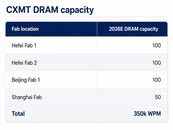
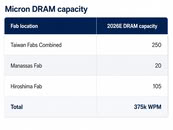
Chinese memory giant CXMT has been expanding its capacity so rapidly that the company is now able to compete with one of the largest memory manufacturers in the world—Micron. According to analysis from Citrini Research and their proprietary data, CXMT is projected to produce about 350,000 DRAM wafers per month by the end of 2026, assuming all current projects are completed on schedule. This is an impressive figure, especially considering that Micron, one of the "big three" DRAM manufacturers, is currently estimated to produce about 375,000 DRAM wafers per month by the end of 2026, assuming their capacity expansions are fulfilled. Micron has been a memory supplier for decades, while CXMT is a relatively new player that emerged to meet China's domestic needs.
A particularly surprising discovery is that CXMT is constructing its cleanrooms—where the actual silicon is produced—in just around 12 months, whereas the rest of the DRAM manufacturing industry typically takes 21-24 months, nearly a full year longer. The biggest challenge for Chinese memory makers like CXMT is acquiring advanced lithography solutions from around the world, as the United States government has imposed sanctions on the company and placed it on a blacklist, preventing access to modern EUV scanners. Instead, CXMT relies on older DUV lithography tools and uses multi-patterning techniques to work around the lack of EUV technology. Despite this, CXMT is matching Micron's output this year with nearly the same number of DRAM wafers, which is impressive for such a new market entrant.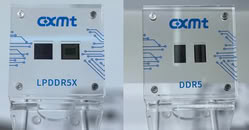
 Earlier this year, it was confirmed that CXMT began shipping 16 Gb DDR5 chips running at 8,000 MT/s, which measure 67 mm² and have a density of 0.239 Gb per square millimeter. The G4 DRAM cells are 20% smaller than CXMT's previous G3 generation. This development follows the company's progression from 23 nm (G1) and 18 nm (G2) nodes. However, it appears that 24 Gb modules are now in mass production, albeit at slightly lower speeds of around 6,000 MT/s. The company is also producing LPDDR5X-10667 DRAM modules, which are in mass production and available in 12 Gb and 16 Gb capacities. Much of this production is driven by the demand from the AI sector.
Finally, the report notes that the Chinese government is encouraging CXMT to transfer its DRAM technology IP to other Chinese DRAM manufacturers such as JHICC, Swaysure, and YTMC's subsidiary XMC. This initiative aims to alleviate memory shortages domestically before CAMT-designed DRAM enters other markets, such as the EU and possibly even the U.S.
Source:
Zephyr on X
A particularly surprising discovery is that CXMT is constructing its cleanrooms—where the actual silicon is produced—in just around 12 months, whereas the rest of the DRAM manufacturing industry typically takes 21-24 months, nearly a full year longer. The biggest challenge for Chinese memory makers like CXMT is acquiring advanced lithography solutions from around the world, as the United States government has imposed sanctions on the company and placed it on a blacklist, preventing access to modern EUV scanners. Instead, CXMT relies on older DUV lithography tools and uses multi-patterning techniques to work around the lack of EUV technology. Despite this, CXMT is matching Micron's output this year with nearly the same number of DRAM wafers, which is impressive for such a new market entrant.


Finally, the report notes that the Chinese government is encouraging CXMT to transfer its DRAM technology IP to other Chinese DRAM manufacturers such as JHICC, Swaysure, and YTMC's subsidiary XMC. This initiative aims to alleviate memory shortages domestically before CAMT-designed DRAM enters other markets, such as the EU and possibly even the U.S.
28 Comments on Chinese CXMT to Match Micron's DRAM Manufacturing Capacity This Year
If a Chinese corporation wants to make a factory, they dont have to worry about local permits, local building restrictions, environmental surveys, power surveys, impact studies, protracted sessions of bidding for contractors as set by the government (especially true for government funded Micron), endless lawsuits from NIMBYs or ambulance chasers or advocacy groups, and so on and such.
To top that all off, China doesnt care about IP. They dont have to wait for companies like ASML to make RAM, they are churning out specialist hardware at a breakneck pace and are building even more production capacity. Substrate shortage? Just build more! More factories, more shifts, more supply, more more MORE!
We warned this would happen. That once the Chinese figured out how to make the machinery needed to make the process nodes, they would dominate the market. And we were absolutely right. What you are seeing is that domination in progress. And frankly, I'm glad they are doing it.
I doubt CXMT can supply enough of the market, though we really need a competitor that isn't the big 3.
By tariffing and blocking this tech for the last decade, the US has forced China to catch up, making the most pro-consumer market you could have: one in which copyright and artificial scarcity are no longer possible.Chinese enterprise hasn't been infected by western clown world tactics yet. To them, if there is a large market, they will expand to meet that market. The idea of limiting production is a foreign concept.Then the Chinese will continue to increase production until demand is met. Unless the banks ad private equity have infinite money, they will reach a plateau eventually.
BTW, Privat equity is having a real bad time right now.....
Silicon sits at #2 on the abundance list
en.wikipedia.org/wiki/Abundance_of_elements_in_Earth%27s_crust
en.wikipedia.org/wiki/Silicon#Production
Getting metallurgical grade silicon is cheap and easy..................refining to semiconductor grade and growing a large silicon crystal with the proper doping, now that's more of a challenge, but the old saying goes........it's difficult to create but easy to duplicate.