Tuesday, March 17th 2026

NVIDIA's DLSS 5 Keeps Image Quality Consistent with Artistic Intent
Yesterday, NVIDIA unveiled its latest DLSS 5 technology, offering gamers the first real-time neural rendering. However, even after the announcement, many questions arose about what DLSS 5 is capable of and how it will work with games. NVIDIA released a FAQ to address some common inquiries. The primary goal of DLSS 5 is to enhance visual fidelity through various techniques that create scenes with photorealistic lighting and materials. Perhaps the most interesting aspect is that DLSS 5 will honor the original artistic intent by using the game's color and motion vectors for each frame, anchoring the DLSS 5 model to the specific setting. This keeps the output in line with what the game developers originally envisioned for each frame. DLSS 5 will add visual enhancements that help each frame undergo an overhaul.
This overhaul is completed in several steps. The first is cinematic lighting, achieved through complex effect reconstruction for realistic skin glow, shadows, and more. Next is material depth—DLSS 5 applies micro-realism to the surface of any object, such as a rock or a wall, delivering a realistic texture that enhances the game. NVIDIA highlights that its latest DLSS installment offers temporal consistency, meaning the image quality is fine-tuned frame by frame to closely follow the game content, ensuring visual enhancements remain consistent. Interestingly, this technology will work alongside existing techniques like path tracing, where path tracing provides lighting accuracy, and DLSS enhances lighting photorealism. This means path tracing improves overall shadow behavior and reflections, while DLSS 5 makes them as realistic as possible.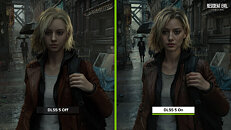
 Regarding DLSS 5 performance, NVIDIA used two GeForce RTX 5090 GPUs to run the GTC 2026 demonstration. One GPU rendered the game, while the second ran a complete DLSS 5 model. As DLSS 5 is expected to launch in the fall of 2026, NVIDIA plans to optimize this model to run on a single GPU with its own quality presets, and most importantly, fine-tune the model to be usable across a range of GeForce RTX GPUs. Of course, the best results are expected from the GeForce RTX 5090. Games debuting with DLSS 5 will include AION 2, Assassin's Creed: Shadows, Black State, CINDER CITY, Delta Force, Hogwarts Legacy, Justice, NARAKA: BLADEPOINT, NTE: Neverness to Everness, Phantom Blade Zero, Resident Evil Requiem, Sea of Remnants, Starfield, The Elder Scrolls IV: Oblivion Remastered, and Where Winds Meet. NVIDIA is collaborating with game developers to include more titles before the DLSS 5 launch.
Source:
DLSS FAQ
This overhaul is completed in several steps. The first is cinematic lighting, achieved through complex effect reconstruction for realistic skin glow, shadows, and more. Next is material depth—DLSS 5 applies micro-realism to the surface of any object, such as a rock or a wall, delivering a realistic texture that enhances the game. NVIDIA highlights that its latest DLSS installment offers temporal consistency, meaning the image quality is fine-tuned frame by frame to closely follow the game content, ensuring visual enhancements remain consistent. Interestingly, this technology will work alongside existing techniques like path tracing, where path tracing provides lighting accuracy, and DLSS enhances lighting photorealism. This means path tracing improves overall shadow behavior and reflections, while DLSS 5 makes them as realistic as possible.


106 Comments on NVIDIA's DLSS 5 Keeps Image Quality Consistent with Artistic Intent
www.techpowerup.com/347269/nvidia-virtualizes-game-development-with-rtx-pro-server
Also I believe they will offer some kind of framework for the devs that will be able to be trained with the models prior and generate much better results.
I don't like it as it is now as well, but remember what we got with DLSS 1 vs now.
I find this very exciting compared to what we have been getting the last 10yrs or so. RT was complete bs from the beginning, backed lighting worked just as well if not even better, since there was only one vision of the game not RT on and RT off.
DLSS started as super scaling and ended up as upscaling. It's neat for handhelds (which we haven't gotten any from nvidia, except for the switch 2), but shouldn't be a must for mid-high to high end GPUs to be able to play the game.
Only thing I am worried about tho, is game devs will use this just like they have used UE5 and Upscaling, to be lazy and feed slop to us, that's when it can be called slop imo.
I'm yet to see a single art direction developer on social media saying DLSS 5 shows any semblance of consistence with artistic intent.
And believe me, many of them are being quite vocal about this on X, youtube, bluesky, etc.
DLSS 4.5 already took a 5% - 10% performance hit. How much is DLSS performance hit going to be like. If it takes another 10% - 15% then what is the point of upscaling when you will have to start lowering graphical settings to maintain playable.
I actually think most of the DLSS 5 images looks much improved. Let's wait and see how it turns out, as I am sure the people that don't like it can just switch it off.
I assume it does nicely conveys with Nvidia's intent though :rolleyes:
Btw how is this not one of those press release posts? It sure reads like one.
With this, devs just have to make graphics on par with Spyro The Dragon for the PS1, low polygon, flat textures, and gouraud shading. Then DLSS5 will add all the other details.
No matter what they try to spin this as, this will just lower the bar even further. Upscaling tech was originally supposed to give better performance on 4K screens, give slower graphics cards a chance to punch above their weight, get higher FPS in VR. What did we get instead? Its a required crutch to make games barely function now because optimization can be skipped.
With stuff like DLSS5 we can just make the equivalent of doodles and AI will handle the rest. Hence my Spyro example.
Of course, they have been immediately accused of selling out etc. Can't wait for the Nexus video, ol' Steve will have to do some heavy mental gymnastics to get out of this one.So, you missed all those who spoke in the original presser? How convenient :DFor sure, the bandwagon won't propel itself and there is a metric f-ton of social media clout to be harvested out of this. In fact all the utubers and the like should be grateful to Nvidia for giving them a boost like that. This is the biggest hysteria overdrive I've seen since, dunno, Cyberpunk launch?
The biggest joke is on people who should know better, like the "enthusiasts" on forums like these, who instead chose to go with the lowest hanging fruit.
Playing to the crowd who always think graphics are never good enough.
The problem is when visages are big inside the frame, like the close-up shot of Leon or Grace, the effect is mild, I personally don't like it, but I find it okay-ish, BUT when face are more of a medium size like the other Hogwarts examples or Grace in street the effect is yikes. This behavior of having bigger change with smaller face is the same problem we have with AI image upscaller and why in certain situation (when subject adherence to ground truth is important) I had to not use them at work.
Edit : by AI image upscaler, I mean software like Gigapixel or other up-scaling oriented diffusion model, NOT DLSS 1-4.5...
:cool:
That's why it needs two RTX 5090:
1. First > for rendering.
2. Second > for Stable Diffusion and Framegen.
;)
A thing that Nvidia could do, would be to alter face only when they are really close-up. But that would mean the effect would be overall less present, less noticeable.
Also it raised the question about IQ at lower input resolution, does the faces are even less stable, even more instagram-ify ?
As for Steve from GN:
I guess the actress herself lacks soul then, it doesn't look that different to me.
Here, have a "hero" render:
Are they the same character?
What a time to be alive.