Wednesday, March 11th 2026

NVIDIA Virtualizes Game Development With RTX PRO Server
Game development teams are working across larger worlds, more complex pipelines and more distributed teams than ever. At the same time, many studios still rely on fixed, desk-bound GPU hardware for critical production work. At the Game Developers Conference (GDC) this week in San Francisco, NVIDIA is showcasing a new approach to bring together disparate workflows using virtualized game development on NVIDIA RTX PRO Servers, powered by NVIDIA RTX PRO 6000 Blackwell Server Edition GPUs and NVIDIA vGPU software.
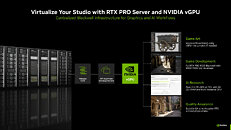
With the RTX PRO Server, studios can centralize and virtualize core workflows across creative, engineering, AI research and quality assurance (QA) - all on shared GPU infrastructure in the data center. This enables teams to maintain the responsiveness and visual fidelity they expect from workstation-class systems while improving infrastructure utilization, scalability, data security and operational consistency across teams and locations.
 Simplifying Complex Workflows
As game development studios scale, hardware can often sit underutilized in one location while other teams wait to access it for production work. QA capacity is hard to expand quickly. Over time, workstation hardware, drivers and tools diverge, making bugs harder to reproduce. AI workloads are often isolated on separate infrastructure, creating more operational overhead.
The NVIDIA RTX PRO Server helps studios move from workstation-by-workstation scaling to centralized GPU infrastructure. Studios can pool resources, allocate performance by workload and support parallel development, testing and AI workflows without expanding physical workstation sprawl.
Centralized GPU infrastructure enables studios to run AI training, simulation and game automation workloads overnight, then dynamically reallocate the same resources to interactive development during the day, improving overall utilization and reducing idle capacity.
The NVIDIA RTX PRO Server supports virtualized workflows for 3D graphics and AI across the game development lifecycle for:
Supporting AI and Engineering on Shared Infrastructure
AI is becoming a core part of everyday game development, spanning coding, content creation, testing and live operations. As these workflows expand, studios need infrastructure that can support AI alongside traditional graphics workloads without introducing separate, siloed systems.
With the RTX PRO Server, studios can support coding agents, internal model experimentation and AI-assisted production workflows without spinning up a separate AI stack for every team.
The NVIDIA RTX PRO 6000 Blackwell Server Edition GPU features a massive 96 GB memory buffer, enabling developers to run multiple demanding applications simultaneously while supporting AI inference on larger models directly alongside real-time graphics workflows.
NVIDIA Multi-Instance GPU (MIG) technology partitions a single GPU into isolated instances with dedicated memory, compute and cache resources. Combined with NVIDIA vGPU software, MIG can help studios securely allocate GPU capacity across users and workloads. In combined MIG and vGPU configurations, a single RTX PRO 6000 Blackwell Server Edition GPU can support up to 48 concurrent users, maximizing utilization while maintaining performance isolation.
Enterprise-Ready Deployment for Game Studios
NVIDIA RTX PRO Servers are designed for enterprise-grade data-center operations. Studios can deploy virtual workstations on RTX PRO Servers via NVIDIA vGPU on supported hypervisor and remote workstation platforms.
That means RTX PRO Servers can fit into studios' existing infrastructure and IT practices, rather than requiring one-off deployments.
Major game publishers already use NVIDIA vGPU technology to scale centralized development infrastructure and improve efficiency at studio scale.
Source:
NVIDIA
With the RTX PRO Server, studios can centralize and virtualize core workflows across creative, engineering, AI research and quality assurance (QA) - all on shared GPU infrastructure in the data center. This enables teams to maintain the responsiveness and visual fidelity they expect from workstation-class systems while improving infrastructure utilization, scalability, data security and operational consistency across teams and locations.


As game development studios scale, hardware can often sit underutilized in one location while other teams wait to access it for production work. QA capacity is hard to expand quickly. Over time, workstation hardware, drivers and tools diverge, making bugs harder to reproduce. AI workloads are often isolated on separate infrastructure, creating more operational overhead.
The NVIDIA RTX PRO Server helps studios move from workstation-by-workstation scaling to centralized GPU infrastructure. Studios can pool resources, allocate performance by workload and support parallel development, testing and AI workflows without expanding physical workstation sprawl.
Centralized GPU infrastructure enables studios to run AI training, simulation and game automation workloads overnight, then dynamically reallocate the same resources to interactive development during the day, improving overall utilization and reducing idle capacity.
The NVIDIA RTX PRO Server supports virtualized workflows for 3D graphics and AI across the game development lifecycle for:
- Artists: Providing virtual RTX workstations for traditional 3D and generative AI content-creation workflows.
- Developers: Powering consistent, high-performance engineering environments for coding and 3D development.
- AI researchers: Offering large-memory GPU profiles for fine-tuning, inference and AI agents.
- QA teams: Enabling scalable game validation and performance testing using the same NVIDIA Blackwell architecture used by GeForce RTX 50 Series GPUs.
Supporting AI and Engineering on Shared Infrastructure
AI is becoming a core part of everyday game development, spanning coding, content creation, testing and live operations. As these workflows expand, studios need infrastructure that can support AI alongside traditional graphics workloads without introducing separate, siloed systems.
With the RTX PRO Server, studios can support coding agents, internal model experimentation and AI-assisted production workflows without spinning up a separate AI stack for every team.
The NVIDIA RTX PRO 6000 Blackwell Server Edition GPU features a massive 96 GB memory buffer, enabling developers to run multiple demanding applications simultaneously while supporting AI inference on larger models directly alongside real-time graphics workflows.
NVIDIA Multi-Instance GPU (MIG) technology partitions a single GPU into isolated instances with dedicated memory, compute and cache resources. Combined with NVIDIA vGPU software, MIG can help studios securely allocate GPU capacity across users and workloads. In combined MIG and vGPU configurations, a single RTX PRO 6000 Blackwell Server Edition GPU can support up to 48 concurrent users, maximizing utilization while maintaining performance isolation.
Enterprise-Ready Deployment for Game Studios
NVIDIA RTX PRO Servers are designed for enterprise-grade data-center operations. Studios can deploy virtual workstations on RTX PRO Servers via NVIDIA vGPU on supported hypervisor and remote workstation platforms.
That means RTX PRO Servers can fit into studios' existing infrastructure and IT practices, rather than requiring one-off deployments.
Major game publishers already use NVIDIA vGPU technology to scale centralized development infrastructure and improve efficiency at studio scale.
8 Comments on NVIDIA Virtualizes Game Development With RTX PRO Server
They can't even help themselves. No matter who they talk to or about it just goes into an AI conversation. All AI all the time. That should be their new slogan.
Please let this end
And then be amazed by real GPUs not using their fans and crashing, because that BUG did not show up on the virtual GPU.
Good Job.
How many times will companies hit their own head until they learn:
when input(keyboard) and output(screen) matters, "virtualising", "streaming" or whatever tf you want to call having it in the cloud will be horrible.
I know it looks enticing with cloud math on paper, but in those usage scenarios users actually care about every millisecond or even nanosecond.