News Posts matching #DLSS

Return to Keyword Browsing

DLSS 5 on Radeon Gets Faster With AMDLSS5 2.0, Up to 64% Performance Uplift

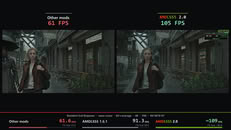
AMDLSS5, a free mod that runs NVIDIA's DLSS 5 Neural Rendering on AMD's Radeon RX 9070 and RX 9070 XT, has reached version 2.0 with an engine its developer, Wehaveall, built for the project. Earlier builds were based on Daniel Blanco's DLSS-NR-on-AMD, the tool that first got DLSS 5 working on Radeon cards back in September, but version 2.0 no longer needs files from any other mod. In a 60-second Resident Evil Requiem run at 4K with FSR on an RX 9070 XT, the new build averaged 101.2 FPS with 78.5 FPS 1% lows, up from 91.3 and 66.0 FPS on version 1.6.1. That is roughly 11% and 19% better, respectively.

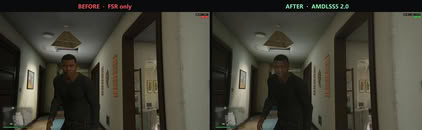
The headline 64% figure comes from a comparison with unnamed "other mods," which managed 61.6 FPS in the same scene. These are the developer's own numbers from one game on one GPU, and there's no mod-off baseline showing what Neural Rendering costs. Game support now includes PRAGMATA, Nioh 3 and GTA 5 Enhanced, the latter only in offline Story Mode with BattlEye disabled. RX 9060 series cards should work but are untested, while RX 7000 support is an alpha that hasn't been tried on real hardware yet.
Zelda: Ocarina of Time Remake Gets a Native PC Port Through Static Recompilation

A GitHub developer going by tangerineturtle1 has released NX2navi, a native Windows port of the new Zelda: Ocarina of Time remake built through static recompilation. Rather than emulating Switch 2 hardware, it converts the game into x86-64 code before you play, then draws everything through a custom Vulkan renderer. No game files are included, so players need their own dump of version 1.1.1, and the launcher then builds the game locally, which takes 10 to 25 minutes the first time. RTX owners get DLSS, while FSR 3.1 and its frame generation work on any GPU, and HDR is supported too. Resolution goes beyond 1440p to 5K, frame rate can be uncapped or set as high as 240 FPS (60 FPS is the default), and 21:9 or 32:9 ultrawide screens are supported with the HUD kept at 16:9.

The remake only launched last week, and it was already running through an emulator on launch day, albeit poorly. NX2navi is much further along, but it is still labeled early development. Visual bugs, the occasional crash and brief stutters when entering new areas are listed as known issues. It also needs 16 GB of RAM, about 30 GB of storage and a GPU with Vulkan 1.3 and mesh shader support. An earlier showcase on an RTX 5090 reportedly used 18.6 GB of VRAM, though a newer showcase claims memory use is way down.

NVIDIA Marks 20 Years of the GeForce 8800 GTX With a Free Path-Traced Steam Demo

NVIDIA is celebrating 20 years of the GeForce 8800 GTX, which hit store shelves on November 8, 2006, with a free tech demo on Steam. Called GeForce 8800 GTX - 20 Years of a Legend, it was created by Unreal Engine artist Dylan Browne, the developer of Through The Ages, with support from NVIDIA. The semi-interactive demo puts players in a 2006-era PC gaming room, where they can unbox the 8800 GTX, inspect it up close, and install it in an era-accurate PC tower, with GeForce easter eggs scattered around. The scene is rendered with path tracing, DLSS 4.5 Ray Reconstruction, Dynamic Multi Frame Generation, and RTX Mega Geometry. It is available now on Steam and is coming soon to GeForce NOW for Ultimate members.

Naturally, the 8800 GTX itself can't run any of this, which is quite ironic, to say the least. Steam lists an RTX 4070 as the bare minimum and recommends an RTX 5080, alongside 32 GB of system RAM and 30 GB of storage. That RAM figure alone is over 40 times the 8800 GTX's 768 MB of video memory. The recommended RTX 5080 is far from cheap right now either, with TechSpot's October survey putting its lowest US price at around $2,200. So a demo built around the thrill of unboxing a new GPU in 2006 wants one of the priciest gaming cards of 2026 to look its best.

NVIDIA App Update Adds DLSS Override Support to 19 More Games

NVIDIA has released NVIDIA App 11.0.9.585, a small update that adds DLSS Override profiles for 19 games and Optimal Settings profiles for six. The list mixes older titles like PUBG: Battlegrounds, The Witcher 3: Wild Hunt, and Dragon's Dogma 2 with Control Resonant, Silent Hill: Townfall, Ace Combat 8: Wings of Theve, Gears of War: E-Day, and Star Wars: Galactic Racer, all of which were scheduled to launch in September or October. Oddly enough, 007 First Light was already listed in the main 11.0.9 release, and Active Matter showed up back in 11.0.8. NVIDIA doesn't explain the repeats, and it doesn't say which overrides each game supports either.

The changelog otherwise only mentions "various stability/security fixes" without any details. This build follows two bigger ones that added significantly more features. The main 11.0.9 release brought DLSS 4.5 Ray Reconstruction and per-game Resizable BAR controls, while 11.0.9.565 added RTX Spark support, a local MCP server for AI agents, and a faster Performance Mode for DLSS Frame Generation. As a refresher, DLSS Override lets GeForce RTX owners use newer DLSS models, or modes like DLAA, that a game may not offer on its own. It sits under Graphics > Program Settings > Driver Settings. Below is the full list of games.

NVIDIA DLSS 5 Arrives in Hogwarts Legacy, War Thunder, and Where Winds Meet, Promising Impressive Performance Boost

NVIDIA is bringing its DLSS 5 neural rendering technology to three more games this month, starting with Hogwarts Legacy on November 5. According to NVIDIA, War Thunder will follow in mid-November, while Where Winds Meet is scheduled to receive support on November 23. NVIDIA is also bringing DLSS 4.5 to several games, and has updated DLSS 4.5 Unreal Engine plugin. NVIDIA was also keen to note that its October 2026 update has significantly reduced the footprint, decreased VRAM usage, and increased performance.

DLSS 5 introduces what NVIDIA calls 3D-Guided Neural Rendering, using AI to enhance lighting, shadows and material details based on information from the game engine. The technology operates as a final rendering stage, using the original frame, geometry, textures and lighting data as its foundation. According to NVIDIA, this approach allows developers to introduce more realistic lighting and material effects without having to explicitly model and render all the additional detail. The company also provides developers with controls to adjust how the technology affects individual scenes, objects and characters, using different AI models, intensity settings and semantic masking to preserve the original artistic direction.

Modded RTX 2080 Ti 22 GB Shows What Extra VRAM Can Still Do for Turing

PC Games Hardware has put a modded GeForce RTX 2080 Ti 22 GB through their test gauntlet, and the extra memory seemingly pays off once games run out of headroom. At 4K with DLSS Performance and FSR 3.1 Frame Generation, the card averaged 52.5 FPS in Flight Simulator 2024 against 30.2 FPS on a regular 11 GB model, roughly 74% faster. Spider-Man 2 jumped from 39.4 to 64.0 FPS, and Indiana Jones and the Great Circle crashed to the desktop on the 11 GB card. At 1440p with DLSS Quality, the gap was smaller, though those first two games still ran about 20% slower on 11 GB. Of course, PCGH chose nine memory-hungry games on purpose, and most titles run fine on 11 GB. Keep in mind that these are just one outlet's numbers, and other results may vary.

These cards have shown up everywhere from Alibaba to eBay listings at $499, and this one came from a reader. All eleven memory chips are swapped for 2 GB Samsung parts. No firmware changes are needed, since relocating a single strap resistor tells the GPU about the extra capacity, and NVIDIA's regular drivers pick it up. Its weak blower-style cooler and 250 W limit held it back, so PCGH tuned both cards to identical 1.9 GHz, 15 GT/s, and 280 W settings. At around €500, the 22 GB card costs quite a bit less than a 16 GB RTX 5060 Ti, which goes for €770 in Germany. PCGH still calls it a gamble, citing eight-year-old hardware and soldering work that can fail weeks later, and advises checking the seller's reputation and whether any warranty goes beyond a 30-day return window.

Phantom Blade Zero Launches Today For GeForce RTX & RTX Spark

Today, at 7pm PT, the much-anticipated Phantom Blade Zero launches with DLSS 4.5, ray tracing and path tracing, playable on GeForce RTX and RTX Spark. The Blood of Dawnwalker can now be upgraded to DLSS 4.5 Super Resolution and Dynamic Multi Frame Generation via the NVIDIA app.

NVIDIA RTX Remix 1.6 has been added to the Half-Life 2 RTX demo and Portal with RTX, introducing support for DLSS 3D-Guided Neural Rendering, and upgrading DLSS Ray Reconstruction and DLSS Frame Generation with our latest AI models. And our beta RTX Remix mod for Minecraft: Java Edition has been released.

New DLSS 5 Mod Borrows a VR Trick for Better Ultrawide Performance

A new DLSS 5 mod borrows a trick from VR headsets to make Neural Rendering less punishing on ultrawide monitors. FoveatedDLSS5, a ReShade add-on built by maximedgoulet, keeps neural rendering at full resolution in the middle of the screen and steps it down toward the edges, where peripheral vision picks up less detail. In a Reddit post, the modder says The Witcher 3 went from 49 FPS to about 80 FPS on an RTX 4090 at 7680x2160 with 2x multipass, a gain of over 60%.

With default settings on a 7680x2160 panel, Neural Rendering ends up processing about 71% of the original pixels. Smaller screens gain less, however. At 4K, the defaults leave 93% of the pixels, and at 3440x1440 the mod turns itself off, so 16:9 and 21:9 users should shrink the center zone. It's also a pre-release tested in one game, and it only works when neural rendering runs after upscaling, which rules out pairing it with the Neural Upstream trick. Videocardz points out a similar project, CheekyFoveatedDLSS, that has been out since early September and adds eye-tracked foveation for VR headsets.

NVIDIA RTXPT 1.9 Path Tracer Gets Around 20% Faster, Adds Windows on Arm Support

NVIDIA has released version 1.9.0 of RTX Path Tracing (RTXPT), its open-source reference path tracer on GitHub, claiming roughly 20% better performance than the previous 1.8.1 release, with comparable or better image quality. RTXPT is a code sample for developers, meant as a starting point for building a path tracer or as a reference for NVIDIA's other ray tracing SDKs. Several changes add up to that uplift. The path tracer can now optionally trace only three quarters, half, or a quarter of the pixels each frame, and the built-in performance presets use this by default, along with lower bounce limits in the faster modes.

On DirectX 12, async compute lets the previous frame's DLSS Ray Reconstruction and post-processing overlap with the next frame's path tracing, and TLAS instance generation has moved to the GPU. Lighting got some attention too. NEE-AT light sampling now handles up to 2 million lights, up from 512K, and the SHaRC radiance cache is on by default in real-time mode, apparently feeding more indirect lighting into DLSS Ray Reconstruction at about the same cost. Version 1.9 also adds Windows on ARM64 support. The release notes don't say why, though it's probably no coincidence, given NVIDIA's own Arm-based RTX Spark chip for Windows PCs.

Cyberpunk 2077 Joins Xbox Play Anywhere as Update 2.5 Goes Live

CD Projekt RED's Cyberpunk 2077 Update 2.5 went live yesterday on PC, PS5, Xbox Series X|S and Mac, with the Switch 2 and Mac App Store versions due in the coming days. The studio announced the update on October 20 with just two confirmed features, and a YouTuber's early video filled in most of the rest. The leak was mostly right, though a few things changed.

Dual-wielding isn't limited to pistols, since the Double Trouble perk also covers revolvers from the Power category and comes with four extra perks. The mystery Night City tour is called Welcome to Paradise and is narrated by Richard Night, while the Clampdown prequel quest rewards a five-piece gear set based on King. Glamdocs also handle the Monowire and Projectile Launch System, and 12 new Minor Arcana tarot cards are hidden around the city, something the leak didn't seem to mention. Mods come through mod.io as a curated selection, and the official notes list Switch 2 alongside PC, Mac, PS5 and Xbox Series X|S, although the leak suggested otherwise. Modded console saves can't earn achievements or trophies.

Call of Duty: MW4 Launches, Cyberpunk 2077 Gets DLSS 4.5, and More RTX Spark Games Released

GeForce RTX GPUs accelerated by DLSS 4.5 give you the definitive experience in the wealth of top-rated games that have recently launched, and new titles such as Call of Duty: Modern Warfare 4, Crimson Desert Enhanced: Charting the Unknown and Phantom Blade Zero.

On October 16th, Call of Duty: Modern Warfare 4 Campaign Early Access began, followed by DMZ Early Access yesterday. On the 23rd, the full game officially arrives with the addition of multiplayer, and using our latest Game Ready Driver you can optimize your experience with DLSS 4.5 and Advanced Shader Delivery.

NVIDIA Releases GeForce 621.01 WHQL Game Ready Drivers

NVIDIA today announced its latest GeForce 621.01 WHQL Game Ready drivers, designed to bring the latest DLSS and RTX technologies to AAA titles. This update focuses on enhancing DLSS, ray tracing, and various other visual fidelity improvements for games like Phantom Blade Zero, Call of Duty: Modern Warfare 4, NBA 2K27, Cyberpunk 2077, and Crimson Desert Enhanced: Charting the Unknown. In addition to minor DLSS version updates, the driver also addresses issues such as DLSS FG application problems in Wuthering Waves, crashes in Star Citizen with the Vulkan API, and crashes in Surviving Mars: Relaunched after updating to R595 drivers. These issues have been resolved. Furthermore, general bug fixes include quality of life improvements for users of 360 Hz refresh rate monitors, where QHD monitors running at 360 Hz experienced occasional black flashing during gameplay or FPS drops on some models. Lastly, freezing with Meta Horizon Link streaming and dimming on ASUS notebooks have been fixed.

DOWNLOAD: NVIDIA GeForce 621.01 WHQL

NVIDIA's Faster DLSS 5 Model Gets Extracted From NBA 2K27, Modders Report Up to 90% Gains

NVIDIA shipped its faster DLSS 5 Neural Rendering model with NBA 2K27 on October 16, and it didn't take modders long to pull it out and test it elsewhere. Renan Maniero on X extracted the new 310.9.16.0 build of the DLL. That lets people inject it into games that don't officially support DLSS 5 through tools like RenoDX and OptiScaler. The new DLL also keeps the older model around as Preset A, with the new one sitting under Preset B, so comparing the two is as simple as switching presets. Gaming Optimized on X did exactly that, and found the new model running up to 90% faster than the old one in The Witcher 3. The channel points out that the gain varies from game to game, so 90% looks like the best case rather than the norm.

That roughly aligns with NVIDIA's own claims. The company says the October update shrinks the model by 24% to roughly 118 million parameters, cuts VRAM use at 4K by 20%, and runs the neural rendering workload up to 2x faster than the September version. NVIDIA also quoted up to 40% higher frame rates in NBA 2K27 specifically. Officially, DLSS 5 is still limited to RTX 50-series GPUs and GeForce NOW. NVIDIA plans to bring it to the RTX 40-series, though there's no date yet, and there's no word on RTX 30 or RTX 20 support. Modders, apparently, aren't waiting, since the OptiScaler README notes a modified runtime that gets it running on RTX 20-series cards as well.

Uncharted Trilogy Reaches PC Through Unofficial Ports

The first three Uncharted games have made their way to PC, though Sony had nothing to do with it. Developer SuperMedo, who is also behind an unofficial Bloodborne port, has released Uncharted for Windows. It's an unofficial port of the PS4's Uncharted: The Nathan Drake Collection, covering Drake's Fortune, Among Thieves, and Drake's Deception. Its first public build went up on GitHub on October 15. Sony did bring Uncharted 4 and The Lost Legacy to PC back in 2022, but the original trilogy never followed. The port runs the PS4 version's own x86-64 game code directly on the PC and replaces the console's system functions. It then translates the graphics work to Vulkan through a renderer based on the shadPS4 emulator. Players need their own decrypted dump of the collection, since no game files are included.

All three games get 60 and 120 FPS modes, with anything higher marked as experimental. Anti-aliasing options include TAA, FSR 3.1, FSR 4, and DLAA. Frame generation comes as FSR 3 on any GPU, or as DLSS Frame Generation at 2x on RTX 40 cards and up to 4x on RTX 50. It's not all smooth sailing, of course. Per the GitHub page, one user finished Drake's Fortune on an RTX 4060 laptop at 1080p with DLAA, mostly seeing 100 to 120 FPS, though a crash in chapter 11 corrupted their save. A separate project from BilalReloaded takes a similar approach, with render resolutions from 720p up to 4K. With Sony reportedly scaling back its single-player PC releases, community projects like this one and the recent native Driveclub port are piling up, while work on PS5 emulators continues to be impressive.

DLSS Swapper Adds Bulk Swap for DLSS, FSR, and XeSS Across Entire Game Libraries

DLSS Swapper finally supports bulk DLL swapping, with version 1.2.7.0 landing on GitHub on October 18. Brad Moore's open-source tool lets PC gamers upgrade or downgrade the DLSS, FSR, and XeSS files in their installed games without waiting for a developer patch, but until now, that meant going through every game one at a time. Videocardz points out that the new Bulk Swap button in the games page toolbar lets users tick multiple games, then pick a version for each DLL type, plus presets for DLSS Super Resolution, Frame Generation, and Ray Reconstruction. Every row defaults to "Don't change," so nothing gets touched unless it's chosen. Apparently, users had been asking for this on GitHub for quite a while, with some saying they had well over 50 DLSS games to update by hand.

Bulk restoration of the original DLLs made it in too. Moore had pointed out in that same thread that users would need an easy way back if a new DLSS build turned out to be a regression across, say, 160 games. Of course, a swapped DLL can still stop a game from launching, and titles with anti-cheat might flag modified files, so online games are probably best left alone. The update also adds DLSS Frame Generation Preset C, the faster performance mode NVIDIA pushed to its app beta last week, which modders have already brought to RTX 30 cards. A bug that could stop the game library from loading has also been fixed, and full library scans are faster too. Manual swappers can still grab individual files from TechPowerUp's DLSS DLL archive.

AMD Radeon Owners Can Now Run Nearly Every DLSS Feature Through Fan-Made Mod

Daniel Blanco's DLSS-NR on AMD project has grown well past its original scope. The mod first got NVIDIA's DLSS 5 Neural Rendering running on Radeon cards back in September, and later pulled off a 74% performance jump in a single day. The new Alpha 0.8.0 release, published on October 17, now brings almost the whole DLSS stack to AMD GPUs. That includes DLSS 4.5 Super Resolution (Models M and L), Ray Reconstruction (Model F), and Frame Generation with up to 4x multi-frame generation (MFG) in games that expose DLSS FG inputs. FSR 4.1.1 is also bundled, so it no longer depends on the driver, and a new NeuralHub mod manager handles game detection and installation.

According to the developer, this is a ground-up reimplementation of the DLSS runtimes using custom HIP kernels rather than a translation layer, and users have to supply their own NVIDIA DLLs. RDNA 4 and RDNA 3 cards get the full feature set, while RDNA 2 support is still experimental and limited to Neural Rendering. The developer says DLSS 5 Neural Rendering now runs at roughly 90 to 100 FPS at 1080p on an RX 9070 XT, and the goal is to match an RTX 5070 Ti. Early results with Ray Reconstruction are mixed, however. One Reddit user reported no performance loss in Cyberpunk 2077 with path tracing at 1440p on an RX 9070 XT, while others saw drops of up to 25%. The mod only works in DirectX 12 games on Windows 11, and anti-cheat software blocks it, so readers are advised to stick to single-player titles.

Modder Fits RTX 5090 With Four 8-Pin Connectors, Halving Current per Wire

Reddit user DallasGrave, who recently soldered a dual 8-pin board to an RTX 5090's 16-pin header, is back with a more ambitious take on the same idea. The new "Quad 2x8 Header Conversion" mounts four 8-pin PCIe connectors right on the card, tapping the contact points of the 12V-2x6 header, so the 16-pin connector can either stay in use alongside it or be skipped entirely. Each 8-pin carries three 12 V conductors, which spreads the load over twelve wires instead of six.

According to the modder, current per conductor is "almost perfectly halved" compared to the native connector, landing at roughly 4.1 to 4.4 A per wire at 600 W, with wire temperatures dropping by around 20°C. The sense pins are set for 600 W, and the board has apparently been tested up to 800 W on a shunt-modded card, where the PCB itself reportedly sat at about 45°C. Videos covering installation, live current data, and a 24-hour sustained load test are apparently being shot now, and custom backplates are in the works to make the mod look more factory-made. Versions for nearly every card, Founders Edition included, are also going into production.

The Blood of Dawnwalker Update 1.1 Arrives Next Week With Skill Respec and New Difficulty

Rebel Wolves has confirmed that Update 1.1 for The Blood of Dawnwalker arrives next week, a little later than the "early October" window the studio mentioned last month. There's no exact date yet. The biggest addition is the Draught of Mind Rebirth, an item that lets players reset their Swordmastery, Witchcraft, and Vampirism skills and get back the in-game time spent learning them, which matters a lot under the game's 30-day limit. There's also a new Story difficulty with extra combat assists, while the existing Story mode gets renamed to Forgiving. Combat targeting, lock-on, and disengaging have been improved, Shadowstep and Planeshift should feel more responsive, and the camera has been tweaked. Players can also pet dogs and cats now, using the directional combat system, of all things.

For PC players, frame generation is getting an update along with its own dedicated settings, though Rebel Wolves hasn't shared any specifics. The game already supports NVIDIA DLSS, and in a September interview, game director Konrad Tomaszkiewicz said broader optimization work was still ongoing, so it's reasonable to hope some of the 1,100+ improvements and fixes target performance. The update also adds larger font sizes and subtitles for all dialogue, and it removes blood and gore censorship from the Japanese version. The Blood of Dawnwalker launched on September 3 for PC, PS5, and Xbox Series X|S, and sold a million copies within days, on a budget that is reportedly just $40 million.

Modders Bring NVIDIA's Faster DLSS Frame Generation Preset C to RTX 30-Series GPUs

NVIDIA's new DLSS Frame Generation Preset C has only been out for a few days, and modders have already brought it to RTX 30 cards. The latest version of dashdogy's Universal MFG Unlocker (v1.5.0, formerly RTX 40 MFG Unlock) adds Preset C support on both RTX 40 and RTX 30 GPUs, including 3x to 6x multi-frame generation (MFG). Officially, Preset C is a beta "performance mode" for RTX 40, RTX 50, and RTX Spark systems, available through the NVIDIA app's experimental features. It swaps one of Frame Generation's two AI models, the one handling optical flow, for a lighter algorithm, and NVIDIA claims up to 35% higher performance in exchange for a small hit to image quality.

According to the release notes, RTX 30 support is now considered stable, with smoother frame pacing at 3x and above, though it only works in DirectX 12 games. However, the newest DLSS Frame Generation build that carries Preset C has only been validated offline on RTX 30, and the preset was confirmed in-game on an RTX 40 card in The Witcher 3. No RTX 30-series performance numbers have been shared yet, so the gains on Ampere are anyone's guess. The update also adds XeSS Multi Frame Generation from 2x to 6x on NVIDIA, AMD, and Intel GPUs through an OptiScaler plugin, and fixes a launch crash in Gears of War: E-Day. This effort follows recent mods that got DLSS Multi Frame Generation running on Ampere and also brought Smooth Motion to the same cards.

NVIDIA Unveils "Preset C "DLSS Frame Generation with up to 35% Faster Generation

NVIDIA has updated its DLSS Frame Generation algorithm to be faster and more efficient. In the latest NVIDIA App beta update, rolling out today, the company introduced "Preset C," the fastest Performance Mode for DLSS Frame Generation. NVIDIA demonstrates that this mode can make frame generation up to 35% faster on the GeForce RTX 5060, with minimal trade-offs in image quality. This improvement applies to the GeForce RTX 40-Series, GeForce RTX 50-Series, and RTX Spark.

According to NVIDIA, there are two models for DLSS: Multi-Frame Generation and Frame Generation. The first model uses a standard AI approach that inputs motion vectors and depth to understand how two rendered frames are constructed. The second model employs optical flow for in-game elements like UI and ray tracing. Today, NVIDIA replaced this optical flow model with a much faster and lighter AI algorithm that boosts FPS across DLSS Frame Generation, Multi-Frame Generation, and Dynamic Multi-Frame Generation. This new model is available for download through the NVIDIA App beta update, so ensure you're running the latest beta version to try out the "Preset C" setting.

NVIDIA DLSS 5 Gets 2x Performance Boost with 20% Less VRAM Usage

NVIDIA's continuous optimization of software and its technology stack has yielded another great improvement. The latest DLSS 5 update, scheduled for October 16, will deliver another 2x performance boost, meaning that previously DLSS 5-optimized workloads will literally run twice as fast. Alongside this significant performance uplift, NVIDIA promises that in 4K gameplay with DLSS 5 enabled, the neural rendering technology will use 20% less VRAM, leaving more room for game textures to load without DLSS 5 interfering with capacity or hogging resources. NVIDIA updates its DLSS by running a continuous loop on top of an internal supercomputer that constantly optimizes DLSS technology for performance, efficiency, and visual fidelity. Specifically for this week's DLSS 5 update, NVIDIA states that the company used a combination of systematic pipeline optimizations and neural model refinements to achieve that 2x performance boost.

Originally in late August, we saw that the leaked DLSS 5 file was roughly a 148 million parameter model. Our analysis turned out to be accurate, and we see that, according to NVIDIA, the DLSS 5 October update shrinks the footprint of this model by another 24% to roughly 118 million parameters, meaning that our original estimation was correct. Consequently, the smaller model scales memory usage almost linearly and cuts VRAM usage by about 20%. Compared to the initial launch in mid-March, when the DLSS 5 was showcased on two GeForce RTX 5090 GPUs, we see that NVIDIA managed to scale the performance by 10x in the span of a couple of months.

Gears of War: E-Day Available Today With DLSS 4.5, Ray Tracing & RTX Mega Geometry

Starting today via Premium Edition Early Access, and from October 6th for all other players, experience the horror and brutality of Emergence Day, fourteen years before the original Gears of War. Join Marcus Fenix and Dominic Santiago in a gripping origin-story campaign as the Locust Horde first erupt from below, igniting a desperate fight for survival. Then, rally your squad and fight on in multiplayer with a reimagination of Gears' iconic PvE mode, Horde Siege, or go head-to-head in Versus PvP.

On GeForce RTX PCs and laptops, and GeForce NOW, you can experience Gears of War: E-Day with the highest levels of image quality and performance thanks to DLSS 4.5, RTX Mega Geometry, and hardware-accelerated ray tracing, giving you the definitive PC experience.

[Editor's note: You can read our Gears of War: E-Day performance analysis and handheld performance review here]

CD Projekt Red Unveils Detailed PC Requirements for The Witcher 3: Wild Hunt Remastered

CD Projekt RED has published the full and updated PC requirements for The Witcher 3: Wild Hunt Remastered, which launches tomorrow, September 29, as a free upgrade for existing owners. Only the minimum and recommended specs were public until now, but the new detailed requirements are broken down by categories and even include separate Ray Tracing and Path Tracing requirements. The updated table covers six tiers: Minimum, Recommended, Ultra, RT Minimum, RT Recommended, and Path Tracing.

The Minimum tier targets 1080p at 30 FPS with the Low preset, and requires a Core i5-8400 or Ryzen 5 2600 CPU, 12 GB of RAM, and a GTX 1660, RX 5500 XT, or Arc A580 graphics card. CDPR says the GTX 1660 can reach 60 FPS or higher there. Recommended (1080p, 60 FPS, High) asks for a Core i7-8700K or Ryzen 5 3600X CPU, 16 GB of RAM, and an RTX 2060 Super, RX 6600 XT, or Arc B580 GPU. If you want to play at Ultra (1440p, 60 FPS), it calls for a Core i7-13700K or Ryzen 7 7700X CPU, 24 GB of RAM, and an RTX 3070 Ti, RX 6800 XT, or Arc B580 graphics card with XeSS.

Modder Squeezes 74% More Performance Out of DLSS 5 on AMD Radeon in One Day

Modders working on bringing NVIDIA's DLSS 5 Neural Rendering to AMD Radeon GPUs just had their busiest day yet. The developer behind the DLSS-NR-on-AMD tool shipped two new versions within 24 hours, Alpha 0.3.3 and Alpha 0.4.0, together adding roughly 74% performance on Radeon hardware, according to the project's own GitHub release notes. YouTuber Ancient Gameplays tested the update in Cyberpunk 2077 at 3440x1440, and saw framerates climb from around 30 FPS on earlier builds to roughly 50 FPS on Alpha 0.4.0. That's a big jump for a workaround that started out barely playable. The original mod release had poor performance, but it looks like that's being addressed.

The tool works by feeding NVIDIA's own DLSS 5 DLL into Radeon RX 9000 GPUs, and reportedly RX 7000 cards too, intercepting the calls the DLL expects and routing the neural computation onto AMD hardware, since RDNA 4 supports the FP8 math DLSS 5 relies on. Alpha 0.3.3 also added a graphical installer with a built-in settings editor and overlay controls, so getting Neural Rendering running on Radeon apparently no longer means digging through file paths manually. Moreover, just today, the Alpha 0.4.1 update brought another 8% jump in overall performance, and a 9% performance increase under heavy gameplay loads.

DLSS 5 Boosts RTX 5090 Connector Power Spikes to 647 W, Pushing Past 90°C

NVIDIA's DLSS 5 has been controversial ever since its announcement and eventual launch. Perhaps more concerning than the visual changes is its effect on the user's hardware. As reported by Videocardz, Korean outlet QuasarZone ran its own thermal tests on the RTX 5090's power connector with DLSS 5 enabled, to see if the technology really has a hand in recent reports of melting 12V-2x6 connectors. Testing an RTX 5090 Founders Edition in Cyberpunk 2077 at 4K with DLSS Quality and the Ultra preset over 20 minutes, the 12V-2x6 connector reached 91.7°C on the sense-pin side with DLSS 5 on, up from 80.9°C without it. The latch side climbed from 77.1°C to 83.4°C. An RTX 5080 FE tested the same way stayed far cooler, reaching just 48.6°C and 52.2°C at those two points with DLSS 5 enabled.

The increased heat aligned with a real jump in power draw. HWiNFO logged the RTX 5090's average power draw rising from 509.2 W to 575.1 W with DLSS 5 on, right at its 575 W limit. The RTX 5080 went from 298.2 W to 350.3 W, close to its own 360 W ceiling. External PCAT readings, which also catch short spikes, showed higher figures still: total board power rose from 527.3 W average and 582.5 W peak to 593.9 W average and 658.0 W peak. On the 16-pin 12V-2x6 connector alone, the RTX 5090 pulled 582.7 W on average and briefly spiked as high as 646.7 W. Of course, transient power spikes over 600 W are normal, and are not necessarily to blame for any melting connector issues. The increased power draw, however, lines up with Tom's Hardware's early DLSS 5 testing, which showed a noticeable jump in power draw with DLSS 5 enabled.
Return to Keyword Browsing
Nov 11th, 2026 03:12 CST change timezone

New Forum Posts

Popular Reviews

TPU on YouTube

Controversial News Posts