Wednesday, March 18th 2026

AMD Readies Ryzen 7 9750X and Ryzen 5 9650X Desktop Processors with Increased TDP
AMD is preparing an update to its Ryzen 9000 series desktop processor lineup with the introduction of two new models, the Ryzen 7 9750X, and the Ryzen 5 9650X. Both these chips are non-X3D (lack 3D V-Cache), and implement the regular "Zen 5" CCD with 32 MB on-die L3 caches. The two are being designed with increased clock speeds and TDP, and their launch closely follows Intel's recent product stack refresh with the Core Ultra 7 270K Plus and Core Ultra 5 250K Plus.
The Ryzen 7 9750X is an 8-core/16-thread chip with a base frequency of 4.20 GHz with 5.60 GHz maximum boost frequency, a significant increase over the 3.80 GHz base and 5.50 GHz maximum boost frequency of the Ryzen 7 9700X. The 9750X comes with a 120 W TDP out of the box. In comparison, the 9700X comes with 65 W TDP out of the box, and AMD allowed motherboard vendors to provide a BIOS-based 105 W TDP mode that doesn't break warranty, designed to improve boost frequency residency. The 9750X not only comes with increased clocks, but also increases the TDP further, to 120 W from that BIOS-based 105 W TDP mode.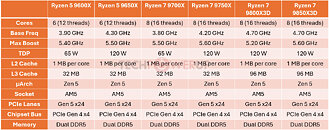 Next up, is the Ryzen 5 9650X. This is a 6-core/12-thread chip, and comes with a 4.30 GHz base frequency with a 5.50 GHz maximum boost, which are increased from the 3.90 GHz base and 5.40 GHz maximum boost frequencies of the current Ryzen 5 9600X. The chip has the full 32 MB on-die L3 cache available to the six cores, just like the 9600X does. There is no word on pricing, it's likely that the two will slightly displace the 9700X and 9600X, respectively, from their current prices.
Sources:
chi11eddog (Twitter), VideoCardz
The Ryzen 7 9750X is an 8-core/16-thread chip with a base frequency of 4.20 GHz with 5.60 GHz maximum boost frequency, a significant increase over the 3.80 GHz base and 5.50 GHz maximum boost frequency of the Ryzen 7 9700X. The 9750X comes with a 120 W TDP out of the box. In comparison, the 9700X comes with 65 W TDP out of the box, and AMD allowed motherboard vendors to provide a BIOS-based 105 W TDP mode that doesn't break warranty, designed to improve boost frequency residency. The 9750X not only comes with increased clocks, but also increases the TDP further, to 120 W from that BIOS-based 105 W TDP mode.

48 Comments on AMD Readies Ryzen 7 9750X and Ryzen 5 9650X Desktop Processors with Increased TDP
Of course most of us will fail to get the 33.666 USD required for the 32GB of DDR6...
These 9x50 CPUs just look like their 7x00 counterparts on the base clock side with a little boost clock uplift.
I expect those CPUs to draw significant more power in idle or under a more "normal" workload like office, browsing or anything that isn't "gaming" or benchmarking, while getting some things done faster cause of higher boost clocks.
So basicly an factory OC.
KS chips were binned and designed for overclocking. Yes almost identical to their K part, their TDP were the same as the non KS parts.
Don't get fooled by TDP. That in no way means actual power consumption, especially with modern AMD.
In my opinion the X on the 9700X is deceiving as it really is a 9700, the same way a 7700 is a lower TDP counterpart to the 7700X.
The 7700 has 65 W TDP / 88 W PPT, 3.8 GHz / 5.3 GHz Turbo
The 7700X has 105 W TDP / 142 W PPT, 4.5 GHz / 5.4 GHz Turbo
The 9700 has 65 W TDP / 88 W PPT, 3.8 GHz / 5.5 GHz Turbo
The 9750X has 120 W TDP / 162W PPT, 4.2 GHz / 5.6 GHz Turbo
The 120 W TDP / 162 W PPT is the same as on the 9900X. Overkill in my opinion as this much juice is not backed up by the compute power of the 9700X.
Based on older data and correlating with the latest 9850X3D review, the 245K should be about 2% better in app avg. compared to the 9700X.
www.techpowerup.com/review/amd-ryzen-7-9800x3d/27.html
A full PBO 9700X will have a 5.5% uplift and therefore manage to overtake the 245K by about 3.5% albeit consuming a lot more power.
www.techpowerup.com/review/amd-ryzen-7-9700x/23.html
This is the point, beating the 245K not the 250K as that will see 10% or a bit more uplift compared to the 245K.
Now my estimation is not at this absurd TDP, but mimicking the 7700X's settings.
What I did is I took these two pics:
tpucdn.com/review/amd-ryzen-7-9700x/images/power-applications-compare-vs-7700x.png
tpucdn.com/review/amd-ryzen-7-9700x/images/power-applications-compare-vs-7700.png
I scaled the 7700 bars to match the 9700X vs 7700X chart, then I lengthened the 9700X bars by the same % increase as from the 7700 to the 7700X. I know it's not 100% accurate but it's much more than ballpark. This what a true 9700X with 105 W TDP and 142 PPT would look like regarding power draw.
Averaging the results it would look like this:
7700 - 57 W
9700X - 61W
245K - 78 W
7700X - 86 W
9700X PBO - 92 W
It would beat the 245K by probably 2%.
But the CPU would be ruined as the power draw would be higher than the Intel opponent.
Thus extrapolating from this I say that the best balance for the 9700X is 80 W TDP and something like 110 W PPT. The current settings are too conservative for a X branded SKU.
Now AMD is going to the extreme with the 9750X, something like Raptor Lake flexing by melting air coolers and then AMD reacting: hold my beer.It was tested, max PBO.
Uplift was 5.5%.
Temps were nasty.
That's all i can say.