Friday, April 3rd 2026

MSI Intros Herald BE9400 PCIe Wi-Fi 7 Adapter
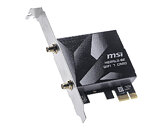
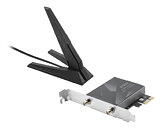
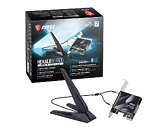
MSI today introduced the Herald BE9400, a PCIe network adapter that provides Wi-Fi 7 and Bluetooth 5.4 connectivity to any PC with a vacant PCIe slot and USB 2.0 header. The card supports 802.11be (Wi-Fi 7), 802.11axe (Wi-Fi 6E), 802.11ax (Wi-Fi 6), and older standards, across the 6 GHz, 5 GHz, and 2.4 GHz radio bands, with a peak Tri-Band bandwidth of 5764 Mbps. The adapter offers a channel width of 320 MHz. Other features include MLO (multi-link operation) and 4K QAM. Under the hood, the Herald BE9400 appears to be based on the MediaTek MT7927 controller, with a PCI-Express 4.0 x1 host interface. MSI includes an antenna module with a magnetized base that sits firmly on top of your PC case. The company didn't reveal pricing information.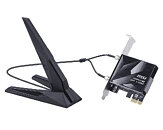


17 Comments on MSI Intros Herald BE9400 PCIe Wi-Fi 7 Adapter
I know the last adapter I had (years ago) came with both 2 & 4 ft leads, which could be connected together to yield a 6 ft length, and expanded it's placement flexibility considerably :)
While this is true. Its not as if you cant plug it in to any 4, 8, 12 or 16x slot.... It just takes up a slot that could have been reserved for something else that would make use of all the extra lanes.
Used to be every ATX board had 7 slots on it. Then it became 6 slots once we realized most GPUs were dual slot and the one directly under the primary went unused.
Now a lot of modern boards have only 2 slots. Sometimes 3, but not as often as you'd think.
The Gen4x1 slot has been around since X570 but, largely was regressed to gen3x1 on most PROM21 AM5 boards. Yet, provides roughly Gen3x2 / Gen2x4 bandwidth; well-more than sufficient even for full 10GbE.
TBQH.
Almost all ATX and mATX boards have at least 1x Gen3x1 slot. Which, while 'below spec' for such a card, is still (arguably) 'sufficient'.
ITX boards have wifi integrated most of the time (industrial motherboards, excepting)
Third party drivers are coming along, but not fully completed as yet.
From what I can tell, the MT7927 claim is just (a probably accurate) speculation based on reading the capabilities of the thing and the drivers for it, not an actual, official declaration from MSI.
As far as I recall, they've done it for every one of their NVMe SSDs I've seen over the past couple years.