Friday, April 24th 2026

Intel Z970 Chipset for "Nova Lake-S" to Cover Much of the B860 Motherboard Segment
Intel's upcoming "Nova Lake" Core Ultra 400 series processors will introduce not only a new CPU platform and socket but also a new motherboard chipset segmentation, unlike anything we have seen from Team Blue. According to a well-known leaker, Jaykihn, the new Z970 chipset platform is set to take over much of the space currently reserved for B860 motherboards. Meanwhile, B960 is expected to be positioned lower in the lineup as a value-focused option, often used by Intel's OEM partners for all-in-one builds or mini-PCs. This makes the Z970 the primary choice for a large share of "Nova Lake" builders, not just enthusiasts. Intel's higher-end Z990 boards are still expected to target the most demanding systems, while Z970 seems to bridge the gap between premium and mainstream desktop segments, incorporating many features that the Zx70 chipsets typically reserved from the Bx60 chipset ranges over the past few years.
The most likely scenario is that the Z970 will offer overclocking and wider I/O selection, while the Z990 will focus on more diverse expansion capabilities. The third entry-level B960 boards are expected to be starter NVL platform designs without overclocking support, intended to get the platform up and running with minimal I/O and SSD expansion. One of the biggest attractions of the Z970 would be CPU overclocking support, a key advantage over the B960, which is anticipated to be the more affordable option but without the same tuning flexibility. While the two chipsets may share similar baseline I/O features, motherboard manufacturers are likely to differentiate them through board design, port count, storage support, and overall feature set.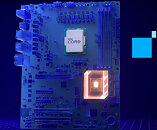 This could mean fewer M.2 slots, fewer PCIe slots, and reduced connectivity options on lower-cost models. Even so, the Z970 may become the more attractive choice for users who want a balance of features and flexibility without stepping up to Intel's top flagship chipset. Intel's 900-series lineup could therefore give motherboard makers more room to spread out products across premium and upper-mainstream tiers. We are waiting to hear more detailed product information and motherboard segmentation as we move closer to the late 2026 launch date. Perhaps getting the Z970 motherboard into more PCs is one of Intel's plans to provide more users with overclocking support and fine-tuning, a feature that the company is expanding on more CPUs as well.
Sources:
Jaykihn on X, via VideoCardz
The most likely scenario is that the Z970 will offer overclocking and wider I/O selection, while the Z990 will focus on more diverse expansion capabilities. The third entry-level B960 boards are expected to be starter NVL platform designs without overclocking support, intended to get the platform up and running with minimal I/O and SSD expansion. One of the biggest attractions of the Z970 would be CPU overclocking support, a key advantage over the B960, which is anticipated to be the more affordable option but without the same tuning flexibility. While the two chipsets may share similar baseline I/O features, motherboard manufacturers are likely to differentiate them through board design, port count, storage support, and overall feature set.

15 Comments on Intel Z970 Chipset for "Nova Lake-S" to Cover Much of the B860 Motherboard Segment
Got it.
@dj-electric
Exactly that.
This will be reserved for the W980 chipset, and if the past is any indication it will be with very limited availability. Probably limited to a board or two from Supermicro and Asus, except for embedded boards. And while the IO of the WS boards are much more flexible than their "enthusiast" counterparts, they usually cost nearly twice the base Z-series boards, making them fairly close to the cheaper Xeon W / Threadripper boards.
But having "ECC" without validation is pointless, so there is an extra cost for the manufacturer to do it right, although it technically have nothing to do with the south bridge, so it is artificial segmentation.
But the even bigger problem is the availability of unregistered ECC memory, which is a tiny niche compared to registered memory, and currently you'll have to pay way more to the point where a proper workstation appears more reasonable. I haven't seen any go past 5600 MHz either.
Exciting times!!
we also flip the pricing :-)
Did intel said if their next socket is a one generation or can one hope for two - the final frontier.
It was hard enough to just get my v-color udimm to run at 6000MT/s let alone 6400MT/s on AM5.
At their webpage they have one OC UDIMM kit which needs a whopping 1.4V (and presumably without clock-drivers), so good luck with running those stable 24-7. As well as constant memory retraining.
At the end of the day RAM is RAM and OC on ECC is not really any different but perhaps much harder to hit higher expectations than with non-ECC. I could get my 2666MT/s DDR4 Microns to 3200MT/s but not much farther without increasing latency or my Nemix 3200MT/s to 3600MT/s same deal. The nice thing with OC ECC is you will get some reporting when it's error correcting so you can back down your OC if it's too close to the edge. That's basically how I tested ECC was working on my AM4 systems with X series non-Pro CPU's.
According to Google AI JEDEC has updated standards to support up to 6400 MT/s (PC5-51200) for ECC RDIMMs. I'd love to try them but too expensive for me at this point.My V-Color DDR5 96GB (48GBx2) 6400MHz CL52 2Rx8 ECC 1.1V (running at 6000MT/s CL48) I readjusted timings back to spec at the lower speed since my CPU/MB couldn't seem to drive 6400MT/s. Running stable 24/7 for a long time now. No issue with memory training or context restore. Of course it's all unobtanium now. So sad.