Monday, May 11th 2026

AMD's DGF SuperCompression Shrinks Geometry File Size by 22%
Late last year, AMD released a paper introducing its new Dense Geometry Format (DGF) 3D graphics technology, designed to compete with NVIDIA's RTX Mega Geometry. Today, the company is unveiling DGF SuperCompression (DGFS), a new compression technique within the DGF graphics stack, which reduces game geometry file sizes by up to 22% compared to standard DGF. With DGFS, AMD aims to achieve an average 22% reduction in compressed game asset streams when GDeflate is applied. This results in significantly smaller asset sizes, allowing for larger games without the need for expanded storage. As games now often require hundreds of gigabytes of installation space, compressing storage formats is a key strategy to fit more games on your PC without immediately needing additional storage. A 22% reduction in file size through proprietary compression makes installation sizes much more manageable.
However, it's important to note that since DGFS is a compression format for DGF, the mesh stream array produced by DGFS must be decoded before the game can load it. It's similar to a ZIP file, which you can't use until it's unzipped. DGFS data will behave in the same way, residing only in PC storage, not in memory as it is not a component that will be directly processed by the GPU. AMD has developed a CPU-based decoding process that decodes the compressed DGFS assets in real time during asset streaming, which AMD claims "should be sufficiently fast." There are also potential GPU-based decoding solutions, suggesting we might see faster implementations in the future when it hits software SDKs.

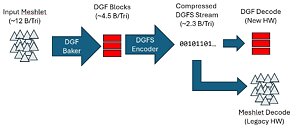 As a reminder, AMD initially introduced its block-based DGF geometry format as a way to significantly enhance geometric detail in 3D graphics, surpassing even current raster methods like tessellation. It achieves this by minimizing the resource footprint of geometry, packing small mesh pieces—up to 64 vertices and 64 triangles—into 128-byte blocks that serve as compact containers for geometry, vertex positions, and light topology. This technology operates on GPU hardware with specific geometry processing, and DGFS further compresses these files for efficient placement on SSDs or HDDs. AMD tested its DGFS features on a system with a Ryzen 9 7950X, 64 GB of DDR5-6000 RAM, and a Radeon RX 9070 XT GPU. This suggests that the RDNA 4 architecture will likely support the DGF graphics stack, without requiring RDNA 5 or UDNA IP to function.
Sources:
AMD, via VideoCardz
However, it's important to note that since DGFS is a compression format for DGF, the mesh stream array produced by DGFS must be decoded before the game can load it. It's similar to a ZIP file, which you can't use until it's unzipped. DGFS data will behave in the same way, residing only in PC storage, not in memory as it is not a component that will be directly processed by the GPU. AMD has developed a CPU-based decoding process that decodes the compressed DGFS assets in real time during asset streaming, which AMD claims "should be sufficiently fast." There are also potential GPU-based decoding solutions, suggesting we might see faster implementations in the future when it hits software SDKs.


19 Comments on AMD's DGF SuperCompression Shrinks Geometry File Size by 22%
They could use deflate with aggressive parameters and uncompress the entire game’s meshes to memory async or during loading screens and it would prolly work. I mean, y’all gamers should be on no-worry rigs with 32GB ram anyway.
ntfs is one of the worst disk space waste file systems in use. why etc. can be easily researched when you look in other operating systems.
Just saying that a big cause is windows itself. When windows would stop polluting everywhere lint files and also the applications that would help too.
-- It is a good AMD technology. The bigger impact would be if microsoft would reuse already in use technologies which the open source world and synology for example uses for years.
for myself it matters a lot that my main system has 15 to 25% disk gains over my backup with a very old outdated file system format.
weird management of resources
The assets need to be decompressed before they can be used to they will take op space in vram or ram
AMD does what it can, developers can and should do a lot regarding asset sizes.No, this is a native format the CPU will process. It is not decompressed in VRAM, otherwise it would be useless.
We already have that technology for asset streaming from disk.
AMD is said to be working on full compression inside the GPU. Currently it is mostly color data and texture data, maybe some geometry but I'm not sure.