Tuesday, May 19th 2026

AMD Readies Ryzen 7 7700X3D: Zen 4-based Gaming CPU with a Unique Value Proposition
AMD is giving finishing touches to the "new" Ryzen 7 7700X3D desktop processor. Powered by the older "Zen 4" microarchitecture and compatible with all Socket AM5 platforms with a UEFI firmware update, the 7700X3D is essentially a downclocked 7800X3D—the flagship gaming processor from the Ryzen 7000 series. It is designed to occupy a unique price-performance point between the Socket AM4-based Ryzen 7 5800X3D, which the company recently resurrected, and the current-generation Ryzen 7 9800X3D. The older 7800X3D remains EOL.
The Ryzen 7 7700X3D is an 8-core/16-thread processor, just like the 7800X3D, but comes with lower clock speeds of 4.00 GHz base, and maximum boost frequency of just 4.50 GHz. In comparison, the 7800X3D came with a 4.20 GHz base frequency, and 5.00 GHz boost. The 7700X3D comes with a proper 3D V-Cache implementation, with a total of 96 MB of last-level cache that seamlessly combines the 32 MB on-die L3 cache of the "Zen 4" chiplet with 64 MB of 3D V-Cache stacked on top. Each of the eight cores comes with 1 MB of L2 cache. The armed with larger caches and faster DDR5 memory, the Ryzen 7 7700X3D should be faster than the Ryzen 7 5800X3D in gaming workloads; it should be faster than even the regular Ryzen 7 7700X thanks to 3D V-Cache, but it should be a few percentage points slower than the 7800X3D, which in turn was about 5% slower than the 9800X3D, and about 9% slower than the latest 9850X3D.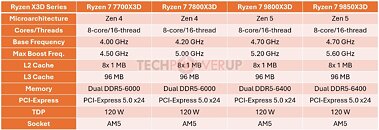
Sources:
chi11eddog (Twitter), VideoCardz
The Ryzen 7 7700X3D is an 8-core/16-thread processor, just like the 7800X3D, but comes with lower clock speeds of 4.00 GHz base, and maximum boost frequency of just 4.50 GHz. In comparison, the 7800X3D came with a 4.20 GHz base frequency, and 5.00 GHz boost. The 7700X3D comes with a proper 3D V-Cache implementation, with a total of 96 MB of last-level cache that seamlessly combines the 32 MB on-die L3 cache of the "Zen 4" chiplet with 64 MB of 3D V-Cache stacked on top. Each of the eight cores comes with 1 MB of L2 cache. The armed with larger caches and faster DDR5 memory, the Ryzen 7 7700X3D should be faster than the Ryzen 7 5800X3D in gaming workloads; it should be faster than even the regular Ryzen 7 7700X thanks to 3D V-Cache, but it should be a few percentage points slower than the 7800X3D, which in turn was about 5% slower than the 9800X3D, and about 9% slower than the latest 9850X3D.

59 Comments on AMD Readies Ryzen 7 7700X3D: Zen 4-based Gaming CPU with a Unique Value Proposition
Will probably never happen, but would be a nice upgrade for my am4 system.
Even today, AMD still sells ZEN3 and ZEN2 CPUs for laptops. Uninformed people buy these "new" laptops, thinking they are acquiring a new computer.
Feels weird to say 4.5GHz as low, but time flies. I still remember OC'ing any CPU (even P4) over 4GHz as amazing.
Still people do not care in buying 450 Watts, was it intel 14...K, what igorslab wrote in a big news piece, ignoring the power consumption of the motherboard, dram and nvme.
i admit i also bought am4 and am5 with much higher idle and much higher chipset consumption according to many people on tech forum and news sites.
I do agree those relative charts misses in brackets [123 Watts power consumed] or [123 Watts*] with the * later explained average power consumption etc etc. A bad comparison as motherboard features and brand will matter, but who cares. As the end Consumer it only matters what does computer a with amd needs vs computer b with intel in that tested configuration. Yes i will also complain than it is apples vs bananas as there would be hardly two similar amd and intel motherboards available for testing.
--
the intel 270k plus, or whawtever it is called, of course is the better choice for microsoft windows only with the more advanced motherboard features and more pcie lanes for peripherals. But only when you go full ATX. when you go for those newer pc cases with uatx motherboards intel looses the advantage.
--
if the 7700x3d is the power consumption winner? who knows? you will limit yourself to lower frequencies and that will bite you sooner than later.
Though 7700X3D will be 12-13% below 9800X3D in 720p gaming performance, 7700X3D's gaming efficiency will most likely be better than 7800X3D's.
videocardz.com/newz/amd-ryzen-7-5800x3d-10th-anniversary-edition-appears-in-india-for-around-310
7700X3D will be 12-13% slower than 9800X3D but much more efficient.
Who would buy 7700X3D for, let's say 350 € when they can purchase 9800X3D for just a bit more and gain significant (generational) performance bump?
Many e-shops still sell Ryzen 7800X3D. 2nd popular shop in Czechia has listed 7800X3D for 301 € incl. (20% VAT) (calculated from Czech currency).
Thats not going to drag the 5800X3D price regardless of the performance gap. The 5800X3D is aimed at AM4 users who fancy a finale of an upgrade without getting rinsed with the AM5 switch and more importantly, getting mugged in broad daylight by crazy DDR5 prices. Cheeky AMD knows theres plenty of AM4 owners who would overpay a fair bit of cash for some convenience. I wouldn't be surprised if the 5800X3D quickly shot up to £320 and beyond, basically over taking the 7700X3D and matching the 7800X3D's price.
let's see (this one EU shop is somehow cheaper rn than "more famous" COMPUTERUNIVERSE lmfao):
So my laughing part is always about AMD X3D line that you can get newer gen of non-x3d cheaper than prev gen x3d. So if 7700X3D will be cheaper (or at least SAME PRICE) than 9700X I'll be one who prays it. Otherwise it's a big ? mark....... OF SH...
(sorry I was same sarcastic about Intel i7-8086K overpricing too lol)
7700 is the Zen4 VIP and currently going for 170€ - which leaves quite a wide gap to Zen5 (9700X @ 255€).
50% higher price for 2-3% moar performance is hard to justify.
The 7700X3D is in relation to the 7800X3D what the 9800X3D is in relation to the 9850X3D.
So I could just apply the Rule of Three and be done really quick.
However when looking at the Max Boost clocks we have:
7700X3D - 4.5 GHz
7800X3D - 5.0 GHz (11.1% increase)
9800X3D - 5.2 GHz
9850X3D - 5.6 GHz (7.7% increase)
11.1 is 44.1% more than 7.7, therefore I should apply a 1.441 penalty amplifier to the difference between the 9850X3D and 9800X3D.
As such we get:
As for temperatures:
And finally power draw:
For the right price this could be a banger. A lean, mean, cool running fps machine.
However AMD could be shitty and give this less bang per buck/value than the 7800X3D thus forcing some people to shoot for the Zen5 parts if they can afford it.
The market could compensate for some of that and in the end this would end up being good in value but probably too close to the end of the year.
The ball's in AMD's court. :slap::nutkick:
If we go by those we have:
9850X3D - 5484 MHz for 8t and 5367 MHz for 16t (avg of three load types)
tpucdn.com/review/amd-ryzen-7-9850x3d/images/boost-clock-analysis.png
9800X3D - 5220 MHz for both 8t and 16t (avg of three load types)
tpucdn.com/review/amd-ryzen-7-9800x3d/images/boost-clock-analysis.png
7800X3D - 4889 MHz for 8t and 4875 MHz for 16t (avg of three load types)
tpucdn.com/review/amd-ryzen-7-7800x3d/images/boost-clock-analysis.png
In this case the 9850X3D has 5.06% / 2.82% higher frequency for 8t / 16t compared to the 9800X3D.
If the 7700X3D will have less than ~4550 MHz for 8t compared to the 7800X3D performance will likely suffer more than in my pessimistic estimation.
4889 is 7.45% more than 4550.
7.45 is 47.2% more than 5.06.
Of course this assumes linear scaling. Well actually it's closer to linear at lower frequency and it flattens out the higher you go, thus it seems correct when I say that downclocking the 7800X3D hurts more than overclocking the 9800X3D helps with.
Despite that, I'd still settle for 9800X3D instead, as I not only game but also work on my PC (audio conversion and RAW photos processing).
It's more future-proof and some software and emulators can really benefit AVX-512 support, but biggest advantage over 7800X3D is 10-15% increased IPC.
7700X3D will be roughly 18-20% slower in apps than 9800X3D and 2-3% slower than 7800X3D.
Then there is 3D cache placement change which vastly improves temperatures. 7800X3D (and 5800X3D) were kind of constrained because of top placement position.
Lastly, there are new instructions related to AI inference. Not useful for me, but for someone who does AI inference and also gaming, this might be crucial.
The price difference is 41%, but in terms of € it's not that much (in my opinion) given the above-mentioned.
I'd say "hype job" is more about 9800X3D vs. 9850X3D. That's totally burnt money.
But again, if strictly budget-oriented for gaming, 7800X3D is really good choice, especially for it's unmatched fps/W ratio.
9800X3D does audio media encoding really well (MP3 encoding performance is on par with 7950X - that's 8 vs 16 cores btw).
PCM (WAV) to FLAC, again, 9800X3D wins over 7950X. (openbenchmarking.org/test/pts/encode-flac)
Both 9950X and 9950X3D are weaker in gaming than 9800X3D. Slightly undervolted 9800X3D's power draw maxes out at 105W. You can't do that with 12 or 16 cores.
TL;DR: I would not underestimate 9800X3D. It's powerful processor for both gaming and apps and for today's 380 € it's a really good deal.
When apps are taken into account, only Intel 270K Plus (330 €) can beat it, but not in gaming.
9900X called, it's "only" 320 bucks and therefore more affordable than ze 9800X3D while beating it in applications.
The 9950X is suing for libel, because it's going for 425€, which is not even remotely 700€.
Considering that you get maybe 10% extra performance with the 9800X3D in the most extreme cases for double the power consumed and at a much higher price, I call the 7800X3D a much better overall CPU.Money thrown out of the window, imo.