Tuesday, May 19th 2026

AMD Launches EPYC 8005 Series Server CPUs with Up to 84 Zen 5 Cores
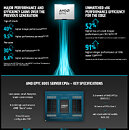
AMD has formally launched the EPYC 8005 series, codenamed "Sorano" after its announcement at MWC 2026 back in February, and now the full details are in. The new lineup succeeds the EPYC 8004 "Siena" family and sits between the high-end EPYC 9005 and the entry-level EPYC 4005, targeting single-socket low-power platforms with eight to 84 Zen 5 cores across a 95 W to 225 W TDP range. The flagship is the EPYC 8635P featuring 84 cores, 168 threads, 384 MB of L3 cache, and a 225 W TDP with a 1.6 GHz base clock. Compared to its 64-core EPYC 8004 predecessor, AMD claims 40% higher integer performance and 9.5% better performance per watt. Against Intel's 40-core Xeon 6716P-B at 235 W, it offers 2.1 times the core count (84 vs 40), a 10 W lower TDP (225 W vs 235 W), and 91% higher integer performance. AMD also claims 48% better integer performance per CPU watt per dollar versus Intel 72-core Xeon 6776P-B in a single-socket configuration.
The full lineup spans seven SKUs, from the 8-core EPYC 8025P at 95 W up to the 84-core 8635P at 225 W. All models are single-socket only and support six channels of DDR5-6400 ECC memory with up to 3 TB total capacity, 96 lanes of PCIe Gen 5, and full AVX-512 support. AMD is positioning the 8005 series around dense edge deployments and software-defined storage workloads. In those scenarios, core density, I/O bandwidth and power efficiency matter more than raw single-threaded performance.
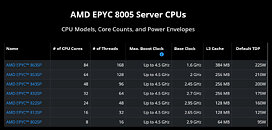 According to ServeTheHome, 1K unit list pricing starts at $529 for the eight-core EPYC 8025P and $729 for the 16-core EPYC 8125P. The 64-core EPYC 8535P is listed at $5,499, while the 84-core flagship EPYC 8635P comes in at $5,799.
Sources:
AMD Blog, EPYC Series (product page)
The full lineup spans seven SKUs, from the 8-core EPYC 8025P at 95 W up to the 84-core 8635P at 225 W. All models are single-socket only and support six channels of DDR5-6400 ECC memory with up to 3 TB total capacity, 96 lanes of PCIe Gen 5, and full AVX-512 support. AMD is positioning the 8005 series around dense edge deployments and software-defined storage workloads. In those scenarios, core density, I/O bandwidth and power efficiency matter more than raw single-threaded performance.


9 Comments on AMD Launches EPYC 8005 Series Server CPUs with Up to 84 Zen 5 Cores
something is fishy with that specification or the boost rates
desktop cpus struggle with 250 watts with 16 cores only, one fifth of those mentioned 84 cores
www.amd.com/en/products/processors/server/epyc/8005-series.html#specifications
www.amd.com/en/products/processors/server/epyc/8005-series/amd-epyc-8635p.html
The IO die eats a lot of the power, and like most cpus they will exceed tdp limits for turbo to some degree.
Feel free to elaborate how 250 Watts can work on 80 Cores.
if that is true that 80 cores can boost to 4.5ghz with 4 Watts each, why does my ryzen 7700x, previous ryzen 7600x needs much more? I did not bother yet measuring it, for sure in the 100-150 Watt territory for 6 or 8 cores.
That is the argument. the watt number is around factor 20 wrong or the cores are low clock cores to stay in the power budget.
i assume amd use smaller building blocks in server and consumer cpus. and the better ones go to the server segmetn. i highyl doubt there is a factor 20 difference in power consumption.
i did not pull out the igorslab claim of 450 watt for a intel desktop cpu + motherboard + dram consumption. I could have compared that also. Wahtever a 14...k intel cpu has for core count.
-- just look at the core count + base clock and you will see a pattern, all in the picture above in the news piece
- TDP is not itself consumption.
- Epyc 8000 series use compact cores, which are denser cores, hence the "c" in Zen5c, they are physically smaller and more efficient than regular Zen cores.
- Ryzen 7000X, specially X variants do consume a lot more than necessary because of the boost behavior, you can check Ryzen 9 7950X3D consumes a lot less than 7950X when comparing both stock, but the difference in performance for multithread is not even near the difference of consumption. Ryzen 9 7900 vs 7900X shows another thing like this, as 7900 consumes less than half in full load compared to 7900 and sure, does not reach only half the performance.
100-150 is not territory for only 6/8 cores... that's not how things work.