Friday, May 29th 2026

Microsoft and NVIDIA Jointly Tease Possible N1X Debut as a "New Era of PC"
Microsoft and NVIDIA, through their X handles, each teased "A new era of PC," along with the map coordinates "25.0528, 121.5990," which correspond to the Nangang Exhibition Centre, the seat of Computex 2026. If it wasn't obvious already, NVIDIA is announcing its much awaited N1X client PC processor, and it has the full blessings of Microsoft to power Windows 11 AI PCs with full Copilot+ acceleration. The N1X is widely expected to get NVIDIA to supplant Qualcomm's Snapdragon X2 Elite series as the fastest Arm-based processor for Windows, powering experiences on par with high-end x86-64 PC processors from Intel and AMD.
NVIDIA is allegedly building the N1X on the TSMC 3 nm foundry node. The latest leaks hold the chip to be a 20-core processor, with an Arm big.LITTLE configuration of 10 performance cores, and 10 efficiency cores. All 20 cores are custom-designed by NVIDIA, and based on the Arm v9.2 machine architecture. The CPU complex is expected to feature 32 MB of shared, last-level cache. The star attraction here is the iGPU that allegedly doubles up as an NPU. Based on the "Blackwell" graphics architecture, the iGPU is expected to feature up to 48 streaming multiprocessors (SM) for 6,144 CUDA cores, and performance possibly comparable to the discrete GeForce RTX 5060 Ti. The chip will feature LPDDR5X interface, with a unified memory architecture. NVIDIA's plan is to outclass Apple M5 Pro and AMD Ryzen AI Max 400. There's nothing in this class from Intel, unless the company decides to build chips with large iGPUs based on its Xe3 "Celestial" architecture.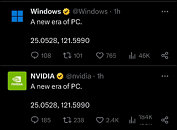
Sources:
Microsoft Windows (Twitter), NVIDIA (Twitter), Anthony B (Twitter)
NVIDIA is allegedly building the N1X on the TSMC 3 nm foundry node. The latest leaks hold the chip to be a 20-core processor, with an Arm big.LITTLE configuration of 10 performance cores, and 10 efficiency cores. All 20 cores are custom-designed by NVIDIA, and based on the Arm v9.2 machine architecture. The CPU complex is expected to feature 32 MB of shared, last-level cache. The star attraction here is the iGPU that allegedly doubles up as an NPU. Based on the "Blackwell" graphics architecture, the iGPU is expected to feature up to 48 streaming multiprocessors (SM) for 6,144 CUDA cores, and performance possibly comparable to the discrete GeForce RTX 5060 Ti. The chip will feature LPDDR5X interface, with a unified memory architecture. NVIDIA's plan is to outclass Apple M5 Pro and AMD Ryzen AI Max 400. There's nothing in this class from Intel, unless the company decides to build chips with large iGPUs based on its Xe3 "Celestial" architecture.

90 Comments on Microsoft and NVIDIA Jointly Tease Possible N1X Debut as a "New Era of PC"
No thank you
Also, my iPhone 17PM is pretty strong, and the battery is in tents.
primarily refers to recent Windows 11 update failures, most notably error code 0x800F922 or 0x800F092.
I think Nvidia should try again this time round, there's a certain giant hole in the ground where the White House East Wing used to stand that still need a ballroom.People have been saying this for YEARS, for more than 20 years to be precise. And yet here we are, Microsoft Windows is still the dominant operating system for personal computers.
If Windows ME or Windows Vista which are two of the worst versions of Windows are not bad enough for most people to swap to Linux, then Windows 11 is certainly not going to do it either.
But if it succeeds, it won't be a good thing. We know Nvidia's business practices. Throwing money left and right, exclusive technologies incompatible with other manufacturers' hardware, and blocking the competition in various ways. However, if it succeeds, it won't be long before desktop motherboards appear in 5–10 years featuring an exclusive Nvidia interface for connecting the graphics card, which will offer advantages not supported by PCIe.
Latest NVIDIA 610.47 WHQL Packs DLSS 5 Neural Rendering Profile Settings
www.techpowerup.com/349403/latest-nvidia-610-47-whql-packs-dlss-5-neural-rendering-profile-settingsNVIDIA Now Reports GeForce Gaming GPU Revenue Under "Edge Computing"
www.techpowerup.com/349255/nvidia-now-reports-geforce-gaming-gpu-revenue-under-edge-computing*and neither will we*
Yes you are!
So you hate duopolies, while defending fiercely monopolies. How cute!Oh, I am sorry. You are defending two monopolies, not just one. My bad.
2.- While not necessarily making a point to say "you're wrong", this part is more of a note to make: Drivers for new GPUs on Linux do take a bit to get good, due to them being open source while not receiving help from the hardware manufacturers (though last I heard mesa is now going to be getting help from AMD, who are dropping their proprietary drivers). You can see benchmarks for RDNA2 hardware where it does end up performing better on Linux, and cpu limited benchmarks (say, old games) do also often see Linux performing better. Can't say anything about nvidia drivers, however, those simply don't perform.
Here is a benchmark for an older game on Windows vs Linux:
For a more modern game that can (though as always is still a case by case basis) see itself leaning more towards Linux in a GPU limited scenario, see here:
You can also see intel Arc performance generally (though of course not all the time) improving when going from Windows to Linux, alongside some amusing nvidia driver bugs.
At the end of the day it does fluctuate from game to game and computer to computer, but at the same time, for game performance to be this close, and at times be better, while running through one or multiple compatibility layers, is pretty interesting.Yeah, here's to hoping that microsoft can do it.
I bet they have a roadmap for this that starts with a reasonably powerful laptop and ends years down the road with what amounts to a terminal where you pay a subscription to use a machine that is actually capable of doing anything substantial. We the plebs own nothing; that is the future they want. A return to a feudalism of sorts where the wealthy owners control everything and everyone else serves at their pleasure.
Yes, GPUs are harder to break into than CPUs because the software ecosystem matters just as much as the hardware, but saying Qualcomm is incompetent, or that AMD and Intel simply "don't want to do the work", feels a bit unfair.
ARM licensing lowers the barrier to entry, but building a competitive CPU is still incredibly difficult. Otherwise we'd have a lot more companies competing with Apple.
I also don't buy the idea that ARM on desktop needs AMD or Nvidia to succeed. Apple already proved ARM can work extremely well on laptops and desktops. Windows on ARM's biggest challenge is software compatibility and ecosystem adoption, not just GPU performance.
As for Nvidia, they absolutely deserve credit for investing heavily in drivers, developer tools, CUDA, and long-term software support. But their dominance isn't just because everyone else is lazy or incompetent. There are a lot of technical, business, and historical factors involved.
Overall, there are some valid points in your post, but it reads more like a strong opinion than an objective analysis.