Friday, May 29th 2026

Microsoft and NVIDIA Jointly Tease Possible N1X Debut as a "New Era of PC"
Microsoft and NVIDIA, through their X handles, each teased "A new era of PC," along with the map coordinates "25.0528, 121.5990," which correspond to the Nangang Exhibition Centre, the seat of Computex 2026. If it wasn't obvious already, NVIDIA is announcing its much awaited N1X client PC processor, and it has the full blessings of Microsoft to power Windows 11 AI PCs with full Copilot+ acceleration. The N1X is widely expected to get NVIDIA to supplant Qualcomm's Snapdragon X2 Elite series as the fastest Arm-based processor for Windows, powering experiences on par with high-end x86-64 PC processors from Intel and AMD.
NVIDIA is allegedly building the N1X on the TSMC 3 nm foundry node. The latest leaks hold the chip to be a 20-core processor, with an Arm big.LITTLE configuration of 10 performance cores, and 10 efficiency cores. All 20 cores are custom-designed by NVIDIA, and based on the Arm v9.2 machine architecture. The CPU complex is expected to feature 32 MB of shared, last-level cache. The star attraction here is the iGPU that allegedly doubles up as an NPU. Based on the "Blackwell" graphics architecture, the iGPU is expected to feature up to 48 streaming multiprocessors (SM) for 6,144 CUDA cores, and performance possibly comparable to the discrete GeForce RTX 5060 Ti. The chip will feature LPDDR5X interface, with a unified memory architecture. NVIDIA's plan is to outclass Apple M5 Pro and AMD Ryzen AI Max 400. There's nothing in this class from Intel, unless the company decides to build chips with large iGPUs based on its Xe3 "Celestial" architecture.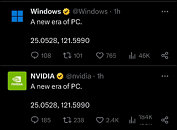
Sources:
Microsoft Windows (Twitter), NVIDIA (Twitter), Anthony B (Twitter)
NVIDIA is allegedly building the N1X on the TSMC 3 nm foundry node. The latest leaks hold the chip to be a 20-core processor, with an Arm big.LITTLE configuration of 10 performance cores, and 10 efficiency cores. All 20 cores are custom-designed by NVIDIA, and based on the Arm v9.2 machine architecture. The CPU complex is expected to feature 32 MB of shared, last-level cache. The star attraction here is the iGPU that allegedly doubles up as an NPU. Based on the "Blackwell" graphics architecture, the iGPU is expected to feature up to 48 streaming multiprocessors (SM) for 6,144 CUDA cores, and performance possibly comparable to the discrete GeForce RTX 5060 Ti. The chip will feature LPDDR5X interface, with a unified memory architecture. NVIDIA's plan is to outclass Apple M5 Pro and AMD Ryzen AI Max 400. There's nothing in this class from Intel, unless the company decides to build chips with large iGPUs based on its Xe3 "Celestial" architecture.

90 Comments on Microsoft and NVIDIA Jointly Tease Possible N1X Debut as a "New Era of PC"
Having memory on die might save a little bit of power, but I don't think it's that great of savings.
And since this topic is about the N1X, this is based on the same GB10 of the DGX Spark. That's NOT a low power design by any means, even without the Connect-X don't expect it to have stellar long battery life.3/400 series from AMD are as efficient as PTL.
Also, the CPU themselves are pretty much as efficient. When you're talking about battery life, the CPU itself is often not the culprit, but rather the overall SoC around it. Qcom and Apple have a pretty tight design (the former sells a pretty expensive package with their own PMICs and whatnot, and the latter does everything in-house), whereas Intel and AMD just leave their partners to implement it however they want, hence why the same x86 CPU in different laptops with similar specs can have a widely different battery life.
And it's always good to remind: ISA has NOTHING to do with performance or efficiency.The DGX Spark has full Linux support (and only supports Linux) and uses the same open source kernel driver as the desktop parts. This N1X is based on the same GB10 of the Spark, so I think it's a fair assumption to say yes to that question.
An ARM laptop will be in a different league when it comes to energy efficiency and quietness.
It would be nice if things change and Linux becomes the dominant work OS, but since it's a monopoly and set in stone, it won't happen, unless somehow M$ goes bankrupt, for whatever reason.
It's already a huge ask to get the steam library working in Linux. You think trying to game on ARM is going to be as easy?
Efficiency? Sure. But in no capacity is arm faster than the best x86 has to offer. And you can't point at mac as "evidence" because that chip series has more onboard memory cache than anything x86, even x3d, so cheating really at the arch IPC comparison.
Especially with the investments that Valve made + NPUs + lots of ML-based algos; The ground work for the era of VR has been laid down and we're 10-15 years before getting something like in the 'Ready Player One'.
It's already somewhat possible, just out of my price range.
Apple's ARM has lots of extensions to it, as qualcom's, mediatek's does. It's the same base, but it can differ significantly in terms of pipelines used. (Correct me, if I'm wrong on this)
SteamOS and deck are niche market that isn't even 1% of gaming, let alone, MS Windows business.CUDA lock-in is so much weaker in 2026.
Ollama natively supports Vulkan.
AMD's "Amuse" is the most polished desktop AI image gen tool that I've ever touched.
All major libs have native AMD versions for quite some time.
And then there is this on top:
techstrong.ai/features/claude-code-ports-nvidia-cuda-to-amd-rocm-in-30-minutes/
But full cross compatibility is far awayLol!!
Some ARM-based processors are designed to be installed in sockets, similar to traditional desktop and server x86 CPUs:
Server processors such as Ampere Computing's Altra and Altra Max use large server sockets on motherboards.
Some development and embedded systems use ARM modules or socketed processor cards that can be replaced or upgraded.
Historically, several ARM-based single-board computers and industrial systems have used removable CPU modules.
But for consumer grade Products, the CPU usually comes in a BGA (Ball Grid Array) package soldered directly to the motherboard.
As for Nvidia's splash into the desktop market, but there's a reason why Nvidia has delayed their N1X chips for a while. Nvidia's DGX Spark did not set the world on fire. It costed $4k while using a lot of power, and barely outperforming AMD's Strix Halo. Even then, it's still CUDA that gives these machines an edge over AMD.
Now, in the working world things are indeed different, but even then, most corporate environments are wanting actively-supported code for their users. You are correct in some ways, but the need for legacy code support is more the exception than the rule now in terms of raw overall numbers. You can call people names if that helps you feel better, but perhaps the millions of Apple customers you so disparage don’t actually care about particular features that matter to you. You need legacy support, and that’s fine, but what’s the point of insulting people who are also just buying what they prefer?