Thursday, July 2nd 2026

NVIDIA GeForce RTX 5090D Overclocked to 4 GHz with Liquid Nitrogen
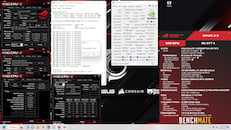
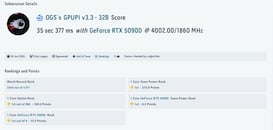
Thanks to an incredible feat by Team OGS, NVIDIA's "Blackwell" GPU architecture has finally breached the 4 GHz mark with the help of liquid nitrogen. Using the GALAX GeForce RTX 5090D Hall of Fame OC Lab Edition GPU, the team pushed the core GPU clock of the GB202 SKU to 4,002 MHz, while the memory was running at 1,860 MHz. The HWBOT submission shows that the 4 GHz run was validated with GPUPI v3.3 32B benchmarks, which were active for 35.377 seconds, crunching compute and loading the GPU, but without any 3D workloads. This allowed the GPU to boost higher than it usually would when running any 3D task like a game.
Additionally, this configuration used an external clock board from Elmor, which was set at 28.7 MHz. The remaining platform configurations include an Intel Core i9-14900KF running at 6.0 GHz on an ASUS ROG Maximus Z790 Apex Encore motherboard, 32 GB of memory, and a 3,000 W Corsair WS3000 power supply. In the video below, you can see the demo running live at 4 GHz.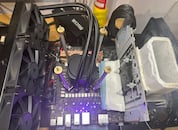
Sources:
HWBOT, via VideoCardz
Additionally, this configuration used an external clock board from Elmor, which was set at 28.7 MHz. The remaining platform configurations include an Intel Core i9-14900KF running at 6.0 GHz on an ASUS ROG Maximus Z790 Apex Encore motherboard, 32 GB of memory, and a 3,000 W Corsair WS3000 power supply. In the video below, you can see the demo running live at 4 GHz.


11 Comments on NVIDIA GeForce RTX 5090D Overclocked to 4 GHz with Liquid Nitrogen
This "record" really makes just about as much sense as a "fastest car in a freefall". No 3D workload? Then it's basically not on at all.
Hardware is getting to expensive to be doing that. IMO.
After this version nvidia lowered overclocking potential across all blackwell gpus.
All in all pathetic
Yes, knowing your limit is useful for being able to identify eventual stability. But otherwise useless and doesn't give you bragging rights IMO.
But I know my view on this is not widely shared in the community.
It's like tuning a Honda B18 engine to 1500Hp, running it for 30seconds before blowing up and then claiming you had the most powerful B18 for 30seconds.
Intel, AMD, NVIDIA, ASUS, MSI, Gigabyte, ASRock, GALAX, Corsair, G.Skill, Kingston, TeamGroup, ADATA, and pretty much every memory manufacturer has celebrated LN2 world records, max-frequency validations, and benchmark records for years. It's marketing, and everyone does it.
Trying to turn a NVIDIA overclocking article into "AMD fanboys did it too" misses the point entirely. Either you think these extreme OC demonstrations are interesting, or you don't. The vendor doesn't change the argument.