Friday, July 3rd 2026

Samsung Readies SSD 990 Value Gen 4 NVMe SSD
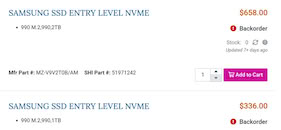
Samsung is giving finishing touches to the SSD 990, a new upcoming M.2 NVMe Gen 4 SSD taking up the value end of the company's client SSD lineup. The 990 is not to be confused with the 990 EVO Plus, which was the company's DRAMless performance-segment SSD for PCIe Gen 4 generation. What segments the new 990 from the 990 EVO Plus is probably the NAND flash type (QLC vs. TLC), and an updated controller on the 990. While the 990 EVO Plus came with a Gen 4 x4 or Gen 5 x2 interface, the 990 is squarely Gen 4 x4. References to the Samsung 990 briefly surfaced on Samsung's Canadian website, before being removed, but VideoCardz grabbed some screenshots.
The Samsung 990 is, predictably, a DRAMless drive, which uses an in-house controller from Samsung. The drive is noted as offering lower write endurance than the 990 EVO Plus, which uses TLC NAND flash, so it's possible that the drive uses QLC NAND flash. The 1 TB model is shown offering 400 TBW write endurance, while the 2 TB variant offers 800 TBW. In terms of performance, both variants offer sequential transfer speeds in the upper band of PCIe Gen 4 era, with up to 7250 MB/s sequential reads for the 2 TB variant, up to 7150 MB/s for the 1 TB variant; and both variants offering up to 6450 MB/s sequential writes.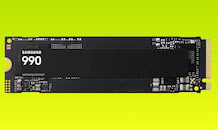
Source:
VideoCardz
The Samsung 990 is, predictably, a DRAMless drive, which uses an in-house controller from Samsung. The drive is noted as offering lower write endurance than the 990 EVO Plus, which uses TLC NAND flash, so it's possible that the drive uses QLC NAND flash. The 1 TB model is shown offering 400 TBW write endurance, while the 2 TB variant offers 800 TBW. In terms of performance, both variants offer sequential transfer speeds in the upper band of PCIe Gen 4 era, with up to 7250 MB/s sequential reads for the 2 TB variant, up to 7150 MB/s for the 1 TB variant; and both variants offering up to 6450 MB/s sequential writes.


67 Comments on Samsung Readies SSD 990 Value Gen 4 NVMe SSD
And you probably don't need to buy such large SSDs either, and in these pressing times there's a better solution;
1x ~500 GB for the OS
1x 1-2 TB for a game drive (if needed)
1x 1-2 TB for scratch space, if you do work, simulations, content creation, etc.
and the rest as HDDs, either internal, external or through a file server.
But don't buy those crappy WD MyBook/MyPassport, buy instead the WD Gold/Ultrastar series. I just managed to score one WD Gold 22 TB at below current MSRP.You forgot the snail speed mode™ which kicks in after a while!
Regards,
Fred.
As for larger HDDs, Toshiba NAS/MG series has been working fine for me.
No. I based my assessment on the NVMe's specifications and compared them with the drives I have in my system—the Lexar NM710 and NM790. The latter falls into the upper mid-range category. When you compare the specs, the "entry-level" label Samsung uses for the time being actually seems accurate.
Let's be realistic: the "CoreParts" NVMe mentioned above—and similar drives—can't really be used for comparison. That applies even to drives from well-known manufacturers that have essentially been sitting in a warehouse for a decade.
Regards,
Fred.
I still have one 1TB 980 Pro and an 4TB 990 EVO Plus sitting in a box after picking a load of the 990 E.P for around £200-208 in 2025. Not to mention 4 or 5 other SSDs that have been in and out of use. I gave a 4TB Acer one to my dad because I had too many and he was still using an old 1TB spinning hard drive.
Its crazy to think that I only purchased the samsungs back around September 2025 and now the price is over double what I paid. I never predicted the market would blow up this way and so fast. I thought I was buying stuff I didnt really need but the price was cheap for a samsung so I bought a few just in case.
I dont know if they are going to get stingy with cashback now... From what Ive read (and also personal experience). Asus tends to be the worst when it comes to getting money back with their cashback promotions when it comes to europe.
Current Samsung SSD are no different from Gold prices, 2TB is near $800.
Any higher will cross the $1k mark.
Sorry Samsung I will boycott you until you make SSD cheaper.
Not every user need Gen 4 spec, Gen 3 is more than enough for most users.
I also wouldn't say that QLC should be avoided at all costs, it's still MANY times faster than spinning rust, and for most consumers, it will be fine, and it should last at least as long as the warranty on the drivemost people don't want HDDs anymore, they run hot and are noisy, and are pretty expensive themselves and the bigger they are, the more backup you need
The 22TB Ultrastar runs at $800, the Gold is $900 (US), and even below this price, it's still super expensive for most people www.newegg.com/p/pl?d=wd+gold
A 4TB Ultrastar goes for $270 (US) www.newegg.com/wd-ultrastar-dc-hc310-0b35950-4tb/p/N82E16822234363
that is way too expensive for most people for what you get, and a QLC SSD would be a better bang for the buck device for most people
If you are a prosumer, that is a different story
But I suppose forums will be banned soon—too much information that harms the economy. /s
But I don't think we're the target audience.
The companies buying 1,000 laptops at a time will buy them regardless.
The hardware hobby has lost its appeal for me.
Just as well; I'll save my money for sweets or a used motorcycle.
By the way, I just noticed this;
Enclosed;
ComputerBase (de)
Regards,
Fred.
The Chinese companies are no saints either, the costs for them are also rising, YMTC is perhaps the biggest maker of NAND there, but the prices are not much different from the rest
the demand is just too great, and we have to wait for a AI company to go bust, then, there will be a ton of things that fall in price
My argument is to go for smaller, faster and more reliable SSDs plus HDDs for long-term storage. It is cheaper overall, regardless of whether a person needs less than 4 TB, or tens of TBs. And SSDs are not suitable for long-term storage.
And those who don't have a lot of data to store, don't have a need for large SSDs anyways.Irrelevant.
The more data you have, the more backup you need, regardless of the storage device.
Any data worth keeping, should be kept in at least three different devices.
Some of the cheapest 2TB options right now seem to be the Acer GM7000 (if you dare) on amazon.de and the Crucial T710 (if you don't hate) on amazon.es. Sandisk Optimus has already had its prices "optimüsed".
Samsung was one of the first makers to use planar TLC with tiny transistors in actual (non-lab/prototype) products in popular (very hyped because of brand) 840 Evo...
Which then needed firmware updates making controller refresh cells frequently to prevent bits from "evaporating" and drive slowing to crawl when error corrections were doing overtime to reconstruct data asked from the drive.