Friday, July 3rd 2026

Samsung Readies SSD 990 Value Gen 4 NVMe SSD
Samsung is giving finishing touches to the SSD 990, a new upcoming M.2 NVMe Gen 4 SSD taking up the value end of the company's client SSD lineup. The 990 is not to be confused with the 990 EVO Plus, which was the company's DRAMless performance-segment SSD for PCIe Gen 4 generation. What segments the new 990 from the 990 EVO Plus is probably the NAND flash type (QLC vs. TLC), and an updated controller on the 990. While the 990 EVO Plus came with a Gen 4 x4 or Gen 5 x2 interface, the 990 is squarely Gen 4 x4. References to the Samsung 990 briefly surfaced on Samsung's Canadian website, before being removed, but VideoCardz grabbed some screenshots.
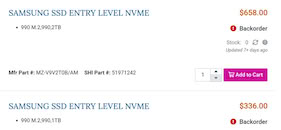
The Samsung 990 is, predictably, a DRAMless drive, which uses an in-house controller from Samsung. The drive is noted as offering lower write endurance than the 990 EVO Plus, which uses TLC NAND flash, so it's possible that the drive uses QLC NAND flash. The 1 TB model is shown offering 400 TBW write endurance, while the 2 TB variant offers 800 TBW. In terms of performance, both variants offer sequential transfer speeds in the upper band of PCIe Gen 4 era, with up to 7250 MB/s sequential reads for the 2 TB variant, up to 7150 MB/s for the 1 TB variant; and both variants offering up to 6450 MB/s sequential writes.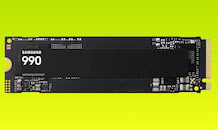
Source:
VideoCardz
The Samsung 990 is, predictably, a DRAMless drive, which uses an in-house controller from Samsung. The drive is noted as offering lower write endurance than the 990 EVO Plus, which uses TLC NAND flash, so it's possible that the drive uses QLC NAND flash. The 1 TB model is shown offering 400 TBW write endurance, while the 2 TB variant offers 800 TBW. In terms of performance, both variants offer sequential transfer speeds in the upper band of PCIe Gen 4 era, with up to 7250 MB/s sequential reads for the 2 TB variant, up to 7150 MB/s for the 1 TB variant; and both variants offering up to 6450 MB/s sequential writes.


67 Comments on Samsung Readies SSD 990 Value Gen 4 NVMe SSD
They've offered plenty of models with fatally-bad, or abysmally poor performance. Their early TLC stuff suffered from voltage drift and firmware bugs, their QVO stuff was (and still is) some of the slowest product on the market, and there are plenty of reports of drives failing, having burnt through their pitiful endurance ratings.
1 year ago, those 1TB QLC junks were selling for ~100$. Now x3.36 times more?!?! Yeah right...
I've stayed away from both 980 Pro and 990 Pro due to severe firmware issues causing premature wear or even failure, which has happened several times for both of them. (Haven't heard anything bad about the 9100 Pro yet though.) They also have a terrible reputation when it comes to warranties...
And don't get me started on the 870 Evo, I can't believe they still get away selling that crap.
Have they released anything good for the consumer segment since the venerable 970 Pro?
old models TLC m.2.
Samsung SSD 990 Review: "Affordable" Efficiency Between Evo and Pro?
ComputerBase (de)
Fred.
I have 5-year old spinning rust that writes faster than that...
I'm not really surprised though, Samsung's low-end SSDs have been dreadful for several generations now. You avoid them because there's overwhelming evidence they're bad and literally thousands of reviews showing the world how just about anything else is better use of the same budget.
I don't advocate for spinning rust but when the garbage-tier QLC drives are slower, it's really driving home how shit low-end QLC really is. It's only good as a second drive for something like a Steam library where the content only arrives via slow internet and the burst SSD performance is useful for patching.
that qvo drive was max like a spinner drive too the most I seen was like 230 some briefly. sucks I never got any disk health screenshots of it cuz I didn't check that stuff much back then. I can't look at the drive since it went read only and then dropped out completely, not even bios seen it. I got pissed and broke it and smashed it to smithereens and put the peices in 3 different trash weeks. so good luck finding it lol.
Most don't realize how little space an OS actually needs, and if money is tight, 250 GB is more than plenty for even most Windows users.There are options to have large storage pools with SSD caches like that, especially using ZFS or Btrfs, and fits certain workloads well, but can also result in sub-optimal performance, high maintenance, high resource requirements(RAM, CPU) and have various disastrous pitfalls.
A simpler solution of having just simple RAID1 or 1+0 HDD setups + SSDs in separate volumes (e.g. scratch space for work, OS, games) will result in more consistent performance, and is much easier to maintain.I wouldn't wish them upon anyone.
I'd recommend some suspicious used enterprise drive off eBay before this load of crap.
EoL for enterprise hardware isn't EoL for personal use :D
A KINGSTON SNVS2000GB 2 TB (Really slow write speed after SLC cache is full, around 40 MB/s).
And an Acer FA200 4 TB (i got it for under 200 € just before the SSD Price hike). The Acer one is on my Raspberry 5 as an USB Drive and i use it as a mini-NAS because my Raspberry is always on. It has decent write speeds around 200 MB/s as the lowest, so write speed doesn't even matter in this scenario.