Thursday, September 3rd 2026

Samsung Leads NAND Market as Prices Climb 55% in a Single Quarter
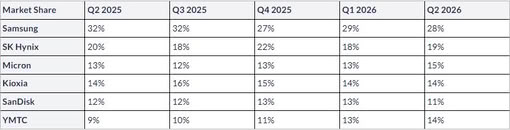
The latest NAND market share data from Counterpoint Research shows just how far prices have risen in 2026. The global NAND market grew 70% quarter-over-quarter in Q2, following 90% growth in Q1. This is driven almost entirely by rising prices rather than higher shipments. NAND contract prices climbed 55% QoQ in Q2 alone, which lines up with earlier TrendForce estimates pointing to a 70-75% jump over the same stretch. Samsung held onto the top spot with 28% revenue share, down slightly from 29% in Q1 and 32% a year earlier, while SK hynix sits second at 19% and Micron rounds out the top three at 15%, helped along by high selling prices.
The surge traces back to AI infrastructure eating up NAND supply that would otherwise go toward consumer SSDs. Enterprise and hyperscale buyers are stockpiling high-capacity flash for AI servers, and manufacturers have leaned into that shift since it carries far better margins than retail drives. That's left less capacity for client SSDs, and it's part of why consumer drive prices keep climbing even as shipment volumes stay flat. China's YMTC is one of the more interesting movers here, growing from a 9% share a year ago to 14% in Q2, likely picking up volume as the bigger three chase their most profitable enterprise orders instead. Most forecasts still put meaningful price stabilization sometime in 2027, since new NAND capacity takes years to bring online and AI demand shows no sign of slowing.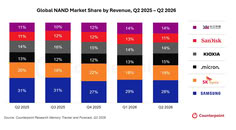
Source:
Counterpoint Research
The surge traces back to AI infrastructure eating up NAND supply that would otherwise go toward consumer SSDs. Enterprise and hyperscale buyers are stockpiling high-capacity flash for AI servers, and manufacturers have leaned into that shift since it carries far better margins than retail drives. That's left less capacity for client SSDs, and it's part of why consumer drive prices keep climbing even as shipment volumes stay flat. China's YMTC is one of the more interesting movers here, growing from a 9% share a year ago to 14% in Q2, likely picking up volume as the bigger three chase their most profitable enterprise orders instead. Most forecasts still put meaningful price stabilization sometime in 2027, since new NAND capacity takes years to bring online and AI demand shows no sign of slowing.


12 Comments on Samsung Leads NAND Market as Prices Climb 55% in a Single Quarter
Remember that a lot of corporate AI infrastructure is going into AI systems for proprietary research and business operations. FedEx was an early adopter of AI for delivery truck route planning. The financial industry was also an early adopter of AI for things like fraud detection. Neither are running consumer-facing AI chatbots.
Google themselves started using AI years ago for automated image captioning at first.
While the consumer-facing AI chatbot services get much of the public visibility and vilification, there are other AI pursuits like AlphaFold that aren't consumer facing. AI is also accelerating a lot of medical and pharmaceutical research in things like drug discovery, prosthetics development, and more.
It's not just about generating AI girlfriends to post on TikTok, Instagram, etc. or fill up YouTube Shorts with slop. My guess is that some of the consumer-facing services and functionality will go out of style but most of the corporate stuff will stay and even expand. I know there are restaurant managers and chefs who are eagerly awaiting the day where some AI assistant will do shift scheduling for them (it's one of the most hated tasks for any manager in the hospitality and service industries).
We're all consumers, even the guys running the big AI accelerators. That Amazon Fire tablet they want to give to their kid at Christmas is now way more expensive than a year ago. The people building these massive systems don't want to pay more for what they install in their server rooms. They have to because of the limited supply of components. Why would anyone running an AI service/chatbot/research facility/whatever want their costs to increase?
The chipmakers and associated companies (like UV lithography equipment manufacturers) are the only ones happy right now. And they're still leaving money on the table because they don't have enough capacity. A new chip foundry is about $10-20 billion these days and takes about 5 years to bring online. The semiconductor industry is rightfully cautious about building these facilities because no one wants to idle a $20 billion foundry if the supply-demand situation quickly changes.
So high NAND and DRAM prices are going to persist, probably for 5 years and will then plateau. We aren't going to see prices crashing back down to 2024 levels because the Fortune 500 is going to use AI for their own internal business operations -- not running consumer chatbots.
And it's not just about NAND and DRAM price increases. Even things like PCBs are more expensive because some of the raw materials used for their manufacture typically pass through the Strait of Hormuz. Chemicals used to make fertilizer go through that channel too. There are other weird semiconductor supply chain bottlenecks.
I think Toto (the Japanese toilet maker) and Ajinomoto (the Japanese company most famous for popularizing food additive MSG) also have commercial products used in the semiconductor manufacturing process. Both of those companies are struggling to keep up with increased demands.
Hell Apple has joined the ranks of many other companies who are already using AI for front-line customer service interaction and as a shopping assistant (much of it is product and/or review summary). There are more and more valid usage cases for AI emerging with each passing month.
slopslot machines can claim some form of (capital) depreciation on their business expenses! Regular consumers cannot, so no we're not all (equally) in this together :shadedshu:Netflix depreciates their servers that stream video. Spotify depreciates their servers that stream music. That luxury hotel depreciates that commercial espresso machine installed in the cafe.
Specifically calling out AI service providers for getting this benefit is really a type of virtue signaling since pretty much all other companies get similar depreciation writeoffs.
Companies are usually going to get some sort of tax break from their respective governments because they are creating jobs, blah blah blah. This has been the case for decades and decades and for all companies. The guys running AI slop machines are getting the same capital depreciation amounts as every other company that qualifies for it, whether it be in some factory making forklifts or some egg processing plant.
If you want to change that, be my guest. Just contact your local legislator and have a chat with them about enacting legislation to abolish those sort of corporate advantages. Perhaps you can change the world.
wccftech.com/samsung-locks-70-of-memory-capacity-into-2031-deals-long-term-hbm-deals-run-5x-cheaper-than-spot-as-ai-demand-chokes-the-dram-market/
Here's a classic, actual restaurant example. There's a hot new tequila that's desirable but very hard to get due to limited supply.
Restaurant Manager: "Say I can order a bottle of X Super Premium Tequila?"
Wholesale Liquor Rep: "If you take a case of Z regular tequila to put in your well."
If you owned a potato farm, you could sell your potatoes at higher profit at your local farmers market, maybe your on-site produce stand, to local farm-to-table restaurants than selling most of your production to a wholesaler, some more to a frozen foods processor, some more to an artisan flour factory or chip manufacturer. Or you could just sell everything to McDonalds, one (1) account receivable.
Whatever distribution mix you choose, there's always some inherent risk that part and/or all will fail to materialize. There are peach farmers who have been growing fruit for decades who suddenly ripped out their orchards because a Central Valley fruit processing plant (in California) suddenly shut down leaving them with no one to take their crops.
The semiconductor industry is very big with very few big players controlling almost all over the supply. I think 3 companies generating something like 93% of all DRAM production, maybe 5 making 91% of NAND production. HBM is a industrial product and Samsung makes their lives easier by allocating most of their wafers and foundry lines to HBM production. HBM is not a retail product that sits on a store shelf until OpenAI, JPMorganChase, MetLife, or some Dell engineer (building AI servers for their Fortune 100 customer) walks by and grabs a few boxes to put into their shopping cart.
If the corporate world suddenly gave up on AI systems and anything requiring HBM (unlikely), Samsung would be stuck holding the bag on inventory of HBM chips previously destined for corporate servers. Somehow I don't see that materializing in the next few years based on news reports I've read about 2027 productions (and much of 2028) already fully booked.
There's a very high chance that many of these corporate HBM customers have put down some sort of deposit or pre-payment. Apple did this for years to secure production of its SoCs at TSMC. Absolutely nothing new about this.
People thinking that consumer DRAM prices are going ease up in 2028 are delusional if Samsung has committed to corporate buyers that they will be allocation 70% of their production to HBM through 2031.
the vast majority of RAM and NAND (and other stuff) are going directly to huge mammoth warehouses, just sitting there collecting dust
This is all anticipated demand in the future, and that is why they are doing these crazy long term contracts with the companies
But who know what really goes on behind closed doors?