Wednesday, July 8th 2026

AMD 10-Core "Medusa Point" Zen 6 APU Reappears in Geekbench with Improved Performance
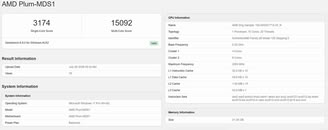
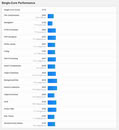
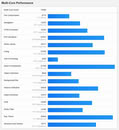
Another Geekbench entry for AMD's Medusa Point APU has been spotted by a well-known hardware leaker, HXL. This time, the submission lists the identifier 100-000001713-33_N on the Plum-MDS1 FP10 platform and is a step up from the previous leak in terms of performance, despite the chip reportedly running at just over 2.0 GHz. What we have there is listed as a Ryzen 9 part with 10 cores and 20 threads, 10 MB of L2 cache and 32 MB of L3; however, the L3 is likely misreported. The core layout is believed to follow a 4 + 6 configuration based on Zen 6/6c. Scores indicate 3,174 single-core and 15,092 multicore, roughly 29% and 22% higher than average Ryzen AI 9 365 Strix Point results, which is interesting given the low clock speeds in play. Engineering samples at this stage typically run below final frequencies, so the actual performance gap at launch could look quite different.
According to previous leaks, AMD's upcoming Medusa Point lineup could scale up to 22 CPU cores on the flagship Ryzen 9 model by combining a 10-core APU die with a 12-core desktop CCD. Integrated graphics are expected to have eight RDNA 3.5+ (RDNA 4m) compute units, with the lineup remaining unchanged despite the higher CPU core count. Another interesting new detail in this Geekbench submission is that we can see listed the FP16 AVX-VNNI support for a Zen 6 chip, pointing to expanded FP16 instruction handling in AMD's next-generation architecture. This is mostly relevant for AI and machine learning tasks. However, as with any early ES benchmark, take the numbers with a grain of salt. Pretty much everything from clock speeds, firmware, and platform tuning is a work in progress at this point. AMD Medusa Point is expected to arrive sometime next year with a likely initial launch at CES 2027 in January.
Sources:
@HXL, via Wccftech, Geekbench
According to previous leaks, AMD's upcoming Medusa Point lineup could scale up to 22 CPU cores on the flagship Ryzen 9 model by combining a 10-core APU die with a 12-core desktop CCD. Integrated graphics are expected to have eight RDNA 3.5+ (RDNA 4m) compute units, with the lineup remaining unchanged despite the higher CPU core count. Another interesting new detail in this Geekbench submission is that we can see listed the FP16 AVX-VNNI support for a Zen 6 chip, pointing to expanded FP16 instruction handling in AMD's next-generation architecture. This is mostly relevant for AI and machine learning tasks. However, as with any early ES benchmark, take the numbers with a grain of salt. Pretty much everything from clock speeds, firmware, and platform tuning is a work in progress at this point. AMD Medusa Point is expected to arrive sometime next year with a likely initial launch at CES 2027 in January.


21 Comments on AMD 10-Core "Medusa Point" Zen 6 APU Reappears in Geekbench with Improved Performance
more interesting are possible extra avx512 instructions. avx512 was extended, and has several sub instructions which it seems.
i am not sure if the author points out to 6c and zen 6 cores, some cores have less cache?Why else would you indicate 4+6 ?
except one desktop cpu, i hardly remember any am5 cpu with 4 physical cores.
It is likely boosting 5-5.5ghz for those scores.
While it has potential to exceed previous performance via ipc gains at similar or slightly quicker clocks it is not logical to expect these gains at half clock...
I might end up switching to Intel in 1-2 years, their iGPUs starting to become more powerful.
Ryzen 5 7600x
Another one (I got my hands on) ST: 3027, MT: 14498
I could take only +5% in ST due lower than final clock & it being low powered mobile chip
But 10 cores (even if its 4 + 4c + 2lp) Zen6 making only +4% over 6 Zen4 is ... just Off.
We need to know the power settings.
The 8700G is a well-rounded desktop APU, I doubt that Zen 5 and Zen 6 on AM5 (assuming it will be based on this same Medusa Point) can ever take its place without too many tradeoffs.
Well considering my 9700x is quite abit faster than this "leak"....I'm not sure what to think. Maybe this is a scaled down chip? My PBO limits are unlocked and undervolted but sure...zen 6 should be able to top that...right?