Thursday, July 23rd 2026

AMD Advancing AI 2026: Pensando "Salina" DPU and "Vulcano" AI NIC Power Helios Networking
Networking is the third pillar of AMD's Advancing AI 2026 rack-scale strategy, and today the company detailed the AMD Pensando silicon and fabric technology that connects the Helios rack. As Helios is AMD's first rack-scale design, the company encountered challenges in interconnecting many GPUs, memories, and data movement speeds within a single system, both for scaling up and scaling out for multi-rack connections inside the data center. Current AI infrastructure must closely follow model development as AI model sizes have grown exponentially, from the original 65-million-parameter Transformer in 2017 to trillion-parameter GPT-4-class systems and now 10-trillion-plus parameter agentic and reasoning models. To run a model with more than 10 trillion parameters, you need to connect dozens of GPUs with high-speed VRAM, as well as a high-speed interconnect to split model weights effectively so latency isn't an issue. The modern interconnect of choice is again the plain-old Ethernet, not proprietary interconnects, which have become the standard for AI networking.
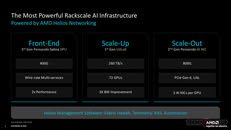
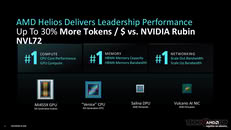
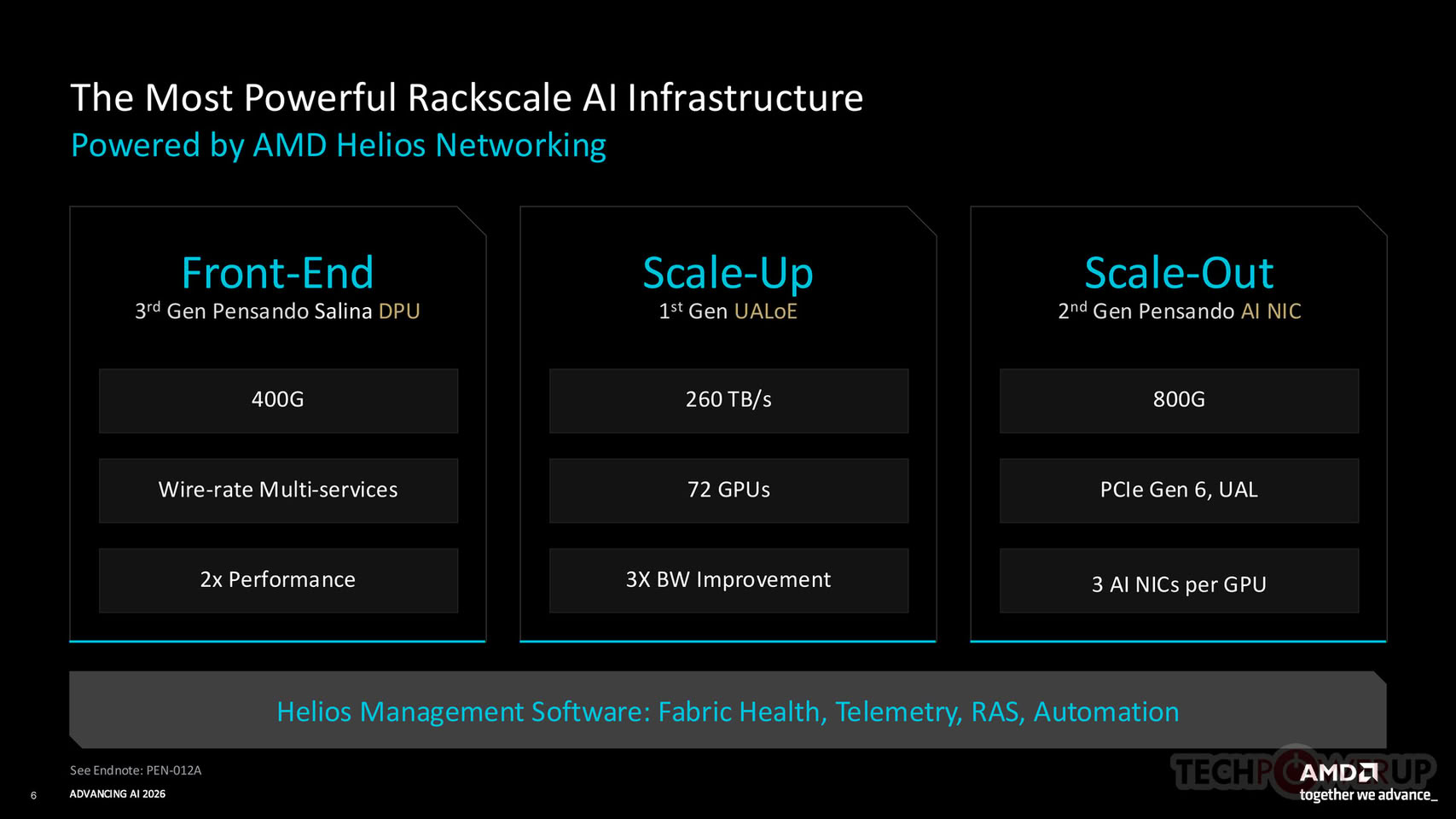
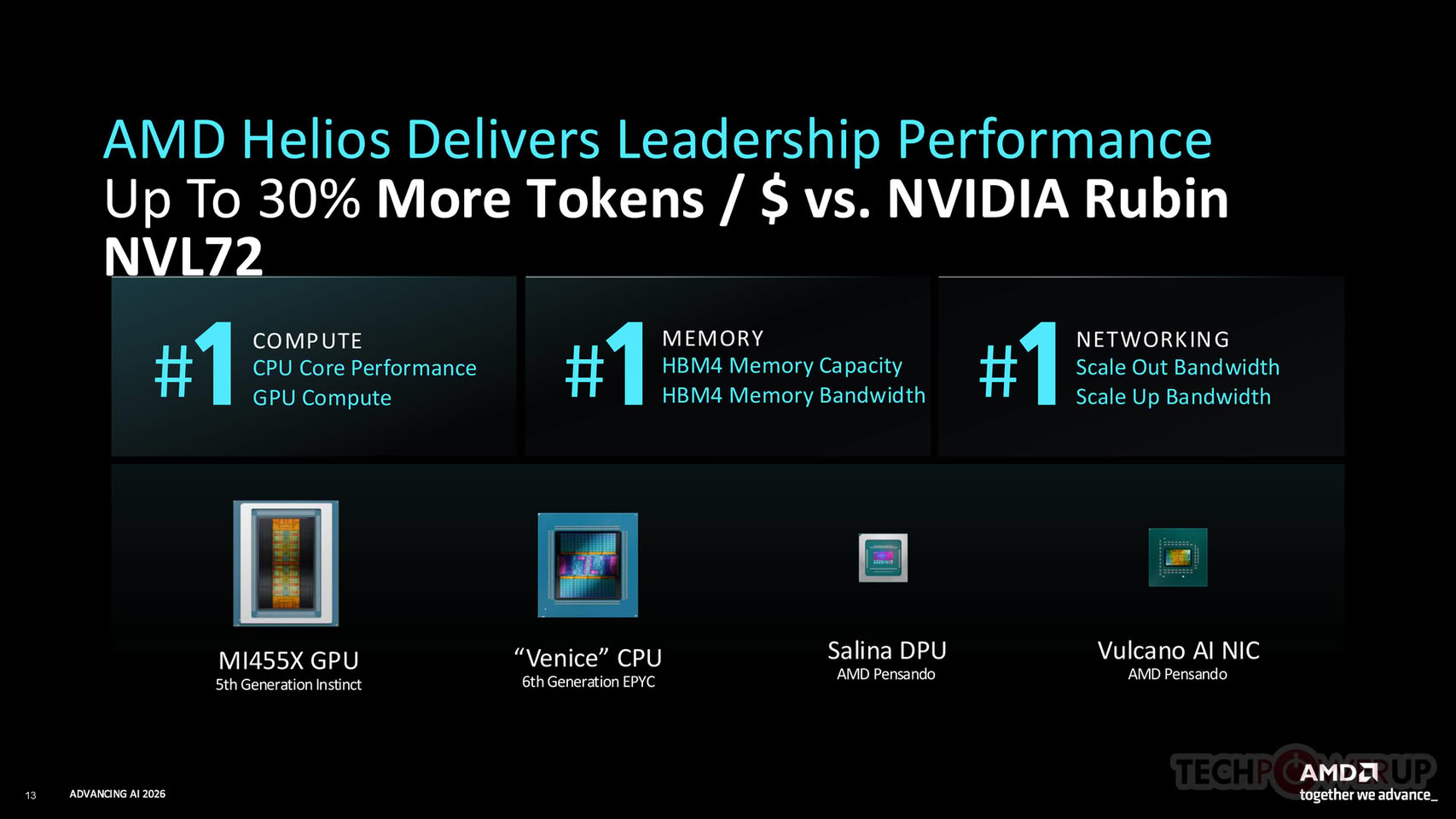
AMD's solution spans three layers: a third-generation Pensando "Salina" DPU on the front end, a first-generation UALink-over-Ethernet (UALoE) scale-up fabric inside the rack, and a second-generation Pensando "Vulcano" AI NIC for scale-out. All of this is managed by AMD's Helios management software and Fabric Manager. AMD outlined challenges that bandwidth needs are doubling in less than two years driven by massive AI models growing at a rapid pace, and that the hardware iteration cycles need to account for intelligence in the data fabric layer, not only compute layer.

 3rd Gen Pensando "Salina" DPU (Front-End)
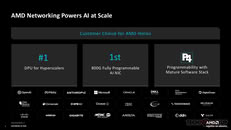
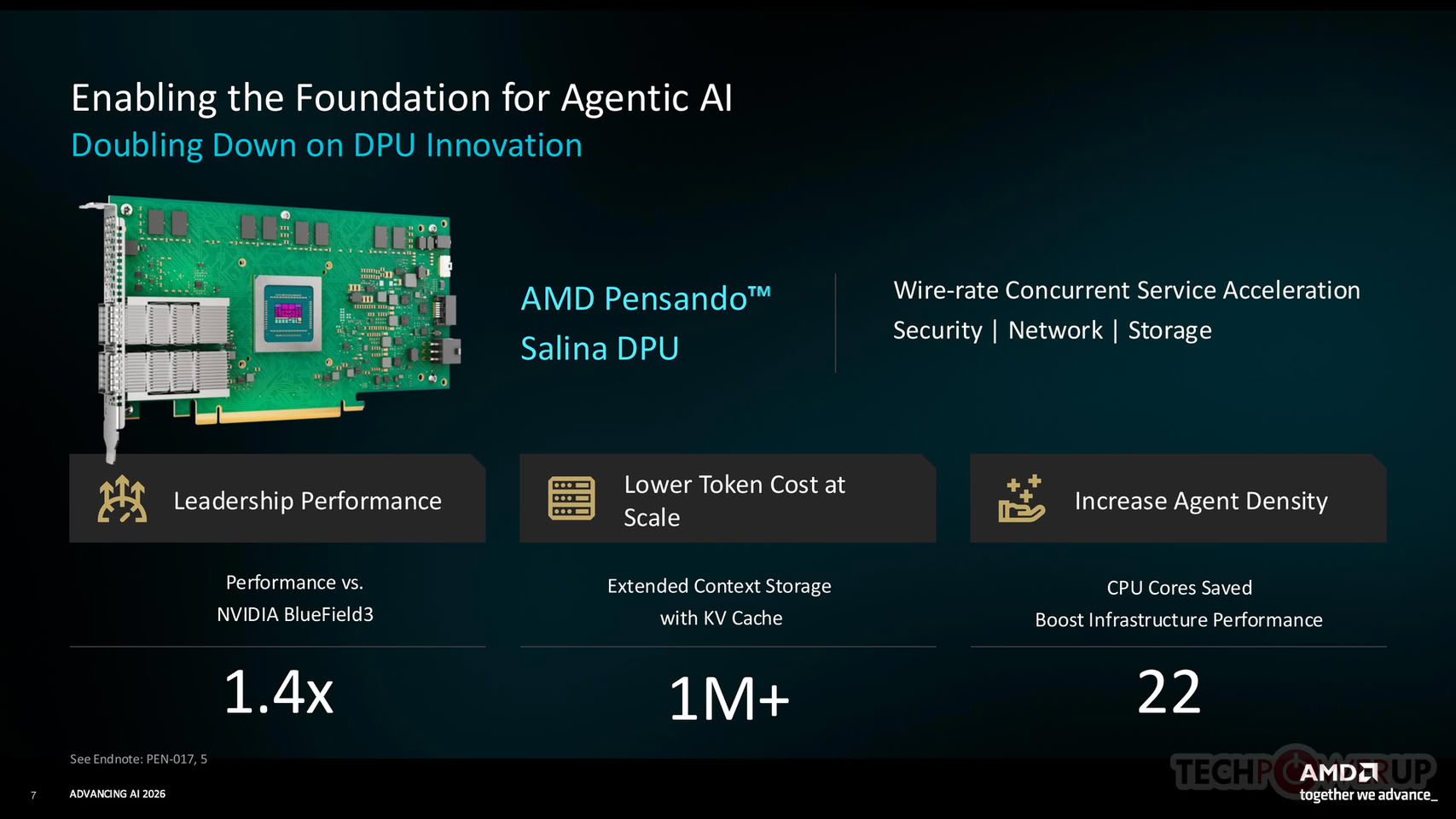
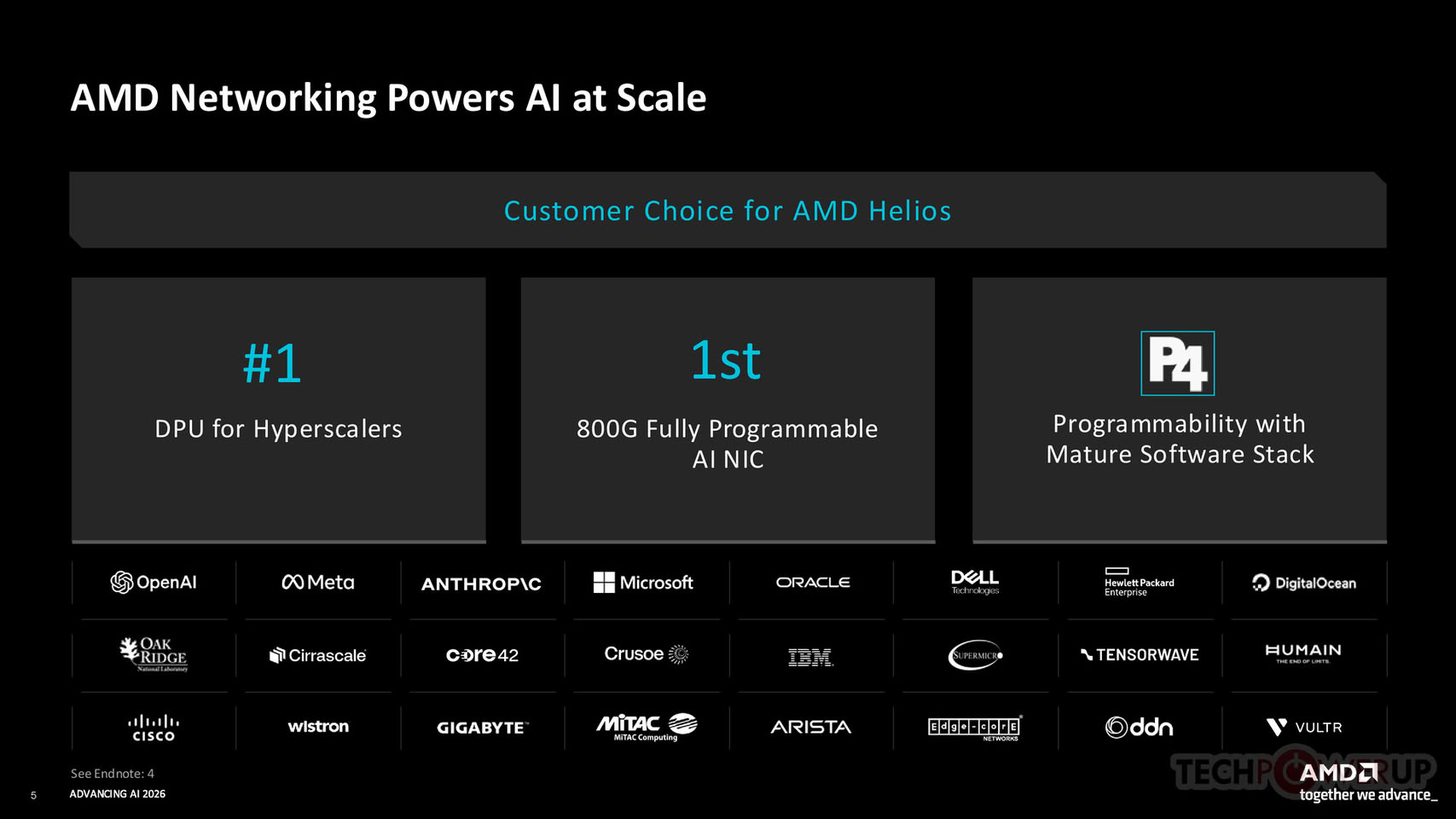
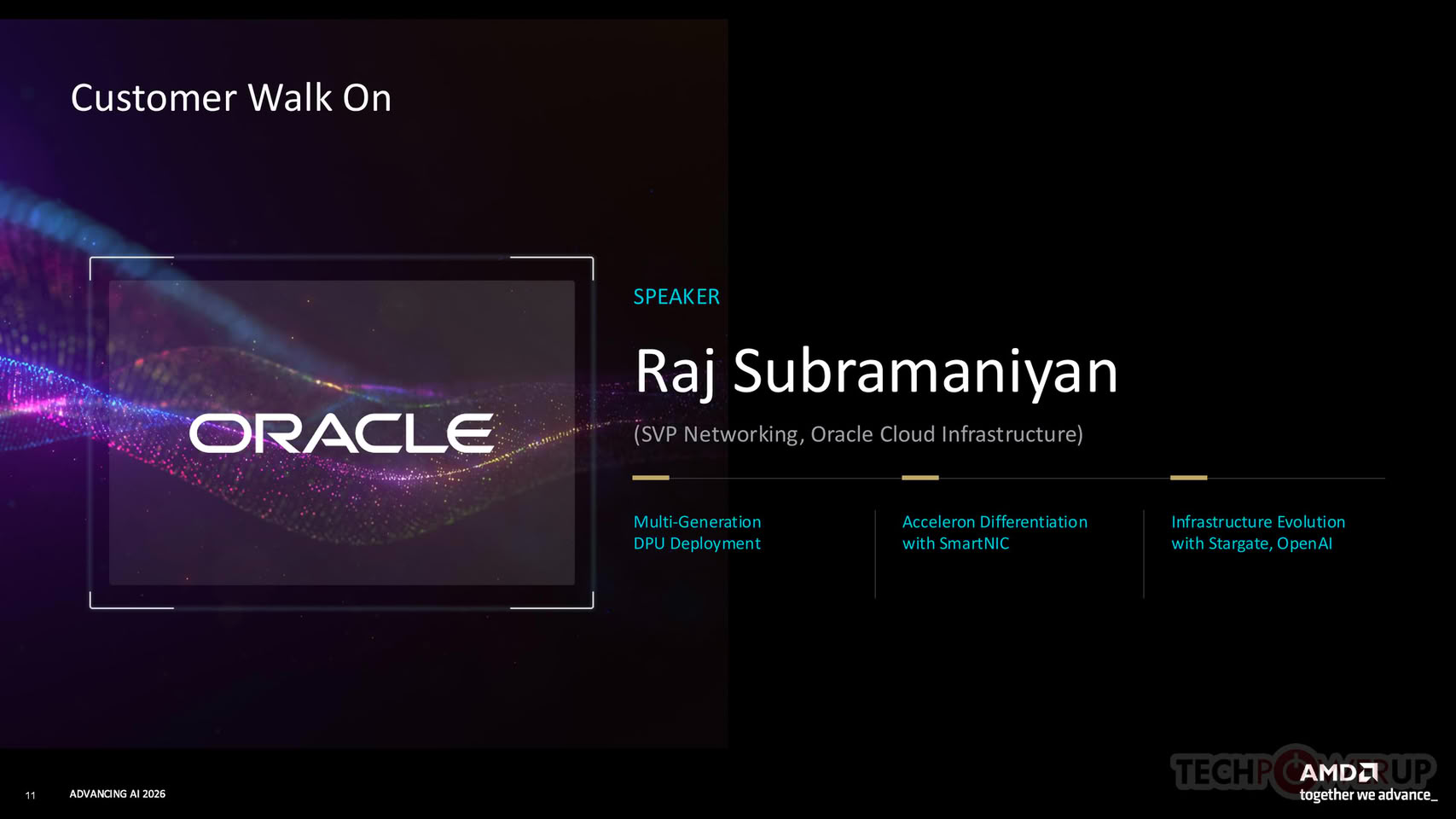
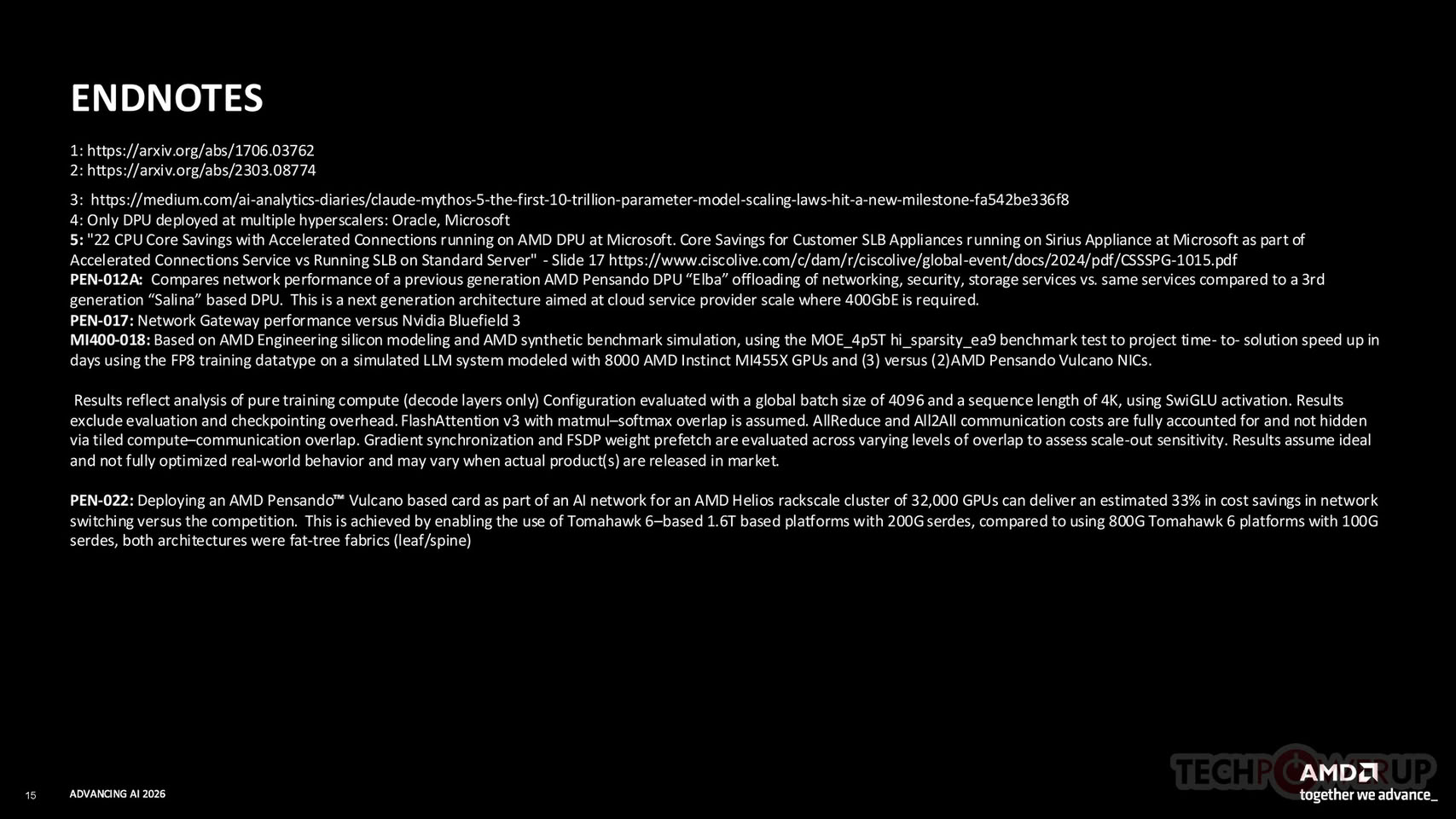
 The Salina DPU manages front-end networking at 400G, providing wire-rate concurrent acceleration for security, network, and storage services. AMD claims it offers twice the performance of its previous-generation "Elba" DPU and positions Salina as the only third-party DPU deployed at multiple hyperscalers, including Oracle and Microsoft. While only these two companies have been named, others may also be involved. Additional claims include 1.4 times the performance of NVIDIA's BlueField 3 as a network gateway and support for over 1 million extended-context storage with KV cache to enhance agent density. Microsoft's workloads reported a saving of 22 CPU cores by offloading accelerated connections. These 22 CPU cores are now available to handle other tasks, no longer burdened with smart packet routing.
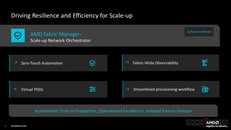
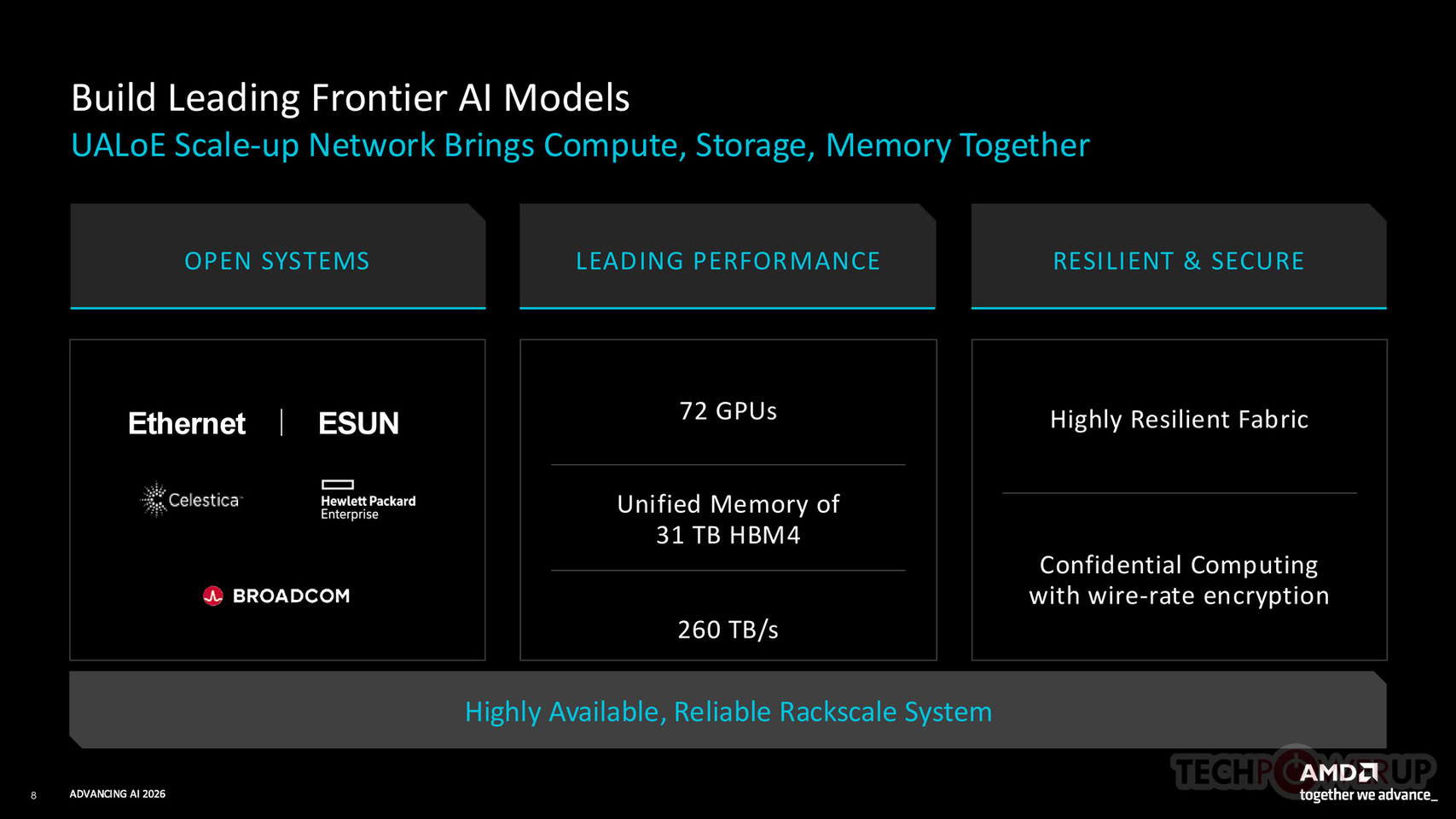
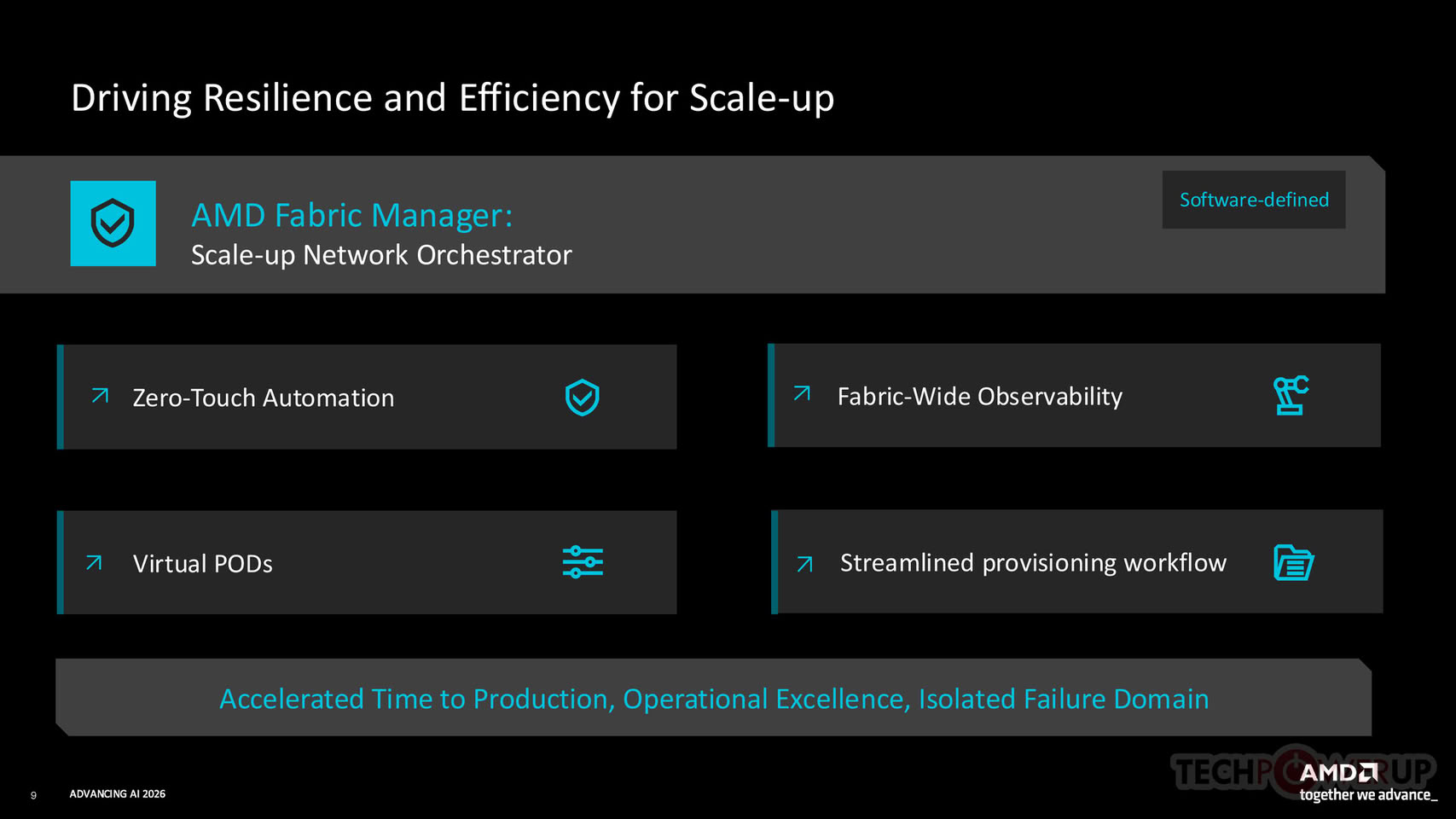
1st Gen UALoE Scale-Up Fabric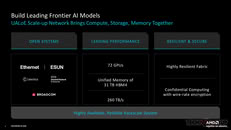 One of the most interesting aspects of the rack is how AMD interconnects its GPUs. AMD uses UALink over Ethernet (UALoE) to connect 72 GPUs into a single scale-up domain, providing 260 TB/s of bandwidth and a unified memory pool of 31 TB of HBM4. This configuration turns the entire rack into a single large GPU, allowing AI models to be deployed seamlessly for inference or enabling the interconnection of multiple racks for AI model training. AMD claims that their open-systems approach (ESUN/Ethernet), highly resilient fabric, and Confidential Computing with wire-rate encryption facilitate development. Orchestration is managed by AMD Fabric Manager, which offers software-defined virtual PODs, zero-touch automation, and fabric-wide observability for isolated failure domains. Even if parts of the system fail, the entire system remains operational.
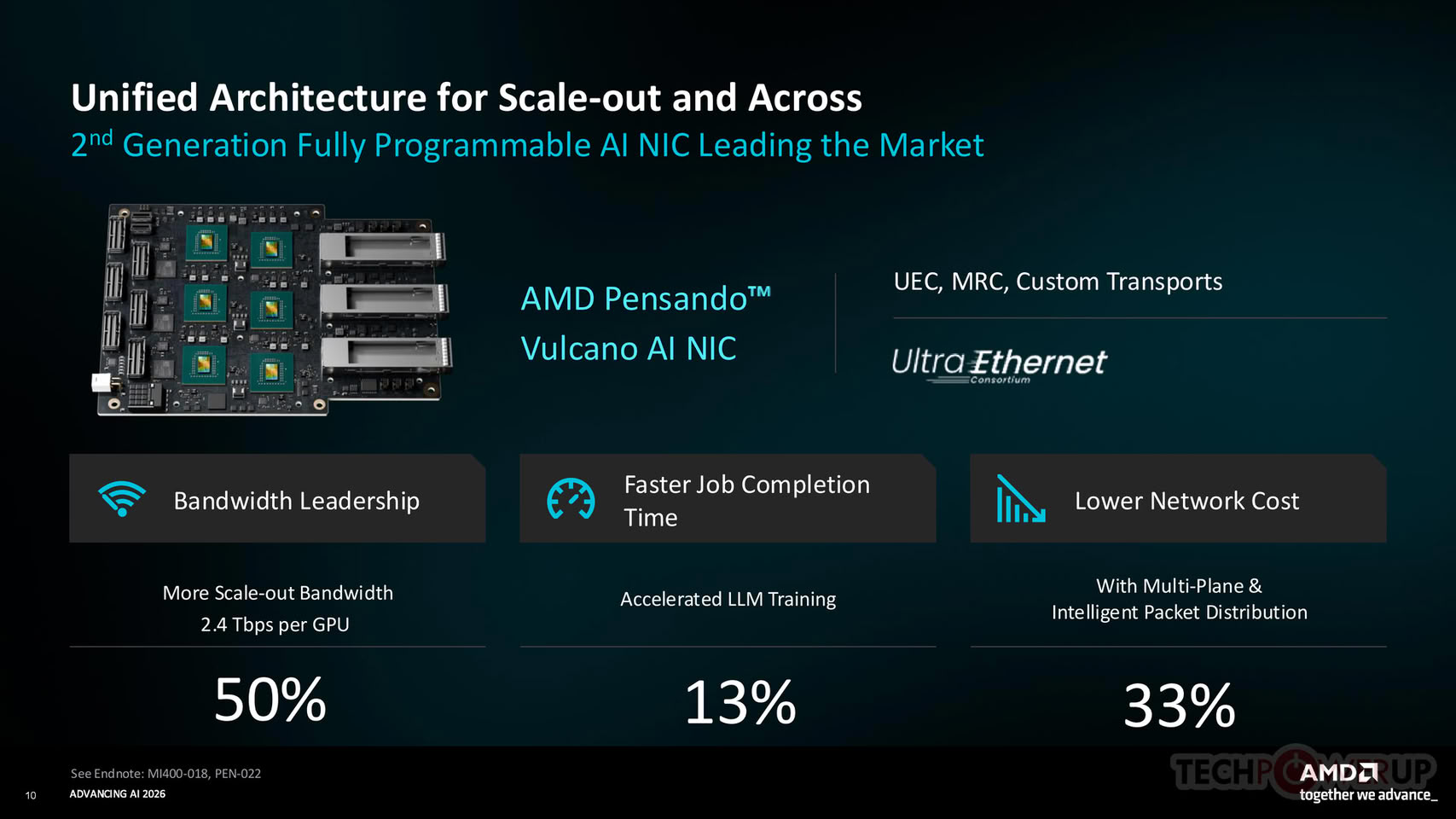
2nd Gen Pensando "Vulcano" AI NIC (Scale-Out)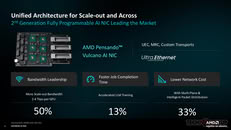 For scale-out fabric that connects multiple racks, AMD uses its second-generation, fully programmable "Vulcano" AI NIC, which operates at 800G with 2.4 Tbps per GPU (three AI NICs per GPU) over PCIe Gen 6 and supports UAL/UEC. AMD claims its custom solution delivers 50% higher scale-out bandwidth than competing solutions and about a 13% increase in LLM training, achieved through intelligent packet routing to minimize latency and losses. By opting for a custom solution instead of an off-the-shelf option like the one from Broadcom, AMD reduced its scale-out costs by a third. For example, the company compared a 32,000 GPU data center running the custom "Vulcano" AI NIC to a 1.6T Broadcom Tomahawk 6 platform for scale-out. The custom solution is not only more performant but also much more cost-efficient, allowing the end customer to redirect those funds into more GPUs and additional compute infrastructure.
Vulcano supports UEC, MRC, and custom transports, and AMD highlights modeling on an 8,000-GPU MI455X cluster, which shows faster time-to-solution when moving from two to three Vulcano NICs per GPU.
Complete slide-deck follows:


AMD's solution spans three layers: a third-generation Pensando "Salina" DPU on the front end, a first-generation UALink-over-Ethernet (UALoE) scale-up fabric inside the rack, and a second-generation Pensando "Vulcano" AI NIC for scale-out. All of this is managed by AMD's Helios management software and Fabric Manager. AMD outlined challenges that bandwidth needs are doubling in less than two years driven by massive AI models growing at a rapid pace, and that the hardware iteration cycles need to account for intelligence in the data fabric layer, not only compute layer.


1st Gen UALoE Scale-Up Fabric
2nd Gen Pensando "Vulcano" AI NIC (Scale-Out)
Vulcano supports UEC, MRC, and custom transports, and AMD highlights modeling on an 8,000-GPU MI455X cluster, which shows faster time-to-solution when moving from two to three Vulcano NICs per GPU.
Complete slide-deck follows:
2 Comments on AMD Advancing AI 2026: Pensando "Salina" DPU and "Vulcano" AI NIC Power Helios Networking