Wednesday, August 26th 2026

AMD Confirms AM5 Compatibility with "Olympic Ridge" Desktop "Zen 6"
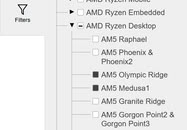
AMD's technical documentation page was updated today to emphasize ongoing compatibility with the AM5 platform. For the upcoming Ryzen 10000 series "Olympic Ridge" desktop processors, the company confirmed that these CPUs will also be compatible with the AM5 platform, bringing the already-announced "Zen 6" CPU technology to the consumer market. Interestingly, the documentation page also lists "Medusa1" as compatible with the AM5 desktop socket, suggesting we might see "Medusa Point" or "Medusa Halo" APUs in a socketed design as well, likely launching after the Ryzen "Olympic Ridge" family becomes available for consumer desktop PCs.
During the Computex 2026 international show, AMD confirmed that Socket AM5 would continue to be supported through 2029. In 2022, AMD introduced Socket AM5 alongside the Ryzen 7000 series powered by the "Zen 4" architecture. At that time, the company promised at least two processor generations on the socket, extending support up to 2027 (five years in the market). The company subsequently launched the Ryzen 8000 series APUs and its current Ryzen 9000 series powered by the "Zen 5" architecture. Its latest product line includes the introduction of Ryzen AI 400 series desktop APUs.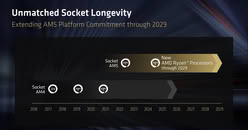
 Without naming any future processor generation or architecture, AMD announced that AM5 will have platform longevity until 2029. This suggests the introduction of at least one more microarchitecture, "Zen 6," and the product lines derived from it. Since AMD didn't announce any desktop "Zen 6" variants at Computex, the company likely won't debut them in 2026. Instead, they may maintain the current lineup and possibly tease or announce "Zen 6" desktop CPUs in 2027, with product launches expected that year. This would align with the market availability of "Zen 6" for the following two years, leading into 2029. We received a server "Zen 6" with EPYC "Venice," but the desktop "Olympic Ridge" is still pending.
Sources:
AMD, via InstLatX64 on X
During the Computex 2026 international show, AMD confirmed that Socket AM5 would continue to be supported through 2029. In 2022, AMD introduced Socket AM5 alongside the Ryzen 7000 series powered by the "Zen 4" architecture. At that time, the company promised at least two processor generations on the socket, extending support up to 2027 (five years in the market). The company subsequently launched the Ryzen 8000 series APUs and its current Ryzen 9000 series powered by the "Zen 5" architecture. Its latest product line includes the introduction of Ryzen AI 400 series desktop APUs.


78 Comments on AMD Confirms AM5 Compatibility with "Olympic Ridge" Desktop "Zen 6"
Let's hope Intel's NVL is able to actually compete in gaming this time, as to keep Olympic Ridge X3D prices in check.
AM5 might have an even longer lifespan, than AM4.
I normally only upgrade hardware every 4-7 years, but Zen6 might convince me to upgrade from my 9700X. I have an alternate use for this CPU, though, so it's more of a convenient excuse to upgrade to an X3D chip.
Side tangent, is there any info confirming Zen6 desktop CPUs will be called "10000" series, or is that just a placeholder? Based on their current mainline generations, and assuming AMD isn't changing anything here, I'd assume Zen6 would use an "11000" scheme. I don't mean to be a boob; this is just something I've thought about since before I made this account.
We will see if it ends up a true AM4 successor if there is a final chip release that moves the goal posts for gaming and or productivity like the 5800X3D did on initial launch.
AM4 is now over a decade old. With the 5800X3D re-release and Raptor Lake getting Re-refreshed for DDR4 platforms, I don't expect AM4 to go anywhere any time soon. It will coexist until AM5 senesces.
At this point, it's looking like DDR5 will never recover in pricing, as the base supply will be continually eaten up by Enterprise/Big Data until no longer produced (thanks to both DDR4 and DDR5 RDIMMs being put on CXL cards). If anything, AM6 will correct AM5's mis-step by including both DDR5 and DDR6 IMCs. IMO, AMD can clearly see how dual-generation DDR compatibility advantaged Raptor Lake in the consumer space and, how they had to expend capital to re-engineer Zen3D production to compete.
Though, I could see 'Zen7' launched in both AM5-DDR5 and AM6 DDR6 flavors; setting up AM5 for 'budget platform' co-existance (just as AM4 ended up for AM5).
There isn't any indication that DDR6 prices would be any more affordable than DDR5, DDR5 at launch was expensive, and I'm assuming the memory manufacturers will try to keep RAMpocalypse DDR5 pricing as the new normal by cutting supply. Memory might end up being one of the highest priced components in a system, which would ruin much of the lower end segments and price/performance DIY builds.
Although a Zen 7 chip with both DDR5 and DDR6 would be nice for compatibility, as DDR5 gets replaced with DDR6 hopefully there would be somewhat lower DDR5 prices.
What remains mystery is Zen 7.
Am4 left ryzen 5000 for ages on am4. the x3d part was just an engineer project most likely not too much supervised.
AMD has always the bad luck windoze follows microslop and intel and therefore the avx512 will never benefit a lot. AMD is always too early with that. It is the consumers fault to buy 70% intel processors always and keeping old technology alive.
note: see the recent article taht intel after 1995 is below 70% market share now.
And when the AI boom ends intel will have spare 10nm capacity it will start using for dram if dram prices stay high.
which they could bundle with their products with a bit of margin and undercut everyone because of it.
www.igorslab.de/en/am5-lives-until-at-least-2029-amd-confirms-zen-6-and-zen-7-for-the-current-socket-and-turns-the-memory-crisis-into-a-selling-point/
Also, looking forward getting my 24 core AM5 next year!
If they're trading blows we could see a bit of a discount war (depending on MSRP differences) but there's also the possibility that each will hold its ground if they're neck and neck and MSRPs are the same.So if it's $250 you're skipping?
A circular client economy 🤣