Friday, September 4th 2026

AMD Introduces Threadripper Halo Station at IFA 2026

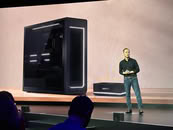
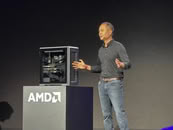
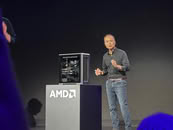
The opening keynote at IFA 2026 was held by AMD and our team on the ground was there to see it. During the event, AMD announced the Threadripper Halo Station, a liquid-cooled workstation built around the 96-core Threadripper PRO 9995WX CPU codenamed "Shimada Peak" and up to four AMD Instinct MI350P accelerators. The system is designed around one specific use case: run AI models with more than one trillion parameters locally, without a cloud connection. Jack Huynh, AMD's SVP and GM of Computing and Graphics, described it as a new class of workstation bringing supercomputer-class compute to individual users and developers. The Threadripper PRO 9995WX Zen 5 CPU has 96 cores and 192 threads, 5,4 GHz boost frequency and supports up to 2 TB of DDR5 system memory.

Going further down the specifications, each MI350P card features 144 GB of HBM3E running at 4 TB/s, offering a bandwidth 14 times higher than any LPDDR5X variant. At IFA 2026, AMD presented a configuration based on two MI350P PCIe cards for a total of 288 GB of HBM3E memory. Users can upgrade the system to four cards and 576 GB of HBM3E. This amount of accelerator memory is enough, says AMD, to hold a trillion-parameter model entirely on-device. Each Instinct MI350P card has a TBP of up to 600 W and is liquid-cooled independently, as is the CPU. Complete system specifications, availability and pricing have not been announced.
Add your own comment

26 Comments on AMD Introduces Threadripper Halo Station at IFA 2026

#1
close
Fully loaded this really pushes the limits of a 16A, 230V European power outlet. On the upside this can really heat up a home and get some useful work done along the way.
Posted on Reply
#2
TheLostSwede
News Editor
closeFully loaded this really pushes the limits of a 16A, 230V European power outlet. On the upside this can really heat up a home and get some useful work done along the way.
Even 16 A isn't that common, maybe in an office where you'd run something like this, but most homes don't have more than 10 A fuses for the regular sockets.
Posted on Reply
#3
MikOnTopGG
Well think of it this way, you can heat your room, but also be very productive. I wonder how many PSU's that is gonna require...
Posted on Reply
#4
Chaitanya
TheLostSwedeEven 16 A isn't that common, maybe in an office where you'd run something like this, but most homes don't have more than 10 A fuses for the regular sockets.
Not even for high energy appliances? We do have 15A outlets in out homes for using microwaves, OTGs, etc...
Posted on Reply
#5
TheLostSwede
News Editor
ChaitanyaNot even for high energy appliances? We do have 15A outlets in out homes for using microwaves, OTGs, etc...
Yeah, in the kitchen, I have some 13 A sockets too.
Posted on Reply
#6
TechLurker
In parts of the US at least, newer home construction usually come with 15A wiring and fuses, and some builders voluntarily opt for 20A fuses and wiring but 15A sockets (needs upgrading to the 20A sockets), or 20A rated wiring but 15A fuses and outlets. A few new home builders also voluntarily include an extra 50A outlet in the garage for any future homeowners with an EV too, located closer to the garage door. Basically offering some limited futureproofing without having to do a costly drywall teardown and wiring upgrade.

My own house and my parents' house were new builds with 20A fuses and wiring but 15A sockets in the common areas but the office and garage, which had 20A outlets (and the kitchen, which has its own requirements). In my case, I forked out extra for a pair of dedicated 20A lines to where a home server would sit, even though I don't intend to use the full power budget any time soon (esp. in this current economic climate).
Posted on Reply
#7
Dr. Dro
MikOnTopGGWell think of it this way, you can heat your room, but also be very productive. I wonder how many PSU's that is gonna require...
It can run off just one 3000 W unit.
Posted on Reply
#8
Patriot
closeFully loaded this really pushes the limits of a 16A, 230V European power outlet. On the upside this can really heat up a home and get some useful work done along the way.
you can shave 150w/gpu with cTDP in power constrained situations.
Likewise you can lower the tdp cap on the cpu from 350 down... but you are going to lose a good bit of boost and memory bandwidth if you do so aggressively.
Posted on Reply
#9
MikOnTopGG
Dr. DroIt can run off just one 3000 W unit.
I hope so.
Posted on Reply
#10
TumbleGeorge
TheLostSwedeEven 16 A isn't that common, maybe in an office where you'd run something like this, but most homes don't have more than 10 A fuses for the regular sockets.

My lowest is 25A. :D
Posted on Reply
#11
TechLurker
MikOnTopGGWell think of it this way, you can heat your room, but also be very productive.
The heat could also be put to use heating your water in a convoluted way that some people with large home servers have done.

Basically, one would have one of those Hybrid Water Heaters or Heat Pump Water Heaters in their own little water utility closet, and set up their home server in another closet next to it with ducts connecting the spaces, or in the same space but elevated off the ground. Since hybrid water heaters and heat pump water heaters work by drawing the ambient air in and drawing out the heat from it to sink into the hot water, it would draw all that heat in and then release the now-cooled air, which can be ducted back to the server. Since those water heaters have to regularly cycle to keep the water hot, even when not actively used, it keeps the heat manageable and also dries the air out.

Granted, it's still inconsistent (esp. if the server isn't running at full speed regularly to generate that much heat in the first place), and some individuals also include a mini-split or a simple temperature-controlled vent to the outside to regulate heat.

On a larger scale, some European companies are offering a variation of this; they provide heat from datacenters directly to a district heating utility. OnZero being one, and there are others as well looking to recycle the heat.
Posted on Reply
#12
igormp
Dang that's a nice setup, but seeing multiple of those MI350P being constrained by a mere PCIe 5.0 x16 is a bit sad. I don't think those halved MI350x PCIe variants have support for any other kind of faster interconnect.
Not like Nvidia has any PCIe model with a faster interconnect anyway, the last one was the H100 NVL PCIe which only allowed to link over 2 GPUs. I guess training over PCIe devices is a thing of the past now.
closeFully loaded this really pushes the limits of a 16A, 230V European power outlet. On the upside this can really heat up a home and get some useful work done along the way.
Here in Brazil we have a plug similar to the euro one, but our variant has 10 and 20A plug/sockets, with certain regions of our country being on 220V, meaning up to 4400W on a single outlet, the problem is that such setup is not obtainable at all here :rolleyes:
Anyhow, 4x of those MI350P (600W each) + that TR 9995WX (350W) = 2750. Even with peripherals, and some safety and efficiency margins it should be well below the 3680W for a 230V/16A connection.
And the shown configuration only has 2 GPUs, which is way easier to figure out logistics and power for.
Posted on Reply
#13
Patriot
igormpDang that's a nice setup, but seeing multiple of those MI350P being constrained by a mere PCIe 5.0 x16 is a bit sad. I don't think those halved MI350x PCIe variants have support for any other kind of faster interconnect.
Not like Nvidia has any PCIe model with a faster interconnect anyway, the last one was the H100 NVL PCIe which only allowed to link over 2 GPUs. I guess training over PCIe devices is a thing of the past now.


Here in Brazil we have a plug similar to the euro one, but our variant has 10 and 20A plug/sockets, with certain regions of our country being on 220V, meaning up to 4400W on a single outlet, the problem is that such setup is not obtainable at all here :rolleyes:
Anyhow, 4x of those MI350P (600W each) + that TR 9995WX (350W) = 2750. Even with peripherals, and some safety and efficiency margins it should be well below the 3680W for a 230V/16A connection.
And the shown configuration only has 2 GPUs, which is way easier to figure out logistics and power for.
It really is... I have a hive of mi100s, (4 way bridge) And nvidia has also gone to dropping pcie variants of their accelerators with blackwell, and went with reusing the workstation cards instead of true pcie accelerators with the RTX PRO 6000, so less ram than H200, less ram bandwidth but bringing new lower precision modes that if used can be competitive (especially in availability and cost per token), but if your workload is FP8.....


Sauce www.cloudrift.ai/blog/benchmarking-rtx6000-vs-datacenter-gpus

So amd bringing the mi350p with more ram than the H200, but less bandwidth... should still net wins over the RTX6000 pro.
Posted on Reply
#14
_JP_
Nomad76Complete system specifications, availability and pricing have not been announced.
Availability: Allocation reserve of units (N>1) per entity, after down-payment confirmation. AMD will then out of their compassion, let you know when you get the hardware.
Pricing: I can guesstimate this will start at $15k.
TheLostSwedeEven 16 A isn't that common, maybe in an office where you'd run something like this, but most homes don't have more than 10 A fuses for the regular sockets.
Well, over here only the lighting has 10A breakers, in a proper "modern" (00's or newer) installation. 16A per-room for outlets, 20A per heavy kitchen appliance, or multi-split A/Cs, 40/30A for the garage breaker box and other floors (which will have their own 20/16/10A collection).
Posted on Reply
#15
Patriot
Lead times suck everywhere and it depends how big of dimms you want and how many...
3mo is about the quickest you can get any server, and a big boy GB300 setup is going to be 6-9mo.
I don't expect this to be different.
Posted on Reply
#16
Bigshrimp
When the energy bill is the least of your concerns...
Posted on Reply
#17
Arctucas
TechLurkerIn parts of the US at least, newer home construction usually come with 15A wiring and fuses, and some builders voluntarily opt for 20A fuses and wiring but 15A sockets (needs upgrading to the 20A sockets), or 20A rated wiring but 15A fuses and outlets. A few new home builders also voluntarily include an extra 50A outlet in the garage for any future homeowners with an EV too, located closer to the garage door. Basically offering some limited futureproofing without having to do a costly drywall teardown and wiring upgrade.

My own house and my parents' house were new builds with 20A fuses and wiring but 15A sockets in the common areas but the office and garage, which had 20A outlets (and the kitchen, which has its own requirements). In my case, I forked out extra for a pair of dedicated 20A lines to where a home server would sit, even though I don't intend to use the full power budget any time soon (esp. in this current economic climate).
15A @ 120V; 1800VA. With .9 power factor; 1620 Watts.

20A @ 120V; 2400VA. With .9 power factor; 2160 Watts.
Posted on Reply
#18
Darmok N Jalad
This isn’t going to run on standard household outlet voltage. Like PSUs that are 1600W+, it will require a 240V outlet, like what you’d plug an electric clothes dryer into. Even then, I think this is a workstation that’s either for an office setting or for someone very serious about processing power—getting the power to it won’t be a problem for these buyers.
Posted on Reply
#19
close
TheLostSwedeEven 16 A isn't that common, maybe in an office where you'd run something like this, but most homes don't have more than 10 A fuses for the regular sockets.
Every European country I've lived in had 16A pretty much everywhere as a standard. Can't say the wires were sized properly but the fuses sure were 16A everywhere except in really old houses.

Anyway, someone who can afford to max out this beast with 4 GPUs and 2TB of RAM in this market surely can afford to build a house with solid electric circuits and a power station to go with it. :)
Posted on Reply
#20
mashie
closeEvery European country I've lived in had 16A pretty much everywhere as a standard. Can't say the wires were sized properly but the fuses sure were 16A everywhere except in really old houses.

Anyway, someone who can afford to max out this beast with 4 GPUs and 2TB of RAM in this market surely can afford to build a house with solid electric circuits and a power station to go with it. :)
Indeed, if you can afford a $150k workstation, power shouldn't be much of a concern.
Posted on Reply
#21
DaemonForce
Darmok N JaladThis isn’t going to run on standard household outlet voltage. Like PSUs that are 1600W+, it will require a 240V outlet, like what you’d plug an electric clothes dryer into. Even then, I think this is a workstation that’s either for an office setting or for someone very serious about processing power—getting the power to it won’t be a problem for these buyers.
Forget the standard voltage, I have no confidence in the internal power delivery system after the first pair of cards. That's how the machine was loaded at the keynote and it's probably the optimal profile for a number of reasons. The board alone is incredibly expensive to max out.
Posted on Reply
#22
kondamin
That’s a lot of heat for a little box.
Posted on Reply
#23
TheGuruStud
Meanwhile, in the US, we can just convert a 120V circuit to 240 at 20A in 5 mins.
Posted on Reply
#24
Dr. Dro
MikOnTopGGI hope so.
Shouldn't be a problem either way, this is AMD's answer to the new Grace Blackwell Ultra workstations. Maybe in 20 years when we manage to get one from the dump (I mean, SGI and Sun workstations ended in the dump after like 2 or 3 decades, didn't they?), we'll worry about their power consumption :banghead:

Posted on Reply
#25
TheLostSwede
News Editor
closeEvery European country I've lived in had 16A pretty much everywhere as a standard. Can't say the wires were sized properly but the fuses sure were 16A everywhere except in really old houses.
For kitchen appliances, yes, but the rest of the place, no. My main breaker is 40 A, but only three sockets are 16 A, with two more in the kitchen being 13 A, the rest are 10 A and the building we live in is less than three years old.
Posted on Reply
Add your own comment
Nov 25th, 2026 04:15 CST change timezone

New Forum Posts

Popular Reviews

TPU on YouTube

Controversial News Posts