News Posts matching #PRO

Return to Keyword Browsing

NVIDIA RTX PRO 5500 Listing Spotted at $17,999, More Than the Flagship RTX PRO 6000

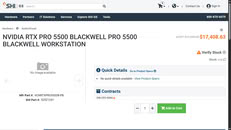
The NVIDIA RTX PRO 5500 "Blackwell" workstation card has shown up at a US retailer, and it surprisingly costs more than the flagship RTX PRO 6000. As spotted by Alex Ziskind on X and corroborated by Videocardz, SHI Government Solutions listed the PNY-built model (VCNRTXPRO5500B-PB) with an MSRP of $17,999 and a discounted price of $17,408.63. NVIDIA's own US marketplace, on the other hand, lists the RTX PRO 6000 for $16,000, even though that card has more CUDA cores (24,064 vs. 21,760) and more memory (96 GB vs. 84 GB). So even at SHI's discounted price, the cut-down card costs around $1,400 more. NVIDIA hasn't announced official pricing since it quietly added the RTX PRO 5500 to its lineup in September, so it isn't clear whether the $17,999 figure comes from NVIDIA or PNY.

Videocardz points out that Chinese demand is probably a big factor behind the RTX PRO 5500's price. According to Reuters, ByteDance, Alibaba, and Tencent have ordered over 3 million RTX PRO 5500 cards at roughly $11,400 each, with total orders from China reportedly topping 6 million. One source said NVIDIA can make no more than 3 million of them in 2027. With the B300 barred from China and the H200 reviewed case by case, the RTX PRO 5500 is one of the strongest NVIDIA GPUs Chinese firms can still buy. The card also packs 28 GDDR7 modules at a time, even as memory prices keep climbing. With orders far ahead of supply, it's reasonable to expect RTX PRO 5500 pricing to stay high for a while.

Micro Center Reportedly Drops the RTX 5090 From Its Catalog as End-of-Life Rumors Pile Up

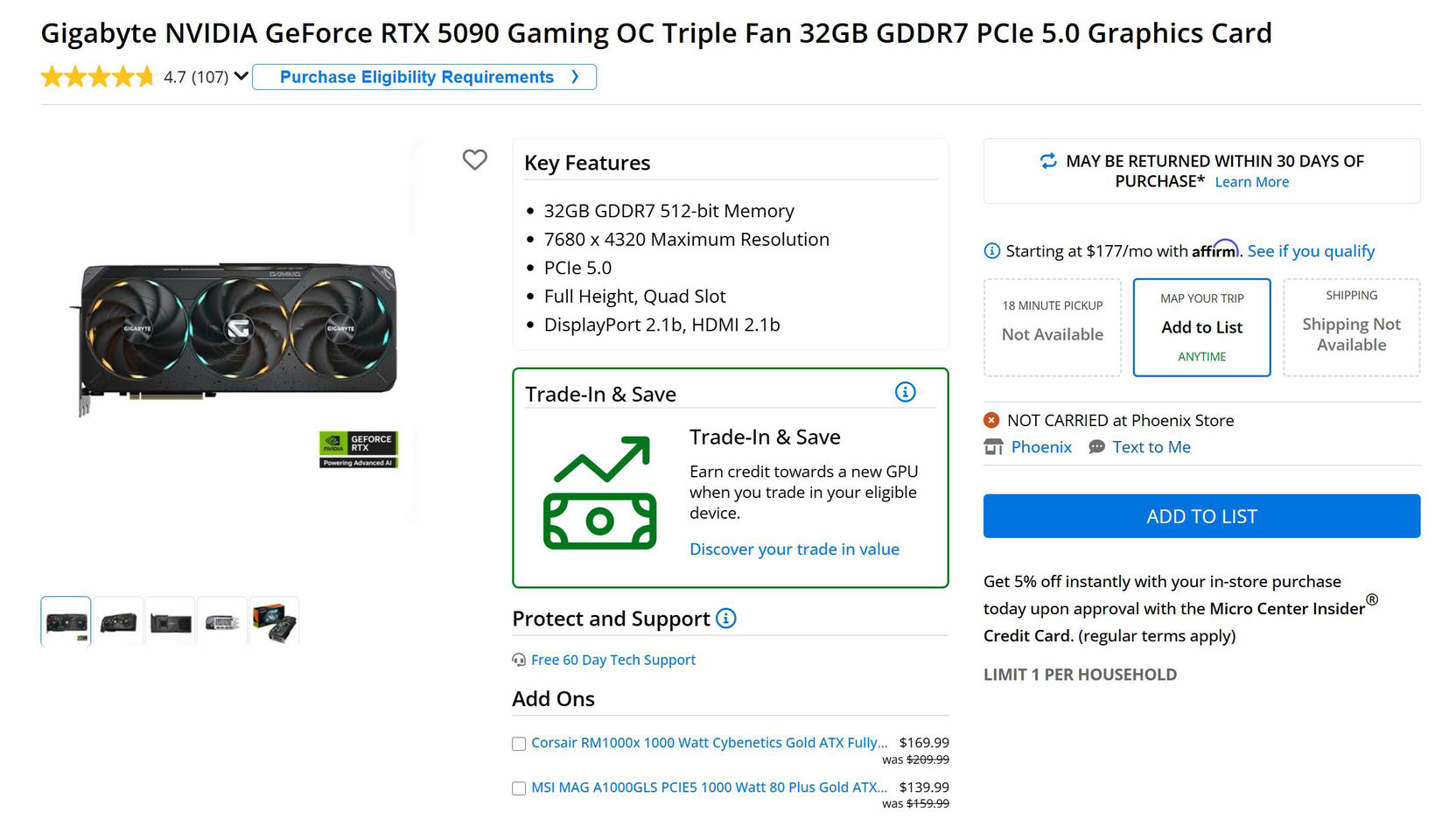
Micro Center seems to have quietly stopped selling the GeForce RTX 5090. Several RTX 5090 listings on the retailer's US website now show as "Not Carried," and a post on r/gpu claims every single one of them does. That label usually means a product has been dropped from the active catalog and won't be restocked. Custom models from ASUS, MSI, and Gigabyte are still listed but out of stock at physical stores, and the only RTX 5090 reportedly still sitting on shelves at most locations is an ASUS ROG Astral sold inside a 20th Anniversary bundle for almost $11,000. Neither NVIDIA nor Micro Center has commented on the situation yet, and NVIDIA's own website still lists the RTX 5090 at the now-mythical price of $1,999.

Separately, Redditor johnnyphotog on r/Microcenter says staff were already pulling RTX 5090 cards from the shelves on October 9. Apparently, a manager told him the cards were being sent somewhere else, and while he did manage to buy one, an employee told him it was probably the last RTX 5090 the store would sell. That timing is interesting, since it came a day before leakers claimed NVIDIA stopped allocating GB202 silicon to the RTX 5090 and is saving it for far pricier workstation cards like the RTX PRO 5500. Of course, the MSRP of the RTX 5090 hasn't meant much for a while, with the card selling out at Walmart for $4,299 last month. If GB202 supply has really dried up, whatever partner stock is left will likely get even pricier, so readers set on buying one shouldn't expect prices to come down anytime soon.

NVIDIA Reportedly Ending the RTX 5090, Reserves GB202 Silicon for Workstation GPUs

NVIDIA has reportedly stopped allocating GB202 silicon to the GeForce RTX 5090, according to leaker MEGAsizeGPU (@Zed__Wang) on X. "No more GB202 for 5090, confirmed," the leaker posted, adding in a follow-up that "all future GB202 supplies are RTX Pro exclusive." GB202 is the largest "Blackwell" graphics chip, and the RTX 5090 doesn't even max it out. The same chip powers the 96 GB RTX PRO 6000 with 24,064 CUDA cores, as well as the recently unveiled RTX PRO 5500, which pairs the RTX 5090's 21,760 CUDA cores with 84 GB of memory. Apparently, NVIDIA would rather put every GB202 it gets into those far pricier workstation cards. The company hasn't confirmed any of this as of the time of writing.

A second leaker, hongxing2020, posted "5090 EOL, 5080 24GB ready" alongside an apparent factory notice saying NVIDIA will no longer sell any RTX 5090 model, China-market D variants included. The same notice says an RTX 5080 24 GB will become the top GeForce card and the 16 GB version will be discontinued. That sounds a lot like the RTX 5080 SUPER, which was rumored with 24 GB of GDDR7 on the same GB203 chip, although it isn't clear if the two are the same card. SUPER cards reportedly reached board partners in July, only to be put on hold over GDDR7 pricing. As for the RTX 5090, I doubt NVIDIA would formally call this an end-of-life (EOL) move, since the chips are simply being redirected to a more profitable product line.

iBUYPOWER Unveils New Workstation AMD AI Halo Mini PC Powered by AMD Ryzen AI Max+ PRO 495 Series Processor

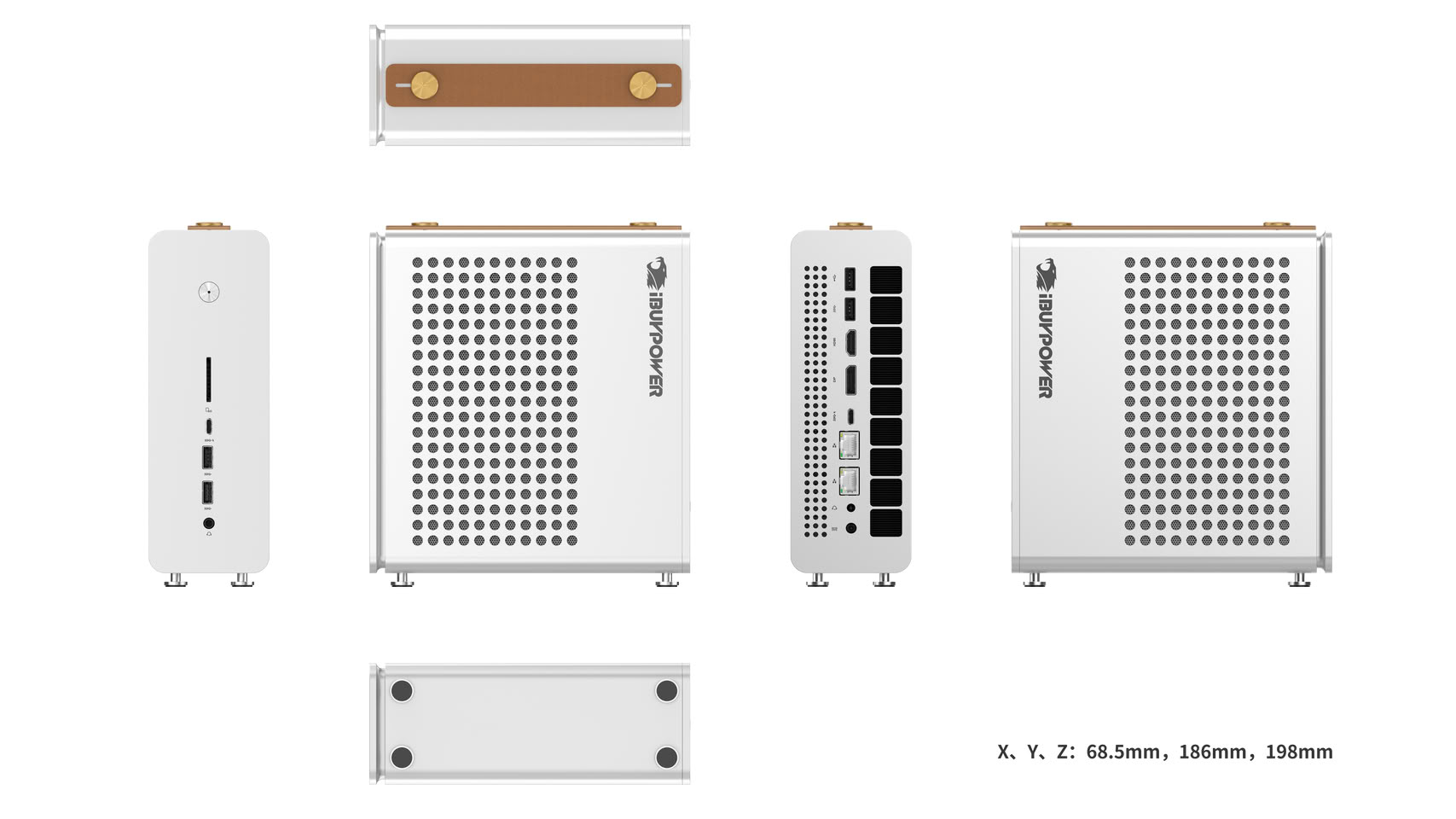
iBUYPOWER, the leading system integrator in North America specializing in high-performance prebuilt and custom gaming PCs, announced today that it is expanding its iBUYPOWER PRO Workstation lineup with the reveal of an all-new mini-PC - the iBUYPOWER Pro AMD AI Halo Mini PC, which is built on AMD's Ryzen AI Max+ PRO 495 Series processors. Available for purchase in Q4 2026 starting at $3999, the iBUYPOWER Pro AMD AI Halo Mini PC enables next-gen workstations and desktops to deliver exceptional ROI with robust security features while maintaining high performance.

COMPACT FORM FACTOR BUILT WITH iBUYPOWER'S HIGH-QUALITY STANDARDS
The new iBUYPOWER Pro AMD AI Halo Mini PC easily fits into any user's existing setup, measuring 70x198x200 mm, making it perfect for discreet or minimalist spaces. For those who prefer mini-PCs as their main system, the iBUYPOWER Pro AMD AI Halo Mini PC uses AMD Ryzen's AI Max+ PRO 495 Processor. This lets users easily render complex AI models, enable instant ray tracing and interactive simulations alongside local AI inference, and seamlessly tackle complex data and engineering projects without using third-party cloud services.

AMD Shares Its Progress with Agentic PCs

AMD held a press briefing to share how its "Agentic PC" push is going, and it brought a fair number of figures along. Apparently, the company has shipped over half a million Agentic PCs across more than 50 designs, alongside tens of millions of AI PCs across more than 250 designs. Of course, the term "Agentic PC" is AMD's own. It covers any PC whose CPU, GPU, and NPU can run AI agents locally, and AMD says Ryzen AI Max+ systems with 64 GB of memory or more give the best experience. The Ryzen AI Max 400 series is pitched as the "next-gen Agentic PC" for 2026, and most of the briefing focused on its flagship, the Ryzen AI Max+ PRO 495 "Gorgon Halo" with 192 GB of memory.

Modder Solders Dual 8-Pin Board to RTX 5090's 16-Pin Header, Wires Stay Below 40°C

Melting 16-pin connectors keep making headlines, and some RTX 5090 owners have started taking the protection of their expensive cards into their own hands. Reddit user DallasGrave has modified an MSI GeForce RTX 5090 with two extra 8-pin PCIe power inputs that work alongside the card's original 16-pin connector. According to their post on r/pcmasterrace, a small pickup PCB is soldered to the contacts of the 16-pin header, and that board feeds a second PCB carrying the two 8-pin sockets. The card then runs on three cables in total. DallasGrave says each conductor now carries roughly 3 A, and that the wires never crossed 40°C during a 48-hour run at 550 W, even at the joint. More test data is apparently on the way, so for now these are the modder's own numbers.

The 12V-2x6 revision was supposed to fix the melting power connector issues. In early 2025, NVIDIA said the 16-pin melting issues were over, pointing to the updated connector on the RTX 50-series. However, the first melted RTX 5090 Founders Edition was reported shortly after, in that case with a third-party cable. Since then, several RTX 5090 power connectors have reportedly melted, including one with an undervolt and a -100 W power limit. Moreover, last month Hardware Unboxed watched its RTX 5090 power cable reach 175°C with a single wire pulling around 22 A.

NVIDIA Unveils RTX PRO 5500 "Blackwell" Workstation GPU with 84 GB GDDR7 Memory

NVIDIA today quietly added another card to its pro-viz product lineup with the RTX PRO 5500 "Blackwell" workstation GPU edition. Featuring 84 GB of GDDR7 memory, it is equipped with a GB202 die that includes 21,760 CUDA cores. This is the same CUDA core count as the consumer GeForce RTX 5090 SKU, but it is now certified for professional workloads and has a much higher memory capacity. The 84 GB of GDDR7 is connected to the GB202 with a 416-bit memory bus that delivers about 1,398 GB/s of memory bandwidth. This would put each GDDR7 memory chip at about 26 Gbps per pin, which is a standard GDDR7 memory speed, but not the fastest available on the market. Additionally, to achieve the massive 84 GB capacity, there need to be 28 memory modules. NVIDIA placed 14 GDDR7 modules on the front side with the GPU die and 14 GDDR7 modules on the back of the PCB, effectively sandwiching the PCB.

Compared to the rest of the RTX PRO lineup, the new RTX PRO 5500 "Blackwell" sits just a tick below the flagship RTX PRO 6000 SKU, which has a slightly higher CUDA core count of 24,064 and a 96 GB memory capacity. However, the RTX PRO 5500 is also much more powerful than the RTX PRO 5000 in the 5000 tier. The RTX PRO 5000 "Blackwell" has a much lower CUDA core count of 14,080 cores, with up to 72 GB of memory. Technically, the new SKU is much closer to the RTX PRO 6000 than the RTX PRO 5000 SKU, just with a slightly lower core count and memory capacity. The official specification sheet follows, courtesy of PNY.

AI Firms Are Reportedly Buying NVIDIA RTX 5090 GPUs in Bulk for Server Use

New photos shared by HKEPC allegedly show pallets of brand-new, boxed GeForce RTX 5090 cards being unpacked at AI server assembly sites. Notably, these firms are not using the RTX PRO 6000 or dedicated data center accelerators NVIDIA actually markets for that work. The cards in question are standard retail RTX 5090s, the same cards gamers have struggled to find at anywhere close to MSRP, being pulled straight from their packaging and slotted into multi-GPU AI rigs. It must be mentioned that some elements of these photos appear to be altered, or at least edited with AI, so take these with a bit of caution.

Despite that, the current situation is not entirely new. During the crypto boom, miners bought up GeForce cards in bulk while gamers got squeezed out, and NVIDIA eventually responded with Lite Hash Rate models that throttled mining performance without touching gaming specs. That restriction got fully bypassed within about a year. This time, the workload is AI instead of mining, but the outcome for gamers looks familiar. As a result, retail RTX 5090 pricing has reportedly climbed past $5,000 on some listings, more than double its $1,999 launch price. Industry analysts even warned about this possibility months ago, and we now have a good idea why the RTX 5090 is at the price it's at.

ASRock's TempGuard Failed to Stop a PSU-Side Connector Meltdown on a $15,000 RTX PRO 6000 Rig

A repair shop technician has reported another melted 16-pin power connector on an ASRock Taichi TC-1650T PSU, paired with a $15,000 NVIDIA RTX PRO 6000 Blackwell Workstation Edition GPU. The former ships with native 12V-2x6 cables carrying ASRock's own NTC temperature sensor. According to the technician's Reddit post, the connector failed catastrophically on the PSU side and melted into the socket itself, even though both ends of the cable were fully seated. The GPU reportedly survived, and the damage was confined to the power supply side. The technician also says the sensor is mounted on the wrong side of the cable, on the ground line rather than the 12 V side it's supposed to watch, which would explain why it apparently never caught the rising heat in time.

ASRock added the NTC sensor and TempGuard system to its 12V-2x6 cables specifically to shut a system down before a connector melts. This time the system failed to catch the rising temperatures, but it has worked in the past. TempGuard reportedly caught a shunt-modded RTX 5090 pulling over 1,300 W, saving its power connectors from melting. On the flip side, this isn't the first time this exact GPU and PSU pairing has run into trouble either, as a similar melting incident on the same combo surfaced back in March. If the sensor placement is really off on at least some cables, that's a bigger concern than one bad unit, especially when paired with a card that costs as much as a used car.

Yunzii Releases AL98 PRO Wireless Aluminium Mechanical Keyboard

Meet the ultimate aluminium mechanical keyboard designed to bring your setup an entirely new level of performance and style. The YUNZII AL98 PRO combines a productivity-friendly 96% layout with 100 keys and a multifunctional knob, powerful Dual 8K polling rate, gasket mount, hot-swappable PCB, an 8000mAh battery, and seamless tri-mode connectivity via 2.4G wireless, USB-C wired, and Bluetooth. With fully customizable key mapping, macros, RGB, and profiles, every detail can be tailored to your preferences.

Wrapped in a full-aluminium body, the AL98 PRO delivers a premium look and solid feel, available in three timeless colors: White, Black, and Pink. It also comes with Double-Shot PBT & PC Cherry Profile keycaps, extra accent keycaps for easy style changes, and a soft silicone wrist rest for added comfort. Whether you're gaming, working, coding, or building your dream desk setup, the AL98 PRO is designed to do it all.

AMD Introduces Threadripper Halo Station at IFA 2026

The opening keynote at IFA 2026 was held by AMD and our team on the ground was there to see it. During the event, AMD announced the Threadripper Halo Station, a liquid-cooled workstation built around the 96-core Threadripper PRO 9995WX CPU codenamed "Shimada Peak" and up to four AMD Instinct MI350P accelerators. The system is designed around one specific use case: run AI models with more than one trillion parameters locally, without a cloud connection. Jack Huynh, AMD's SVP and GM of Computing and Graphics, described it as a new class of workstation bringing supercomputer-class compute to individual users and developers. The Threadripper PRO 9995WX Zen 5 CPU has 96 cores and 192 threads, 5,4 GHz boost frequency and supports up to 2 TB of DDR5 system memory.

Going further down the specifications, each MI350P card features 144 GB of HBM3E running at 4 TB/s, offering a bandwidth 14 times higher than any LPDDR5X variant. At IFA 2026, AMD presented a configuration based on two MI350P PCIe cards for a total of 288 GB of HBM3E memory. Users can upgrade the system to four cards and 576 GB of HBM3E. This amount of accelerator memory is enough, says AMD, to hold a trillion-parameter model entirely on-device. Each Instinct MI350P card has a TBP of up to 600 W and is liquid-cooled independently, as is the CPU. Complete system specifications, availability and pricing have not been announced.

beyerdynamic Introduces the New DT 275 PRO Headphones

German audio specialist beyerdynamic is expanding its popular PRO series with the new DT 275 PRO headphones. Designed for professional users, they enable quick and reliable sound assessments even in noisy environments. The new on-ear headphones combine high passive sound isolation with a design that makes them a portable and versatile companion. The DT 275 PRO is available now at a price of €119.00.

Raising the bar for passive sound isolation
Audio professionals often need to evaluate audio tracks quickly and in challenging acoustic environments. For example, while monitoring sound on set, working in mobile editing workflows, or carrying out a quick signal check at the mixing desk. Background noise can obscure important audio details, which can affect the quality of production and mixing decisions.

Goodram Introduces PRO S6B0 SD Card for Photographers and Videographers

A single missed frame can mean losing the strongest shot from an entire session. For photographers, videographers, and content creators working with demanding formats, storage performance is not just a technical detail. It directly affects how smoothly the camera records, how quickly files move into post-production, and how confidently creators can work under time pressure.

Goodram introduces the new Goodram PRO S6B0 SD card, designed for users who need fast, stable, and predictable performance in everyday creative work. The card supports workflows built around 4K video recording, RAW photography, burst shooting, and large media file transfers.

AMD Quietly Drops Memory Encryption Feature from Consumer Ryzen CPUs

According to an investigation by Ars Technica, AMD has quietly removed a memory encryption feature from its consumer-focused Ryzen processors after years of inclusion. This feature, known as Transparent Secure Memory Encryption (TSME), is used to encrypt a system's memory content and prevent possible physical exploits that unencrypted memory data could be vulnerable to. Reportedly, AMD introduced TSME about a decade ago and began shipping it across all of its processors, including regular Ryzen, professional Ryzen Pro, Threadripper, and EPYC solutions. However, a random test on a Ryzen 7 9700X CPU, which uses "Zen 5" IP, has highlighted the absence of TSME support in consumer chips. In various exchanges between AMD engineers and some security professionals, the investigation led to a single response from AMD stating that "TSME is a security feature only applied to PRO CPUs as part of AMD PRO Technologies."

AMD has reportedly removed the feature quietly without prior notice. Discovering that the feature is missing is incredibly difficult on Windows-based machines, but still possible on Linux-based OS installations. Under a Linux-based OS, checking for firmware security revealed a missing encrypted RAM flag, despite TSME being enabled in the BIOS previously. It turns out that starting with the AGESA 1.2.7.0 build and in future AGESA versions, AMD has systematically removed the feature from its consumer Ryzen processors. After further investigation and inquiries to AMD, there is no information on whether the AGESA firmware is disabling this feature or if newer CPUs will ship with TSME disabled at the silicon level. All we know so far is that the feature is no longer present after years of being included on the consumer side.

Sennheiser Launches the Closed-Back HD 480 PRO Headphones

With the HD 480 PRO, Sennheiser today launches its top-of-the-range closed-back headphones for studio and live environments. Designed with the utmost care and precision, they eliminate the two most-cited pain points of closed-back headphones by delivering a tight, accurate bass reproduction and ensuring supreme comfort for audio professionals tasked with recording, tracking, or monitoring in the studio, in live audio environments or on the move.

Delivering where other closed-backs fail
With closed-back headphones, a good reproduction of the low-end is usually difficult to achieve. "This is where the HD 480 PRO excel. Compared to other closed-back headphones, they are a lot tighter on the bass, their low-end is super-accurate and realistic," notes Jimmy R. Landry, Category Market Manager, Music Industry at Sennheiser.

Sandisk Introduces Extreme PRO CFexpress 4.0 Type B Cards Up to 4 TB

Sandisk introduced new Extreme PRO CFexpress 4.0 Type B memory cards, expanding its high-end storage lineup with capacities ranging from 128 GB up to 4 TB. The new cards target professional video workflows, including high-resolution formats up to 12K. Using a PCIe Gen 4 interface the cards can deliver sequential read speeds of up to 3,700 MB/s and write speeds of up to 3,500 MB/s across the lineup. Sustained write performance varies by capacity, with the 2 TB and 4 TB models rated at up to 3,100 MB/s, the 1 TB model at 1,950 MB/s, and lower-capacity variants (128 GB to 400 GB) at up to 900 MB/s. Higher-capacity models (1 TB to 4 TB) support VPG1600 certification, while lower capacities are rated for VPG800 or VPG400, depending on the SKU.

Sandisk also added its SmartIdle feature to reduce thermal load during idle periods by lowering power consumption. The cards are built for field use, with resistance to drops of up to 5 meters and bend forces up to 70 N. As expected for this class of storage, they are aimed at sustained high-bitrate recording scenarios, including 4K, 6K, 8K, and higher. Pricing starts at $249.99 for the 128 GB model and goes up to $1,799.99 for the 4 TB variant. All models are backed by a limited lifetime warranty.

Intel Arc Pro B70 Shows Up on Newegg With April Release Date and $949.99 Price

Intel just announced the Arc Pro B70 and B65 GPUs with the Arc Xe2 Battlemage architecture, featuring 32 and 24 Xe2 cores, respectively—see TechPowerUp's launch coverage fore more details—but it did not include information on pricing or availability. Fortunately, for those interested in the workstation graphics cards, Newegg has listed the Arc Pro B70 online, spilling the beans on price and a prospective launch date.

According to the pre-order page, the Arc Pro B70 will cost $949.99 and launch on April 24, 2026. Unfortunately, there is no listing for the Arc Pro B65 just yet, but that should launch around the same time as the B70 and will likely be priced somewhere between the B60's current retail price of $659.99 and the Arc Pro B70's $949.99 price, thanks to the increased VRAM on the B65.

NVIDIA Launches RTX PRO 4500 Blackwell Server Edition GPU

NVIDIA has added another graphics card to its server lineup, this time in the form of a passively cooled, single-slot RTX PRO 4500 Blackwell Server Edition GPU. The company positions this release as a highly efficient GPU for compute-dense environments. It comes with 10,496 CUDA cores, 82 Ray Tracing cores, and 32 GB of GDDR7 memory running on a 256-bit bus, providing 800 GB/s of memory bandwidth, all within a total graphics power of 165 W. This specification is similar to the current RTX PRO 4500 Blackwell with an active dual-slot cooler but saves a few watts of TGP, as the actively-cooled edition has a 200 W TGP. The difference in TGP is attributed to higher-binned "Blackwell" GB203 dies with better frequency tuning, resulting in a similar performance target for this GPU. This server edition SKU also reduces memory bandwidth, running the 32 GB GDDR7 modules at 25 Gbps effective, while the regular blower-style RTX PRO 4500 Blackwell uses full 28 Gbps modules.

This server edition SKU is designed for server configurations that require hyper-dense setups, where a single-slot solution will be cooled by high-RPM server fans. For example, server farms could install a dozen of these GPUs in parallel within a single system, stacking them as long as there are available PCIe slots. High airflow chassis would push air through the passively cooled GPU shroud, cooling the 165 W TGP. Interestingly, this is not even the most efficient GB203 bin with 10,496 CUDA cores, as NVIDIA offers a GeForce RTX 5090 Mobile GPU SKU with only a 95 W TDP. However, that comes at the cost of some clock speeds, which are still unknown for the newest RTX PRO 4500 Blackwell Server Edition GPU.

NVIDIA Virtualizes Game Development With RTX PRO Server

Game development teams are working across larger worlds, more complex pipelines and more distributed teams than ever. At the same time, many studios still rely on fixed, desk-bound GPU hardware for critical production work. At the Game Developers Conference (GDC) this week in San Francisco, NVIDIA is showcasing a new approach to bring together disparate workflows using virtualized game development on NVIDIA RTX PRO Servers, powered by NVIDIA RTX PRO 6000 Blackwell Server Edition GPUs and NVIDIA vGPU software.

With the RTX PRO Server, studios can centralize and virtualize core workflows across creative, engineering, AI research and quality assurance (QA) - all on shared GPU infrastructure in the data center. This enables teams to maintain the responsiveness and visual fidelity they expect from workstation-class systems while improving infrastructure utilization, scalability, data security and operational consistency across teams and locations.

Vastarmor Reveals "Custom" Radeon AI PRO R9700 32 GB Graphics Card

Vastarmor's Chinese website has been updated with a new workstation-grade graphics card model. This new addition seems to signal the AMD board partner's debut in the field of producing dedicated professional graphic solutions. The company is better known for its well-populated gaming product range, utilizing several generations of Team Red Radeon GPU tech. At CES 2026, TechPowerUp enjoyed sneak peeking a pleasingly low-profile prototype Radeon RX 9060 XT card at the Minisforum booth. Up until the start of this year, Vastarmor has deployed AMD's Navi 48 GPU die in flagship Super Alloy and regular Alloy Radeon RX 9070 XT SKUs. This supply relationship has expanded into Navi 48 XTW territories, as demonstrated by the manufacturer's fresh listing of a custom Radeon AI PRO R9700 32 GB model.

Somewhat disappointingly, the Chinese AIB has not deviated much from Team Red's official reference design. Visually, Vastarmor's largely faithful interpretation distinguishes itself by adding company logos/branding onto the shroud, backplate, and the blower fan's face. When compared to a slightly older low effort PowerColor rendition, Vastarmor's "customization" goes the extra mile. According to Vastarmor's spec sheet (translated from Mandarin), this new product adheres to AMD's reference levels. No details regarding pricing or regional availability are present on the company's product page. Last October, Team Red's official Radeon AI PRO R9700 reveal set an MSRP of $1299. The ongoing computer memory crisis will likely drive up costs across consumer and professional markets. Workstation cards, that pack 32 GB of GDDR6 or GDDR7 VRAM, are expected to become increasingly expensive prospects.

AGON by AOC Launches PRO AG276QSG2 27-inch Gaming Monitors with NVIDIA G-Sync Pulsar

As a global leader in gaming monitors, AGON by AOC continues its long-term close collaboration with NVIDIA to push the boundaries of esports display performance. The AGON PRO AG276QSG2 is built on this deep technical partnership, bringing NVIDIA G-SYNC Pulsar technology to AGON by AOC's professional esports lineup and translating advanced graphics innovations into real world competitive advantages for gamers.

"The AGON PRO AG276QSG2 was built for players who demand the highest level of performance. These hardcore gamers and esports competitors require absolute clarity at speed. By pairing our 360 Hz Fast IPS performance with NVIDIA G-SYNC Pulsar, we're delivering a monitor that helps top players track faster, react cleaner, and stay locked in when it matters most," says Kevin Wu, Head of Monitor Business Unit, TPV, AGON by AOC.

EPSON Launches First Projector Powered by Google TV and Gemini

At the 2026 International CES, Japanese electronics maker EPSON showcased the first projector powered by Google TV and Gemini AI, featuring a unique form factor. On the show floor, we observed two versions: the Lifestudio Flex Plus Portable Lifestyle and the Lifestudio Grand 4K PRO-UHD Ultra Short Throw Laser projector. The first model uses a 3-Chip 3LCD Triple Core Engine to deliver 1,000 lumens of both color and white brightness. Built-in Google TV provides direct streaming access without the need for extra hardware. Gaming features include an Auto Low Latency Mode that activates when consoles are connected. Connectivity options include HDMI and a USB-C port for video and power delivery. Users can control the projector and adjust settings through the Epson Projection Studio App. The Lifestudio Flex Plus Portable Lifestyle is priced at $999.99 and comes with a two-year warranty.

Lexar Celebrates 30th Anniversary at CES, Bringing Several New Storage Products to the Show

As Lexar celebrates its 30th anniversary, the brand reflects on three decades of innovation, engineering excellence, and trusted performance. Since 1996, Lexar has evolved from a pioneer in memory card standards into a global brand shaping the workflows of creators, gamers, professionals, and next-generation smart devices. Building on this foundation, Lexar enters 2026 with a clear focus: continuing to meet evolving user needs while preparing for a future shaped by AI-enabled workflows, mobility, and real-time data.

Value Leadership-30 Years of Innovation, Reliability, and User-Centric Product Design
For 30 years, Lexar has built its reputation on three core values-Professionalism, Innovation, and Service-delivering storage solutions that evolve with the needs of photographers, filmmakers, gamers, and mobile creators.

AMD Unveils Radeon AI PRO R9700S and R9600D GPUs

AMD has officially expanded its Radeon AI PRO R9000 workstation lineup with two new Navi 48-based cards built on the RDNA 4 architecture. The two models are the Radeon AI PRO R9700S and the Radeon AI PRO R9600D. Both models feature 32 GB of GDDR6 memory on a 256-bit interface, delivering a peak memory bandwidth of 640 GB/s. These additions offer a consistent hardware platform for professional customers who require larger frame buffer sizes for compute and visualization tasks.

The Radeon AI PRO R9700S maintains the full Navi 48 configuration with 64 CUs and 4,096 SPs. AMD rates the card at up to 47.8 TeraFLOPS of FP32 performance when the boost clock reaches 2,920 MHz, with a total board power of 300 W. The Radeon AI PRO R9600D, on the other hand, reduces the Navi 48 configuration to 48 active CUs and 3,072 SPs, offering approximately 24.8 TeraFLOPS of FP32 throughput at a boost clock of 2,020 MHz, while targeting a lower 150 W board power.

MSI Accelerates AI and Data Center Innovation with Next-Gen Server Solutions at SC25

MSI, a leading global provider of high-performance server solutions, showcases its next-generation computing and AI innovations at SuperComputing 2025 (SC25), Booth #205. MSI introduces its ORv3 rack solution and a comprehensive portfolio of power-efficient, multi-node, and additional AI-optimized platforms built on NVIDIA MGX and desktop NVIDIA DGX, designed for high-density environments and mission-critical workloads. These modular, scalable and rack-scale solutions are engineered for maximum performance, energy efficiency, and flexibility, enabling modern and next-generation data centers to accelerate deployment and scale with ease.

"Through close collaboration with industry leaders AMD, Intel, and NVIDIA, MSI continues to drive innovation across the data center ecosystem," said Danny Hsu, General Manager of the Enterprise Platform Solutions at MSI. "Our goal is to deliver scalable, energy-efficient infrastructure that empowers customers to accelerate AI development and next-generation computing with performance, reliability, and flexibility at scale."
Return to Keyword Browsing
Nov 11th, 2026 03:42 CST change timezone

New Forum Posts

Popular Reviews

TPU on YouTube

Controversial News Posts