Tuesday, September 22nd 2026

AMD Shows Off Ray Tracing Tech That Slashes GPU Memory Use By 47x

AMD has detailed a new ray tracing technique called tetrahedral cages, and according to a blog post on the company's GPUOpen developer site, it can cut BVH memory use by roughly 47x while speeding up BVH updates by around 90x. AMD demoed the tech on a large scene with about 25,000 independently animated plants, running at 60+ FPS at 1080p on a Radeon RX 9070 XT. In a conventional setup, every uniquely animated object needs its own acceleration structure updated every frame, which gets expensive fast in dense scenes. AMD says the same demo would normally require up to 80 GB of GPU memory and over 300 ms per frame for BVH updates using standard methods. With tetrahedral cages, that dropped to about 1.7 GB of memory and roughly 3.3 ms per frame.

The trick is that instead of animating the dense mesh directly, AMD wraps it in a much simpler deformable cage. The dense geometry and its BVH stay static and reusable, and only the cage itself needs to be animated each frame, so update cost scales with the cage's complexity rather than the triangle count. The tradeoff is losing per-vertex animation control, which is why AMD is positioning it for grass, foliage, and other dense but not individually detailed objects. AMD says the technique can be combined with Microsoft's DirectX ray tracing too. Still, this is only a research showcase in its current state, and there's no word yet on when or if it might show up in games.
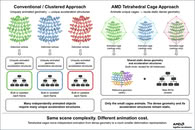
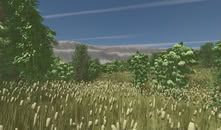
Source: GPUOpen (AMD)
Add your own comment

31 Comments on AMD Shows Off Ray Tracing Tech That Slashes GPU Memory Use By 47x

#1
claylomax
AMD always ahead of the game.
Posted on Reply
#2
SiliconSeraph
DrUsmanSaleemThe tradeoff is losing per-vertex animation control, which is why AMD is positioning it for grass, foliage, and other dense but not individually detailed objects
DrUsmanSaleemAMD says the same demo would normally require up to 80 GB of GPU memory and over 300 ms per frame for BVH updates using standard methods. With tetrahedral cages, that dropped to about 1.7 GB of memory
Even if the current use-case is sort of niche, that kind of streamlining and those results (if honest) is huge. Really curious how this will develop from here.
Posted on Reply
#3
Grimling
This is really impressive and all, but do we really need individually ray-traced grass in Games?
Posted on Reply
#4
Hecate91
This sounds nice for performance efficiency, but I don't see why we need ray traced grass and trees.
Posted on Reply
#5
TumbleGeorge
For as long as I can remember, I have always read advertisements stating dozens, hundreds, and even thousands of times the difference in things compared to previous products, and always in my favor. I don't feel a significant change in my life because of these "thousandfold" improvements over the past decades, as if they don't exist.
Posted on Reply
#6
ThomasK
Grimlingbut do we really need individually ray-traced grass in Games?
The question is: do we really need Ray Tracing at all? As far as I know, this tech was forced down the throat of the gaming industry by Nvidia, when it rebranded its popular GTX line of products to RTX. "Revolutionary" is what was promised, yet here we are in 2026 having to use upscaling/FG to make up for the performance loss of that same tech on more modest hardware. Don't have hardware that supports RT? Some games won't run at all.

Plenty of older games already looked great without RT. Current games, such as BF6, run and look great on a plethora of hardware configs without an RT implementation whatsoever.

In my opinion, pushing RT towards an industry-wide adoption always had more to do with programmed obsolescence and forcing people to upgrade their old hardware, which used to run things all too well.
Posted on Reply
#7
Steevo
TumbleGeorgeFor as long as I can remember, I have always read advertisements stating dozens, hundreds, and even thousands of times the difference in things compared to previous products, and always in my favor. I don't feel a significant change in my life because of these "thousandfold" improvements over the past decades, as if they don't exist.
Gaming early on it was 800X600 or 1024X768 or smaller, with low Anisotropic filtering and antialiasing and trying to keep FPS up by lowering details on the most expensive cards around.

Now pushing 17.28 times the pixels, with more color depth, perfect anisotropic filtering, antialiasing so that essentially no one complains about jaggies anymore, and at the highest textures and multiple lighting passes and options per frame… it’s better and I notice it.

www.techpowerup.com/download/futuremark-3dmark03/

As for the tech, its interesting how they rethought up the way to reduce the performance hit RT/PT comes with. The demo is just that, a proof of concept demo showing their idea and model works, I'm sure they hope developers will integrate it so they reduce the overhead, also so they can use it on console hardware. I wonder what the first game to use it will be. RT is getting close to realistic, still to shiny/plastic looking in most games for the huge performance hit it costs.
Posted on Reply
#8
chrcoluk
Helping their competitor? the one that under spec'd VRAM?
Posted on Reply
#9
shuffy_losys
ThomasKThe question is: do we really need Ray Tracing at all? As far as I know, this tech was forced down the throat of the gaming industry by Nvidia, when it rebranded its popular GTX line of products to RTX. "Revolutionary" is what was promised, yet here we are in 2026 having to use upscaling/FG to make up for the performance loss of that same tech on more modest hardware. Don't have hardware that supports RT? Some games won't run at all.

Plenty of older games already looked great without RT. Current games, such as BF6, run and look great on a plethora of hardware configs without an RT implementation whatsoever.

In my opinion, pushing RT towards an industry-wide adoption always had more to do with programmed obsolescence and forcing people to upgrade their old hardware, which used to run things all too well.
The same could be said about any graphics tech. Or tech in general.
Posted on Reply
#10
Grimling
ThomasKThe question is: do we really need Ray Tracing at all? As far as I know, this tech was forced down the throat of the gaming industry by Nvidia, when it rebranded its popular GTX line of products to RTX. "Revolutionary" is what was promised, yet here we are in 2026 having to use upscaling/FG to make up for the performance loss of that same tech on more modest hardware. Don't have hardware that supports RT? Some games won't run at all.
I understand your point. And sometimes a bad Raytracing implementation looks worse, than no ray tracing at all. Think about that.
But fundamentally, the tech is good. Having real time realistic lightning and reflections, instead of pre-rendered lightning and fake reflections is a good thing to have, especially if you are a developer.
The first and second generation of RTX cards, ironically, can not play those ray-tracing titles that they have been promoted by nvidia to be used for. I also have to ask, what is with physx? why is nobody using that anymore?
Posted on Reply
#11
RejZoR
Hecate91This sounds nice for performance efficiency, but I don't see why we need ray traced grass and trees.
Because they are trying to do shading and shadowing without having to touch anything manually. They just want to slap light sources on the scene and make it all render by itself correctly. Which is the point of RT, but we're not there yet, not even remotely despite countless showcases of ray tracing.
Posted on Reply
#12
Philaphlous
And to demonstrate the tech they show a screenshot from a 3d game from 1999? What's with the second picture in the article. Looks awful. How is this better?
Posted on Reply
#13
Steevo
PhilaphlousAnd to demonstrate the tech they show a screenshot from a 3d game from 1999? What's with the second picture in the article. Looks awful. How is this better?
You are missing the point, the screenshot is of a TECH DEMO showing the technology working, not a pretty demo showing how pretty it can be, thats the job of developers. They made RT work on a normal card without the huge performance hit, no need to brute force it with 600W of power. The demo they showed if performed the way its done now wouldn't even run on a 5090, but with this, a 9070 is running it at 60FPS.

Scaling it, a Gforce 5050 with 8GB of memory or a 9050 with 8GB of memory would be able to run current RT games without issue, im sure future iterations will allow for PT capabilities.
Posted on Reply
#14
Visible Noise
PhilaphlousAnd to demonstrate the tech they show a screenshot from a 3d game from 1999? What's with the second picture in the article. Looks awful. How is this better?
It’s not better - at least not yet.

From the published research:
Although memory consumption of the watertight method is only 2.3−3.2× that of the non-watertight method the required software fallback introduces a significant runtime overhead of 19− 80×, making it unsuitable for real-time rendering and more applicable as a reference solution.
This makes only the non-watertight method applicable to real-time rendering on current generation GPU hardware, while the watertight version can still be used as a validation reference.
So, not for gaming. Unless you want Flickervision.
Posted on Reply
#15
Dr. Dro
Tet-cages work differently. A dense mesh is enclosed by a much smaller deformable tetrahedral cage. The dense geometry of an animated object and its BVH structures remain static and reusable. During runtime, only the cage deforms. Rays are transformed back into a static reference frame before intersecting them with the dense set of triangles. This means animation cost only scales with cage complexity, not with triangle count. This comes at the expense of losing animation control over every vertex, but this is fine for many animations.
I've read about this a few days ago. I think that overall, this is an acceptable tradeoff and the granularity of it would still allow for more precise effects when needed. For most games, you are still going to achieve a great level of visual fidelity, although you are going to lose some of the "faithfulness" of the produced image. From what I understand, this is some sort of precombining meant to reduce the RT load.
chrcolukHelping their competitor? the one that under spec'd VRAM?
This means to address performance shortcomings in hardware, although from what I understand, this wouldn't be a vendor-exclusive technique, but rather an optimization to be deployed at the engine vendor level.
Posted on Reply
#16
Visible Noise
Nvidia’s version, presented at Sigraph 2023.

d1qx31qr3h6wln.cloudfront.net/publications/MicroMesh_generation.pdf

Hardware support was included in Ada, therefore it’s able to run in realtime while remaining watertight, unlike AMD’s version which has to do a software fallback and cannot run in realtime on their current hardware.

Yes, features matter.

Edit: To head off the usual four of you before you go off on your rants, Nvidia’s work is cited in the AMD presentation.
Posted on Reply
#17
Hecate91
The difference for the usual Nvidia fans is this feature isn't limited to Nvidia GPU's, since as the OP states it could be combined with Direct X raytracing.
Posted on Reply
#18
Visible Noise
Hecate91The difference for the usual Nvidia fans is this feature isn't limited to Nvidia GPU's, since as the OP states it could be combined with Direct X raytracing.
Hahahaha. Which Nvidia proposed two years ago. From AMD’s paper that you should have read before posting.

Posted on Reply
#19
john_
The entire technique reminds me of the ZX Spectrum from the 1980s. The ZX Spectrum had a resolution of 256x192 and divided the screen into 8x8 pixel blocks. Each block could only display two colors—in short, individual pixels did not have their own color. This significantly reduced both the required processing power and memory demands.

GrimlingI also have to ask, what is with physx? why is nobody using that anymore?
Nvidia could have established it in the market since at least 2010, but it chose to do what it almost always does. It locked it down and required both it and the graphics to run exclusively on its own hardware. You couldn't have an AMD graphics card in the system for graphics and an Nvidia card for physics. AMD was at 40%-45% of the market back then. At a time when almost all ATX motherboards—even budget ones priced around $60–$70—offered the ability to run more than one graphics card in a system, Nvidia didn't even allow the option to use an AMD graphics card for graphics alongside a second Nvidia graphics card to accelerate PhysX and CUDA technologies.

Furthermore, the software version of PhysX for CPUs was intentionally crippled and acted more like a demo slideshow designed to drive users to buy a high-end Nvidia card, rather than serving as a genuine option. This is another practice Nvidia has implemented a few times over at least the last 15 years. This changed much later, somewhere around 2014 I believe, when hardware PhysX was already dead and Nvidia removed the locks from its drivers.

Nowadays, Nvidia drivers no longer disable PhysX and CUDA when an AMD or Intel primary graphics card is present; instead, they activate and function normally whenever an Nvidia graphics card is added to the system, even as a second GPU. Of course, by the time Nvidia decided to make this move, hardware PhysX was already dead—which is precisely why they did it. If hardware PhysX were still alive, it would still be locked down.
Visible NoiseHahahaha. Which Nvidia proposed two years ago. From AMD’s paper that you should have read before posting.

The typical story we've been seeing for 20 years. Someone has an idea (2023), Nvidia grabs it and builds a proprietary version exclusively for its hardware (2024), AMD steps in and proposes an open version that works everywhere (2026). We should thank both of them, Nvidia and AMD. Without Nvidia, many technologies wouldn't exist. Without AMD, many technologies would remain exclusive to Nvidia hardware, and rendering a game on non-Nvidia hardware would result in a much worse visual presentation on screen. We saw these exact shenanigans back with PhysX, and it was a disgrace.

Posted on Reply
#20
JustBenching
ThomasKThe question is: do we really need Ray Tracing at all? As far as I know, this tech was forced down the throat of the gaming industry by Nvidia, when it rebranded its popular GTX line of products to RTX. "Revolutionary" is what was promised, yet here we are in 2026 having to use upscaling/FG to make up for the performance loss of that same tech on more modest hardware. Don't have hardware that supports RT? Some games won't run at all.

Plenty of older games already looked great without RT. Current games, such as BF6, run and look great on a plethora of hardware configs without an RT implementation whatsoever.

In my opinion, pushing RT towards an industry-wide adoption always had more to do with programmed obsolescence and forcing people to upgrade their old hardware, which used to run things all too well.
Yeap, Nvidia forced Ray tracing down the throat of consoles. Cause we all know Playstation and Xbox are using Nvidia hardware. Right?

For goodness shake can you stop for a single thread going in your usual tangent. We get it, it's the worst company on the planet.
Posted on Reply
#21
kazuviking
SteevoScaling it, a Gforce 5050 with 8GB of memory or a 9050 with 8GB of memory would be able to run current RT games without issue, im sure future iterations will allow for PT capabilities.
Except when this leaves the drawing board nvidia or dx12 will already have something better implemented as usual.
Posted on Reply
#22
Craptacular
GrimlingThis is really impressive and all, but do we really need individually ray-traced grass in Games?
Shadows. Wind Waker HD vs the GC release of Wind Waker is a perfect example of the difference this can have on the visuals of a game.
Posted on Reply
#23
Grimling
CraptacularShadows. Wind Waker HD vs the GC release of Wind Waker is a perfect example of the difference this can have on the visuals of a game.
I am sure that Wind Waker HD has no Ray-Traced Grass whatsoever at all.
You do not need to have Ray-Tracing to have shadows.
Posted on Reply
#24
jdrch
Almost 3x the improvement Nvidia showed in April:
Posted on Reply
#25
Craptacular
GrimlingI am sure that Wind Waker HD has no Ray-Traced Grass whatsoever at all.
You do not need to have Ray-Tracing to have shadows.
The point was why would you want individual blades of grass or foliage or plants to cast shadows. RT or not, why would you want them to cast shadows? The reason is because it makes the game look surprisingly different and better, perfect example is Wind Waker HD
Posted on Reply
Add your own comment
Nov 12th, 2026 04:40 CST change timezone

New Forum Posts

Popular Reviews

TPU on YouTube

Controversial News Posts