Thursday, October 15th 2026

Leaker Hints at 512 GB Partner Versions of Intel's GPU D-Series
A leaker going by Haze on X claims that some partner-built versions of Intel's new GPU D-Series accelerator will come with as much as 512 GB of memory. The October 13 post, spotted by VideoCardz, names no board partners and gives no other specs, so take it with a pinch of salt for now. Intel hasn't confirmed anything like this either. Officially, Intel's own D-Series card, formerly known as "Crescent Island", ships with 160 GB of LPDDR5X, and the company allows partners to go as high as 480 GB. The 512 GB figure is a bit odd when you look at the hardware. The leaked "Crescent Island" PCB from May showed 20 LPDDR5X sites, 12 on the front and eight on the back, each with an 8 GB package for 160 GB in total. Moving to 24 GB packages gets you neatly to 480 GB, while 512 GB doesn't divide evenly across 20 sites.
The D-Series itself is an inference-focused accelerator built on Xe3P with 32 cores, 1.5 TB/s of memory bandwidth and up to 1.3 PFLOPS of FP8 compute. It's a 350 W, air-cooled PCIe 5.0 x16 card with no display or 3D graphics hardware, so gamers shouldn't get their hopes up, and earlier leaks already suggested Xe3P would skip Arc gaming cards altogether. Customer sampling is underway, but pricing and availability are still unknown. A 512 GB partner card, if it exists, would likely cost a small fortune. It would probably take a different board layout or a mix of package densities, and there's no word on whether any partner is actually doing that.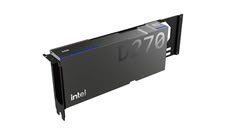
Sources:
Haze on X, via VideoCardz
The D-Series itself is an inference-focused accelerator built on Xe3P with 32 cores, 1.5 TB/s of memory bandwidth and up to 1.3 PFLOPS of FP8 compute. It's a 350 W, air-cooled PCIe 5.0 x16 card with no display or 3D graphics hardware, so gamers shouldn't get their hopes up, and earlier leaks already suggested Xe3P would skip Arc gaming cards altogether. Customer sampling is underway, but pricing and availability are still unknown. A 512 GB partner card, if it exists, would likely cost a small fortune. It would probably take a different board layout or a mix of package densities, and there's no word on whether any partner is actually doing that.

4 Comments on Leaker Hints at 512 GB Partner Versions of Intel's GPU D-Series
Not for me, thank you very much.
512GB would be feasible if they decreased the bus width to 1024-bit, with 16 channels, using 16x 32GB ICs (or 32x 16GB ICs in clamshell).
That is plausible, given that the regular 1280-bit version would be able to go up to 640GB with 40x 128Gb ICs in clamshell, and such modules are already listed in Micron's catalog, it'd just require LOTS of board space lol
But oh well, if Nvidia managed to cram 32 GDDR7 modules into the RTX PRO 6000, maybe Intel can do the same.