Wednesday, May 20th 2026

Leaked Intel Crescent Island PCB Surfaces with Xe3P GPU, 160 GB LPDDR5X and 16-Pin Power
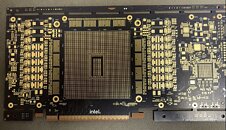
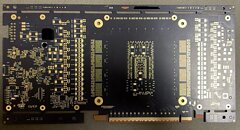
A PCB leak from YuuKi_AnS has given us the first look at Intel's Crescent Island PCIe accelerator and a few things stand out immediately. The Xe3P GPU die is visibly larger than the Xe2-based BMG-G31 in the current Intel Arc lineup. Xe3P is the architecture following the current Xe3. While Xe3 is heading to client products under the Arc C-Series branding, Xe3P is being positioned as a more scalable design that covers client iGPUs all the way up to data center inference. Memory is the other talking point confirming previous rumors by leaker Jaykihn from April. Rather than HBM, Intel is going with LPDDR5X, the PCB showing 20 memory sites in total, 12 on the front and 8 on the back, each carrying 8 GB for a total of up to 160 GB. This is a deliberate choice made by Intel to sidestep the HBM supply issues while keeping costs down, though LPDDR5X trades bandwidth for lower pricing compared to HBM standards.
The rest of the PCB shows 13 populated VRM stages out of 18 total positions, and power comes in via a single 16-pin connector on the back of the board. A USB Type-C port on the side appears to be for engineering and testing purposes rather than a production feature. Intel Crescent Island GPUs are still a few months out, but the leaked PCB looks close to a final design according to the source. However, no gaming variant is expected based on current rumors. The company recently introduced the Arc Pro B70 and B65 professional cards based on Battlemage Xe2 silicon, while rumors surrounding a higher-end Arc B770 gaming model have largely gone quiet ahead of Computex.
Sources:
YuuKi_AnS on X, via Videocardz
The rest of the PCB shows 13 populated VRM stages out of 18 total positions, and power comes in via a single 16-pin connector on the back of the board. A USB Type-C port on the side appears to be for engineering and testing purposes rather than a production feature. Intel Crescent Island GPUs are still a few months out, but the leaked PCB looks close to a final design according to the source. However, no gaming variant is expected based on current rumors. The company recently introduced the Arc Pro B70 and B65 professional cards based on Battlemage Xe2 silicon, while rumors surrounding a higher-end Arc B770 gaming model have largely gone quiet ahead of Computex.


15 Comments on Leaked Intel Crescent Island PCB Surfaces with Xe3P GPU, 160 GB LPDDR5X and 16-Pin Power
aka
Set sail for fail.
Still waiting for an A310/380 replacement to drop.
Depending on how they clock it, on the higher end we could see 8533~9600MT/s being used, which would mean 683~768GB/s of memory bandwidth.
Far from great, but with that capacity it would be a pretty nice device for MoE inferencing, as long as its priced correctly ofc.
This is not for any of us, fully data center oriented, which makes me wonder why did they bother with 12VHPWR 16pin connector, why not just go with a simple EPS connector?
160gb of LPDDR5X sure does sound fun
videocardz.com/newz/intel-crescent-island-gpu-to-support-lpddr5x-9600-memory-and-1-5-tb-s-bandwidth
They are apparently going to use 64-bit modules, so 1280-bit in total with 9600MT/s, which doubles the estimate I had done before to 1.5TB/s of mem bw. This gets it close to a RTX PRO 6000's mem bw with almost double the memory, so it'd allow Intel to price it around $10k without much issues.
If higher density options become available, then 320~480GB total VRAM leaves it at a capacity higher than the current top of the line products from Nvidia and AMD, ofc at a way slower mem bw and compute perf, but hopefully at a fraction of the price as well. It'd be PERFECT for inference.With the above rumor such setup becomes directly competitive with the likes of GDDR7, but at higher memory density.
I can't comment on cost since I don't know how much cheaper/expensive GDDR modules and controllers are when compared to LPDDR ones.
I'm not sure if 192/256Gb are already available, but those would be nice to see.
EDIT: 192Gb dies are available, the Strix Halo refresh is going to be using those to bump its capacity to 192GB:
www.servethehome.com/amd-reveals-ryzen-ai-max-pro-400-series-192gb-ram-for-ai-systems/With a minor caveat that Strix Halo uses 32-bit modules instead of 64-bit ones, but 64-bit modules should not be hard to become a thing.Aren't LPDDR5X dies usually 8 or 16-bit wide? I know that Micron does have some parts which apparently use 32-bit dies, but that doesn't seem to be the norm.
Anyhow, internal organization of a package is almost irrelevant, what matters most is the width of your individual package. Micron lists availability for 16/32/64-bit wide parts, I'm not sure if there are options outside of this range from other manufacturers.
Just anything for the lower end, especially for lower end LP.