Wednesday, October 28th 2026

NVIDIA GeForce RTX 5080 Reaches Nearly $2,000 Across U.S. Retailers
NVIDIA's GeForce RTX 5080 has seen a significant increase in its listed price over the past few weeks, with this high-end GPU now costing nearly $2,000. Due to price hikes throughout the supply chain and the GPU's 16 GB of GDDR7 memory, which is currently in short supply, the listing price has doubled its original MSRP. NVIDIA initially launched the GeForce RTX 5080 in early 2025 with an MSRP of $999. However, add-in card partners introduced custom solutions such as new PCBs, enhanced cooling, and other features that gradually increased the price. The pricing issue escalated when the memory supply became constrained, making the GDDR7 memory modules used in this GPU much more expensive.
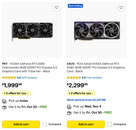
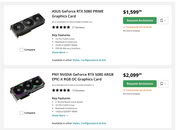
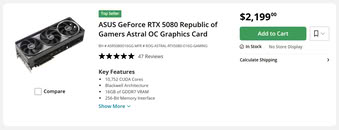
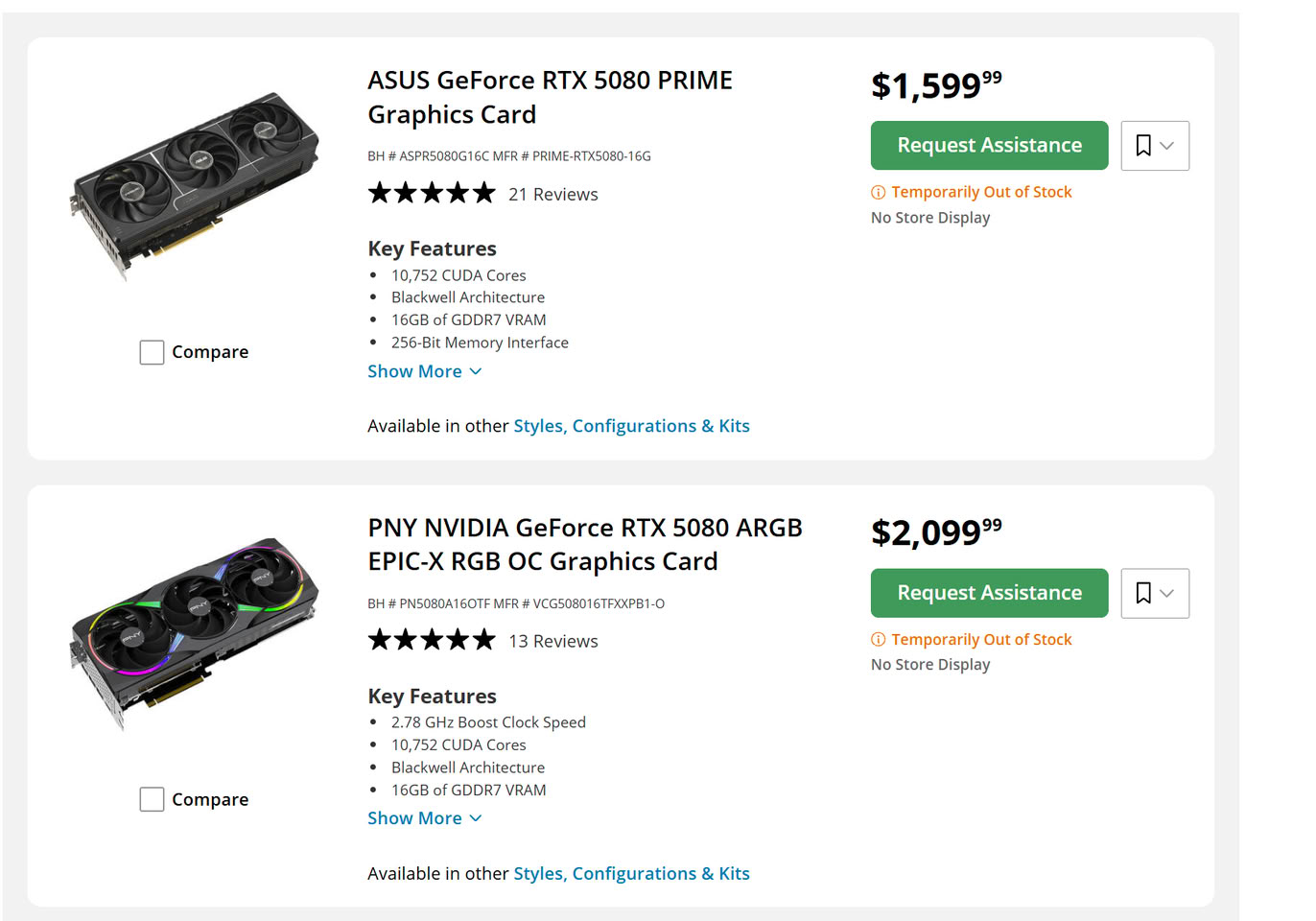
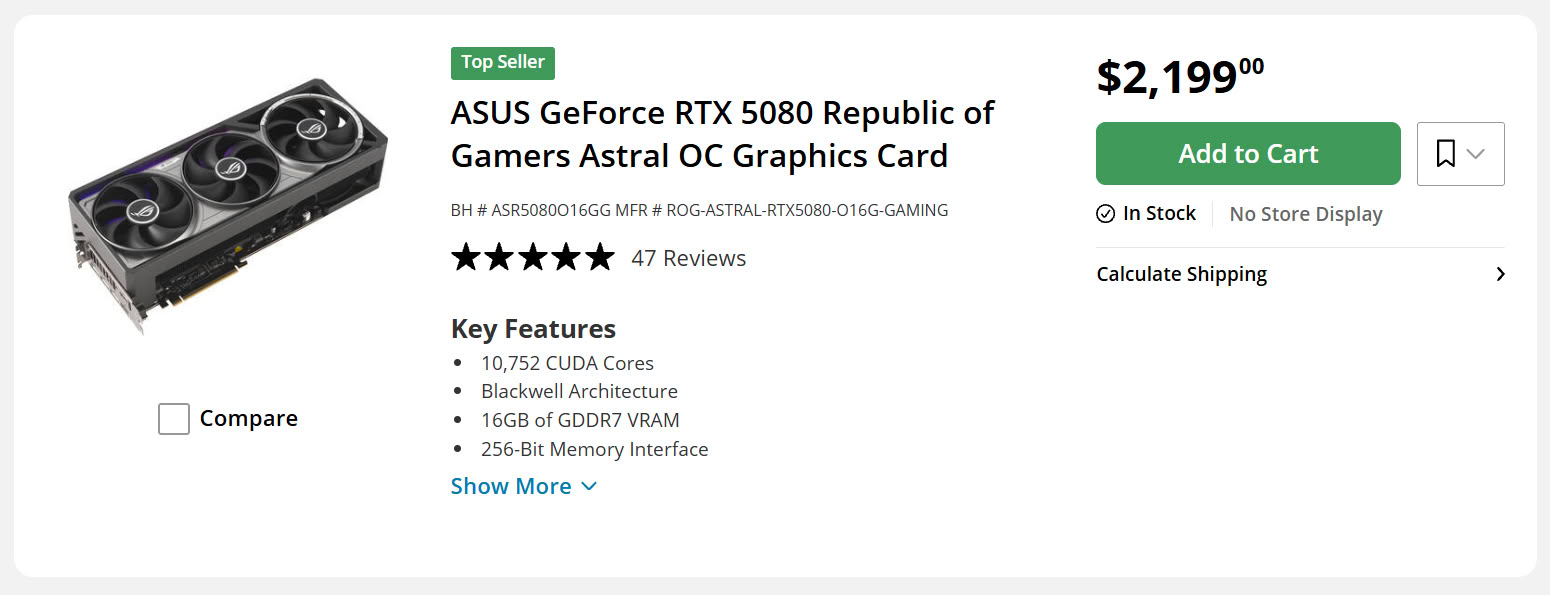
Across U.S.-based retailers like Best Buy, Micro Center, Amazon, Newegg, B&H, and others, the listing price now starts at nearly $2,000. On B&H, older listings show better pricing but are marked as "Temporary out of stock." Only the in-stock listings are priced at $2,000 or more, indicating that new pricing adjustments have been made across all retailers. In just two months, the listings have jumped from $1,200 to $2,000, which is a dramatic increase in pricing. Below are screenshots collected across U.S.-based retailers.

Sources:
U.S. Retailes, via VideoCardz
Across U.S.-based retailers like Best Buy, Micro Center, Amazon, Newegg, B&H, and others, the listing price now starts at nearly $2,000. On B&H, older listings show better pricing but are marked as "Temporary out of stock." Only the in-stock listings are priced at $2,000 or more, indicating that new pricing adjustments have been made across all retailers. In just two months, the listings have jumped from $1,200 to $2,000, which is a dramatic increase in pricing.


60 Comments on NVIDIA GeForce RTX 5080 Reaches Nearly $2,000 Across U.S. Retailers
Not me, I’m saving for an upright freezer.
$2k usd after exchange that’s not far off for the cost of all the PT wood I bought for my new deck 14’x24’.
You're welcome 😄
Things might get much worse for enthusiasts, but hopefully there is some kind of relief if AI companies at least slow down on hoarding servers.Nvidia didn't claim to stop being a gaming company until the AI bubble, it wasn't until recently that gamers got thrown in with edge computing and it became obvious they no longer cared about the gaming market that built the company.
Appalling. :p
Regards,
Fred.
Almost like not making a 9080xt was a.....BAD idea, and will result in your competitor getting a captive market. Whoudda thunk it?Its just a gaming GPU, calm down.
The shortage isnt going away, and prices continue to climb. Logically, that will mean GPU prices will also continue to climb, because there is no supply easing to allow more products to be made. Thats how supply and demand works.
The 5080 doesn't have any more of a market than the 9070XT or 5070Ti does, the x80 class card doesn't have any extra VRAM to be appealing for AI purposes.There never was a shortage, there's still plenty of GPU's to be had, everything is expensive because of the circular financing game that hopefully some of the players in it will give up due to the bubble being unprofitable.
Nvidia has never claimed to stop being a gaming company.The 9070xt doesnt offer the same performance as a 5080. That is why it still sells.Ther eis a memory shortage, that is why prices are sky high. Production has already been spoken for for the forseeable future.
If you have proof otherwise you should present it to the SEC instead of complaining here.
I told you so... 😁
EDIT: I have to correct myself after some more minutes: 6000 USD!
Gaming is just a side business for Nvidia, lumped in with edge computing.A 5080 offers 10-15% more performance at 2X the cost, the 5080 was selling, but probably not to gamers now.What shortage? I can still buy memory or a GPU, if I sell a kidney first though. Production being allocated for in 5 years when the bubble might pop by then is not a shortage.
Any of these 3 letter agencies that should be regulating and fining these companies for colluding to pump up each others stock values are currently allowed to operate as they like for political reasons.
I'd feel a lot differently if I hadn't upgraded in 2024, and I do feel for anyone who's a couple of hardware cycles behind and stuck with what they've got for the foreseeable future. I was in that position with dying old hardware during the COVID/crypto shortages and it was horrible.
I imagine that even if AI capex craters that it will take time for prices to normalize; it will take time for manufacturers to pivot lines back to client/consumer hardware, and it will take even more time to satisfy pent up demand from people who have held off upgrading or buying/building new systems.
"Only" $1700 USD in Australia at the moment too, for anyone willing to risk the shipping and still overpaying by a lot.Well, you rounded down the performance difference and every other advantage got rounded to zero. When GPU limited, the average is more like 21%, or using RT/PT it's anywhere from 25% to 200%+ faster, and has first party support for all the features, and the first party features are better. Paying exorbitant prices for one is absolutely pretty daft to me, but we don't need to misrepresent the product itself.
You do know that in latest financial report Datacenter / AI represented 92% of the roughly 100 billion dollars in a quarter - and even the rest, bunched up in a “miscellanea” category (Edge computing) is getting most of their revenue connected to AI?
So I guess the correct answer is “There is no Dana, only Zuul.”
Oh, here I go again, using forbidden language and terms!
Trump says he is going to ban everyone from using the phrase ‘artificial intelligence’
They never offered free technology, even though they often built upon existing free technologies, modifying them appropriately and then presenting them as their own exclusive developments.
The fact that they redirect far more hardware into AI than others do (Intel and AMD use large quantities of wafers for CPUs—Ryzen CPUs didn't disappear from the market just to manufacture more Instinct accelerators, for example) makes total sense given how Nvidia operates. And that is why they are making the money they make today. Even long before AI, back in 2010 when AMD was offering equally good or even better solutions to consumers, Nvidia played the PhysX (and CUDA) card to charge higher prices. Profit above all else, but we must acknowledge that this strategy never backfired on them. Even back when the HD 4870 launched at $299 while Nvidia was demanding $649 for the GTX 280, they threw a $50 rebate in the face of GTX 280 early adopters, and those buyers actually thanked them for it. They lost a mere single-digit market share.
They couldn't care less about gamers today. Because if AI collapses tomorrow and they are forced to shift all their focus back to gaming hardware, they will still sell with a 75% profit margin, and gamers will still kiss their feet.
The EO is calling for SI to be defined 60 days after enacting the order. Depending on how SI will be defined and its departure from AI’s definition it could have legal ramifications to how the Government deals with SI compared to AI.
Anyway that is my understanding of it.
I got mine for ¥119,000 but before and after that (with a few other dips) it looks pretty steady. Other models graph about the same (reasonably flat). Mostly, 9070XTs seem to range by model (even tho there's actually very little difference in performance) between $700 and $900.
And, what, I guess everyone already (actually) knows the performance differences between the 9070Xt, the 5070Ti and the 5080 - even if they may pretend not to. But, here's a refresher. For raster graphics the 9070XT typically sits (on average) between the 5070Ti and the 5080. For ray tracing the 9070XT is typically about the same or a little under the 5070Ti - it's close. For path tracing the 9070XT is at least 30% slower than the 5070Ti. The 9070XT is also missing a few functions like Ray Reconstruction (RT Noise removal) or the new "regenerative" DLSS 5. And for creative apps (video, 3D rendering, FX processing, ML, SiSim, etc.) it just depends on if the app supports ROCm & HIP - too many commercial (consumer) applications don't but when they do, speeds are very close to 5070Ti and about 15~20% behind the 5080. That's all considering the newest drivers (which matters quite a lot for these comparisons). And of course both platforms have multiple issues; NVidia shudders and shutters more in some games while AMD as already mentioned is behind on driver features for example.
You developed a product using this hardware and optimised / debugged your code so that it runs flawlessly on your standard x50/x60 series card.
Anything that only runs at an acceptable frame rate on an x80/x90 card is merely a tech demo.
Those who bought x80/x90-class graphics cards did so because they could afford them or wanted to show off.
Back when GTX was still a thing, it didn’t matter whether you had the top-of-the-range model or not. By the time the next generation came along, the performance tier had shifted anyway, and what used to be the top-of-the-range model was now, at best, upper mid-range.
With the introduction of RT and ML upscaling, the only thing that’s changed is that you’re now ‘forced’ to keep buying new hardware, as great care is taken to ensure it remains proprietary and the latest software (DLSS, RT) is kept hidden behind a paywall for as long as possible.
But RTX x080 was never classified as anything else as a gaming card. And since RTX 5080 only has about 50% of 5090 performance, it's nominally "a midrange card". That it costs $2000+ is apparently buyer's problem, not a label of what it's purpose really is.
The 2080 Ti was what you’d call a prosumer card, and even then the rationale was questionable, as it was ‘only’ 40–60% faster than the standard 2070. And, depending on the situation, only 8% faster than the 2070 Super.
It was the same story with the GTX 10 series. The key point here was that the 1080 Ti and Titan X had more VRAM than the standard cards.
More VRAM only made such cards attractive to users who could actually utilise that capacity. Back then, that wasn’t yet possible in the gaming sector, and even today, the VRAM on a 5090 is a complete waste if you’re only using it for gaming.
More shaders, TMUs, CUs and ROPs help, but to a certain extent this can also be achieved through clock speeds. As a rule of thumb, simpler chips run at higher clock speeds than more complex ones.
And if the Steam statistics are to be believed, the 5080 doesn’t even have a 2 per cent market share. Whereas the RTX 3060 through to the RTX 5060 Ti account for a good 28% ( 21% excluding laptop GPUs) of the market share.
If I apply the same criteria, all RTX x80 cards currently have a market share of just 6 %. That’s a joke. It’s about as representative as the proportion of Jaguar XFs on the road compared to Toyota Priuses.
But let’s put that argument aside for now, as it’s rather flawed.
At the end of the day, nVidea sells proprietary software which, strangely enough, only runs well if you’re prepared to dig very, very deep into your pockets. (AMD hasn’t exactly covered itself in glory recently either.)
As a rule, the x60 series should be the benchmark. Everything runs on it with good performance, and with just a few compromises, even at 1440p or 4K. But that’s not the case.
The x50 series should really be seen as the budget option, and anything below that is simply better than the iGPU or better than nothing.