News Posts matching #partners

Return to Keyword Browsing

GTA 6 Comes to Xbox One at Launch via Cloud Gaming, PC Players Out of Luck

Xbox One owners will be able to play GTA 6 when it launches on November 19, while PC players still have no official way in. In its pre-load announcement, which also confirmed a 30 FPS target on consoles, Rockstar says the game will be available through Xbox Cloud Gaming on Xbox Series X|S and Xbox One consoles, using Xbox Series S graphics settings. Xbox says streaming opens at 1 AM ET on launch day, and the game still has to be bought separately. Rockstar also warns that connection speed and other technical factors may affect performance in ways that local play would not.

Xbox CEO Asha Sharma framed the news as the start of a much bigger deal with Rockstar's parent company. In a post on X, she called the Xbox One cloud launch the first step of a new 10-year strategic partnership with Take-Two, adding that GTA 6 is already the most pre-ordered game ever on the Microsoft Store. Neither company has shared the terms of that partnership so far. Xbox did confirm that GTA 5, Red Dead Redemption 2, and more Rockstar titles will join Xbox Cloud Gaming in the coming months. Back in October, Sharma reportedly told staff at an internal town hall that Xbox had something planned around GTA 6 that "no other platform holder is doing," which led to reports of exclusive streaming rights. Xbox CSO Matthew Ball shot those down shortly after, saying the game "will not be streaming exclusively or to PC."



NVIDIA Launches Investigation Into Jensen Huang's Relationship With Suspected Chinese Spy

NVIDIA announced on Sunday that the company's board of directors is launching a full-scale independent investigation into recent reports of founder and CEO Jensen Huang having a relationship with a woman the U.S. intelligence community beleives is an agent of the Chinese state. A few days ago, The New York Times broke a story that Jensen had engaged in a close relationship with an executive at Megaspeed, named Alice Huang. Megaspeed is believed to be helping evade U.S. export controls on NVIDIA chips for Chinese companies, allowing them to use chips that have been banned by the U.S. Government from shipping to Chinese customers. Its network of sister companies is building data centers in Malaysia to satisfy the compute needs of Chinese customers. The original NYT report notes that China's Ministry of State Security, the Chinese equivalent of the CIA, reportedly recruited Alice Huang to extract information from Jensen Huang.

NVIDIA RTX 5070 Ti Climbs $160 in Eight Days, Now 79% Over MSRP

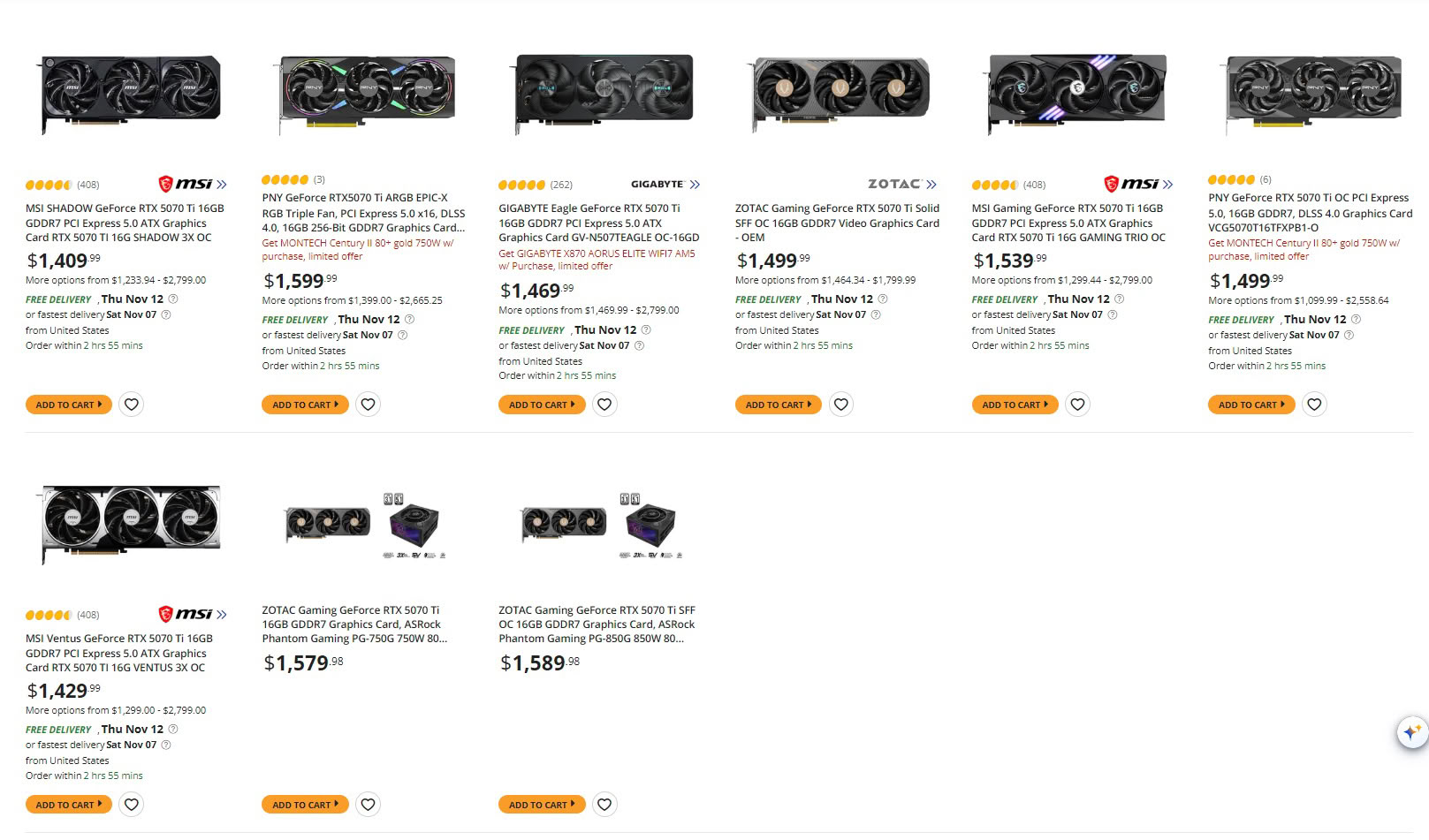
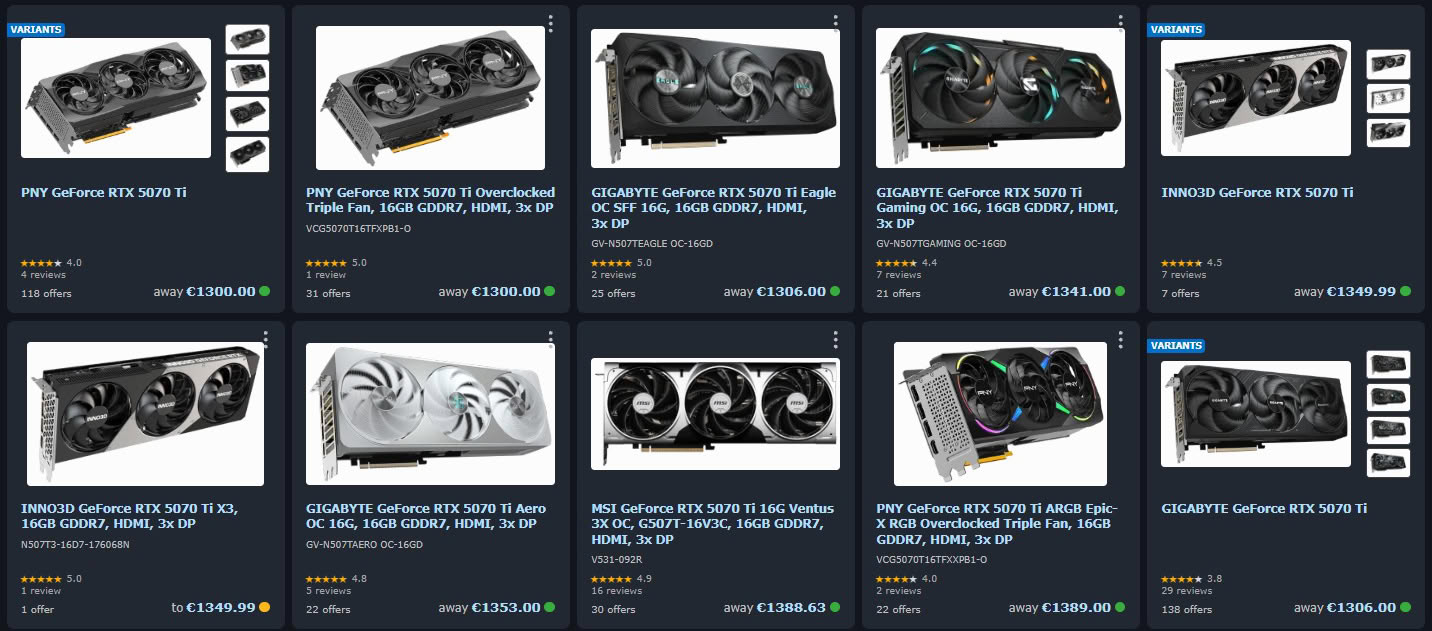
NVIDIA's GeForce RTX 5070 Ti is now close to double its $749 MSRP in the US. According to price tracking by VideoCardz, the cheapest RTX 5070 Ti at major US retailers was $1,339.99 on November 6, about 79% above MSRP, up from $1,179.99 on October 29. That's a $160 jump in just eight days. Some models have already crossed the 2x mark, like the ASUS TUF Gaming OC at $1,499.99 on B&H. Prices are also moving fast. At the time of writing, the cheapest RTX 5070 Ti sold by Newegg itself is an MSI SHADOW RTX 5070 Ti at $1,409.99. Things aren't much better in Germany, where the cheapest listing on Geizhals sits at €1,300 for a PNY model, roughly 48% above the €879 MSRP.

Things are probably going to get worse, too. NVIDIA's board partners in China are reportedly raising RTX 5070 Ti prices by around 1,000 RMB (about $150) this week, with retail prices expected to follow within a week or two. Unlike the RTX 5090 and 5080 16 GB, which have reportedly been discontinued, the RTX 5070 Ti is still officially in production. After reports of an end of production in January early this year, NVIDIA said it was still shipping all GeForce SKUs, and ASUS denied the card was end-of-life, while admitting that memory supply was hurting production and restocking. The card is still listed at major retailers, unlike the RTX 5080, which vanished from NVIDIA's US Marketplace two weeks after the RTX 5090 did the same. Anyone shopping for an RTX 5070 Ti should probably expect these prices to keep rising for a while.

NVIDIA GeForce RTX 50-Series Scheduled for up to $500 Price Hike This Week

NVIDIA's GeForce RTX 50-Series "Blackwell" gaming graphics cards are expected to see significant price adjustments this week. According to Chinese ChannelGate, add-in card (AIC) partners have confirmed that price hikes are scheduled due to the ongoing demand for these GPUs outstripping supply. Some major AIC partners, like Colorful and Galax, have reportedly already started sharing information about these price increases. The most significant example is expected to be for SKUs based on NVIDIA's GeForce RTX 5090 DV2, which will see an increase of up to 3,300 RMB, translating to nearly $500. Even entry-level GPUs are not exempt, as the GeForce RTX 5060 is expected to see around a $30 price increase on existing models. These changes are anticipated to be implemented this week for retail partners, meaning that consumer prices might take a week or two to reflect the new listing prices.
Below is the list of price hikes in China, expected to be the norm.

Samsung Hosts OpenAI's Sam Altman for AI Seminar, No Supply Deal Announced

Two days after arguing that the DRAM in home PCs would be put to better use in data centers, OpenAI CEO Sam Altman sat down with around 50 Samsung presidents on Saturday, October 31. The group went well past the chip business, with leaders from Samsung's finance and biotech arms joining the electronics side at the company's training center in Yongin. Samsung presented it as part of a leadership seminar series for its company-wide AI push, and the talks apparently covered where AI is headed, the markets it could open up, and how it changes the way large companies make decisions. According to Samsung, Altman told the room that adopting AI alone doesn't give anyone an edge, and that the payoff comes from using it to move faster and build better products.

Nothing came out of it in terms of a new supply contract, at least publicly, and Samsung's own write-up stuck to AI strategy. Still, it's hard to look at the visit separately from the memory shortage. Samsung signed a letter of intent with OpenAI back in October 2025 to act as a memory partner for Stargate, with OpenAI's demand projected at up to 900,000 DRAM wafers per month. Separately, on October 31, SK Group chairman Chey Tae-won also reportedly met Altman in Seoul, with SK hynix and SK Telecom executives joining, according to industry sources. Last month, AMD's Lisa Su spent hours with Samsung's chip chief chasing HBM supply, and amid all these meetings, Micron's CEO expects the memory crunch to get worse in 2027 and 2028. It seems like every major buyer is knocking on the same Korean doors.

OpenAI CEO Argues Home PCs Waste the World's Limited DRAM Supply

OpenAI CEO Sam Altman thinks the DRAM sitting inside personal computers would be better used in data centers. He made the comments on the Cheeky Pint podcast, hosted by Stripe co-founder John Collison, in an episode released on October 29. The two were discussing the memory supply chain when the topic turned to local inference, meaning running AI models on your own hardware instead of the cloud. Here's what Altman said, at roughly the 29-minute mark:
Sam Altman, OpenAI CEOA lot of people want local inference. And somehow, they assume that the problem is solved now. Because, we are going to have open-source models. We're going to be able to run them on our computers. And so we're not going to need all the stuff in the data center. But from a global allocation perspective, actually, it's quite terrible to have everybody have a bunch of the world's limited supply of DRAM sitting in their own computer. And, being used 5% of the time. You want maximum utilization in the cloud if you're trying to deal with this very supply constrained environment. And somehow everyone's... many people's intuition is the opposite of that.

AMD Reportedly Plans Another Radeon GPU and GDDR6 Kit Price Hike for November

AMD is reportedly getting ready to raise prices on its Radeon GPU and GDDR6 memory kits again in November. According to a new post from Board Channels, the increase would follow an earlier adjustment in October, when AMD apparently started charging its board partners more for GDDR6 from October 1. The exact scope of the November hike isn't known yet. The main reason seems to be memory, since GDDR6 prices reportedly went up by around 8 to 10% in the third quarter. Board Channels also claims AMD now reviews its kit pricing every quarter to keep up with rising GPU and memory costs. AMD sells its GPUs to add-in board partners bundled with memory, so any increase there usually ends up in the price of the finished card.

This would add to a long list of reported increases this year. A 10% hike on Radeon GPU kits was reported for July, another 10% increase across GPUs, chipsets, and possibly CPUs followed in September, and AMD's suggested Radeon prices in China went up in early October. Retail prices are already moving, too. According to Hardware Unboxed's latest pricing survey, cited by Videocardz, the RX 9060 XT 16 GB costs 17% more than it did in September, while the RX 9070 and RX 9070 XT are up 12%. Of course, AMD hasn't officially confirmed any of this. How much the November change affects store prices will depend on board partner pricing and existing inventory, so buyers who were already planning on a Radeon RX 9000 card might want to buy sooner rather than later.

NVIDIA Reportedly Moves Up RTX 5080 24 GB Launch

NVIDIA's GeForce RTX 5080 24 GB might arrive sooner than expected. A new post from Board Channels' ChannelGate account claims NVIDIA is speeding up the launch, with availability now expected around January 2027 and December 2026 as the earliest option. Earlier this month, various sources relayed that the card was reportedly planned for Q1 2027. The same post says NVIDIA will stop supplying the RTX 5080 16 GB and the RTX 5090 D V2 to China, leaving the 24 GB RTX 5080 as the only flagship model in that market. The report only covers China, so there's no word yet on whether the 16 GB card is going away globally. If the January window pans out, a CES 2027 reveal seems likely, though NVIDIA hasn't confirmed anything.

Apparently, NVIDIA has already cleared out its RTX 5080 16 GB GPU inventory, and the remaining stock should last around two months. That roughly matches a leaker's claim that NVIDIA has January discontinuation dates set for the 16 GB card. The post is machine-translated, so some wording may be off. Specs are still unknown, though 24 GB on the same 256-bit bus would most likely mean 3 GB GDDR7 modules instead of 2 GB ones. Board Channels previously suggested the card could cost around 19,999 yuan (nearly $3,000) in China, while the 16 GB model already sells for close to $2,000 at U.S. retailers, double its $999 MSRP. With the memory shortage expected to get worse in 2027, it's reasonable to expect the 24 GB card to be both expensive and hard to find.

NVIDIA GeForce RTX 5080 Reaches Nearly $2,000 Across U.S. Retailers

NVIDIA's GeForce RTX 5080 has seen a significant increase in its listed price over the past few weeks, with this high-end GPU now costing nearly $2,000. Due to price hikes throughout the supply chain and the GPU's 16 GB of GDDR7 memory, which is currently in short supply, the listing price has doubled its original MSRP. NVIDIA initially launched the GeForce RTX 5080 in early 2025 with an MSRP of $999. However, add-in card partners introduced custom solutions such as new PCBs, enhanced cooling, and other features that gradually increased the price. The pricing issue escalated when the memory supply became constrained, making the GDDR7 memory modules used in this GPU much more expensive.

Across U.S.-based retailers like Best Buy, Micro Center, Amazon, Newegg, B&H, and others, the listing price now starts at nearly $2,000. On B&H, older listings show better pricing but are marked as "Temporary out of stock." Only the in-stock listings are priced at $2,000 or more, indicating that new pricing adjustments have been made across all retailers. In just two months, the listings have jumped from $1,200 to $2,000, which is a dramatic increase in pricing.
Below are screenshots collected across U.S.-based retailers.

Zotac Restocks NVIDIA GeForce RTX 5090 Solid OC in Japan Amid Reports of GPU's EOL Status

The latest in the saga of the NVIDIA GeForce RTX 5090 discontinuation rumors is that OEMs are no longer able to order GPUs or VRAM for the 5090 from NVIDIA, however it seems as though Zotac is undeterred, having just published a restock of the NVIDIA GeForce RTX 5090 Solid OC in Japan. The new listing on Zotac's official online store in Japan was spotted by @momomo_us on X, a popular leaker and hardware insider.

While the GPU appears to be in stock, and selling for as much as 1,190,000 JPY (~$7 558,17 converted), there's no telling if this will remain the case for the foreseeable future. It appears as though Zotac may have had some stock ready to go, but it's also entirely possible that the lack of supply or back-order availability that was previously reported by other board partners could have been due to regional or AIB limitations on GPU allocation by NVIDIA. It may also be an indication that previous reports of the RTX 5090 being end-of-life were inaccurate.

Kingdom Come Developer Warhorse Studios Confirms Cyberattack, Company Data Accessed

Warhorse Studios, the Czech developer behind Kingdom Come: Deliverance II, has confirmed that it was hit by a cyberattack. In an official statement on its website, the studio says the attack involved unauthorized access to company systems and company data. Warhorse is working with cybersecurity experts to secure its systems and assess the full impact, and says it is coordinating with the relevant authorities, though it didn't name them. A much shorter message also went up on the studio's X account on October 27, telling players it was sorry to share the news and thanking them for standing with the studio.

CEO Martin Frývaldský called it "a serious incident for Warhorse Studios and everyone affected," adding that the priority is to secure systems, establish the full extent of the breach, and protect employees, partners, and the community. Other details are thin, however. Warhorse hasn't said when the attack happened, who is behind it, what kind of data was accessed, or whether anything was actually taken, and it isn't giving interviews or further comments while the investigation is ongoing.

NVIDIA Allegedly Stops Accepting RTX 5090 Orders

Although NVIDIA has officially denied the discontinuation of the GeForce RTX 5090, more rumors are emerging that substantiate claims about the flagship gaming GPU being discontinued. This time, NVIDIA board partners are reporting that NVIDIA has officially stopped accepting orders for the 5090, according to a recent report by Der8auer on YouTube, and it appears as though it's not just a temporary freeze on GB202 supply, as has been the case prior, since pre-orders are also not available to buyers.
Unnamed AIB partner via Der8auer on YouTubeNo, NVIDIA did not inform us that the RTX 5090 is EOL. But currently we cannot purchase GB202 together with 32 GB GDDR7 as a complete set, and we also don't know if ordering will be possible in again in future. Similar supplier shortages already happened several times before. But in the past NVIDIA always allowed us to place backorders, which is currently not possible anymore.

Netflix Reportedly Walked Away After Xbox Asked $800 Million for Its Game IP

Netflix reportedly offered Microsoft $500 million for seven years of exclusive film and TV adaptation rights to Xbox games, but the two sides never reached a middle ground. According to Matthew Belloni's What I'm Hearing newsletter at Puck, which cites three sources, the offer came from Bela Bajaria, Netflix's chief content officer at the time. Xbox CEO Asha Sharma and her business affairs team apparently countered at $800 million. Bajaria was recently let go and is being replaced by former Disney and Fox executive Peter Rice, and with her gone, the Netflix offer is said to be off the table. Netflix CFO Spence Neumann was reportedly one of the people who thought the price was too high.

Netflix has not commented on the deal, while Xbox told Puck it has seen "record-breaking interest" in its IP and still considers Netflix a valued partner. The two already have Minecraft and Diablo animated series on the way, and Netflix is also working on a Gears of War movie. Instead of one big exclusive package, Xbox is now said to be chasing smaller deals with more partners, which is pretty much what its new XP division was set up to handle earlier this month. That extra licensing money would probably be welcome right now. Xbox has missed Microsoft's executive pay target for the fifth time in six years, just lost its first chief operating officer, and Sharma recently told staff the division won't survive without new IP. Rice is also expected to go after more IP deals at Netflix, so we can expect the two companies to end up talking again.

NVIDIA Eyes Software Revenue With a $2,000 per GPU Yearly Figure From Huang

NVIDIA CEO Jensen Huang has put a rough price on the software side of the company's AI business. During a Q&A session at GTC Berlin last week, Huang said software licensing will become a growing part of NVIDIA's business, and that it costs about $2,000 per GPU per year to run all the NVIDIA software that powers agents in AI factories. The Register was first to report it, and Huang seems to have offered it as an example rather than a formal price.

The number is a bit confusing, since NVIDIA already sells its AI Enterprise suite on a per-GPU basis. The company's own licensing guide lists it at $4,500 per GPU for a one-year subscription with support, or $18,000 per GPU for five years. NVIDIA hasn't said whether Huang's $2,000 figure covers the same software, a narrower agent-focused bundle, or a future licensing model, so it probably shouldn't be read as a price cut. There's also no word on timing.

ASUS and Gigabyte Bump RTX 5080 Prices in China, RTX 5070 Ti Also Sees Wholesale Increase

Rumors of the RTX 5080 16 GB being discontinued are picking up steam, and the effects are starting to show. RTX 5080 16 GB wholesale prices in China have jumped by around 2,000 yuan (roughly $300), according to new information from Board Channels. The card previously traded at 12,700 to 13,500 yuan (~$1,900 to $2,020) and now sits at 14,500 to 15,000 yuan (~$2,170 to $2,240). Board Channels blames tighter upstream supply and the reported discontinuation of the 16 GB model. A leaker recently claimed that NVIDIA has set January discontinuation dates for the card, though NVIDIA hasn't confirmed anything.

Along with the RTX 5080 16 GB, the RTX 5070 Ti, which uses the same 16 GB of GDDR7, is also facing price hikes. It is now going for 9,650 to 9,850 yuan (~$1,440 to $1,470), compared to 9,000 to 9,150 yuan (~$1,350 to $1,370) before, a roughly $100 bump. Board partners are adjusting too. ASUS has reportedly added 1,000 yuan (~$150) to all of its RTX 5080 16 GB models and 200 yuan (~$30) to the RTX 5070 Ti, RTX 5070, and RTX 5060 Ti 16 GB cards. Gigabyte went further, with 1,200 yuan (~$180) on its RTX 5080 cards and 200 yuan (~$30) on the RTX 5070 Ti and RTX 5070. Cheaper RTX 5060-class cards from both brands saw smaller bumps of 200 yuan (~$30) or less, and ASUS reportedly raised prices on its Radeon cards as well, between $15 and $50.

NVIDIA and Supply Chain Partners Expand Capacity to Accelerate AI Infrastructure Buildout

NVIDIA today announced plans with a group of supply chain partners to expand global manufacturing capacity to meet growing demand for its accelerated computing and full-stack AI factory platform.

Working with Amkor Technology, IBIDEN, King Yuan Electronics (KYEC), Samsung Electro-Mechanics, Siliconware Precision Industries (SPIL) and Unimicron Technology Corporation, NVIDIA is enabling new and existing suppliers to expand critical manufacturing capabilities across substrates, advanced packaging, testing and optical engines, strengthening the resiliency and redundancy of NVIDIA's global supply chain.

NVIDIA Denies RTX 5090 Discontinuation Rumors, Admits Supply Is Tight

NVIDIA has finally responded to reports that the GeForce RTX 5090 is being discontinued. Jeff Fisher, senior vice president of NVIDIA's personal computing business, told Taiwanese media after the RTX Spark launch party in Taipei on October 16 that the rumors aren't true, as reported by 4Gamers and the Central News Agency (CNA). The whole thing kicked off last week when leakers claimed NVIDIA had stopped allocating GB202 silicon to the RTX 5090, and BenchLife later added that board partners were no longer receiving GB202 chips for the card. The RTX 5090 also seemingly vanished from NVIDIA's own marketplace and from Micro Center shelves, which only added fuel to the fire. Here's what Fisher said, translated from 4Gamers' Chinese report:
The supply chain (capacity) is indeed somewhat constrained, but NVIDIA is going all out to bring products to market. Although there are other variants of the RTX 5090 (chip), it has definitely not been discontinued. NVIDIA will continue to ship it, and this is very important.

AMD Addresses Radeon RX 7000 vBIOS Patch

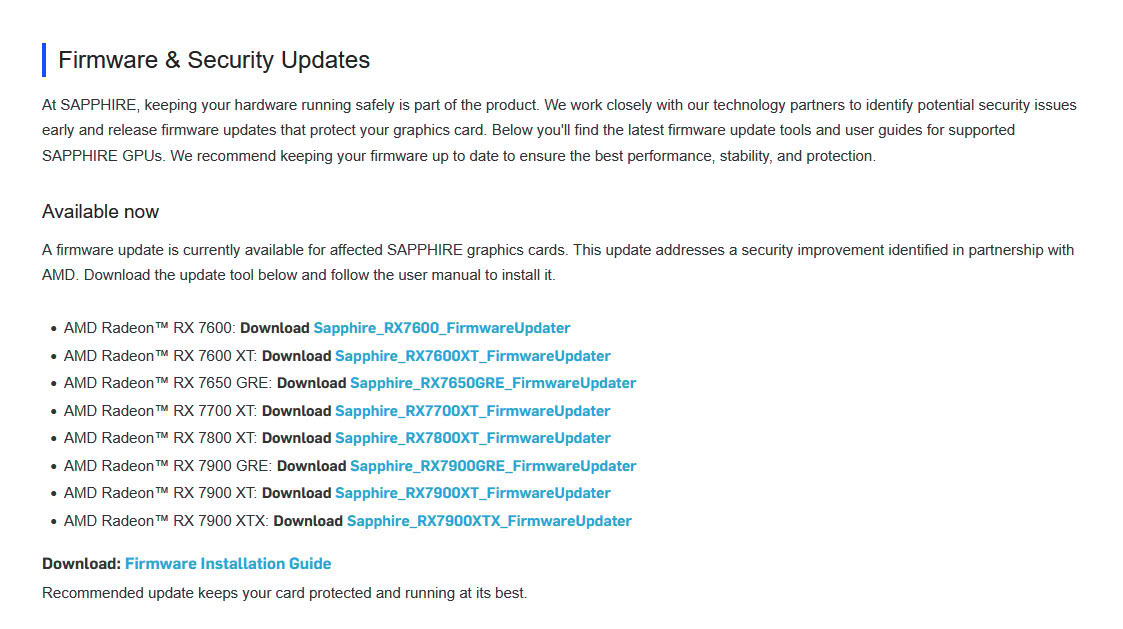
AMD has finally commented on the vBIOS updates that Sapphire and Gigabyte are pushing out for Radeon RX 7000 series graphics cards, though the statement doesn't clear up much. The company reached ComputerBase through Sapphire, which the German outlet had asked last week about what the new firmware actually fixes. Sapphire started offering the updates earlier this month for its RX 7600 through RX 7900 XTX models, citing only a security issue identified in partnership with AMD. Gigabyte followed and was a bit more specific, pointing to vulnerabilities in the AMD VBIOS under the AMD-SN-6023 identifier, an entry that still doesn't show up on AMD's product security page. Here's what AMD said:
As part of our standard procedure, AMD is releasing a firmware update to address potential security vulnerabilities. These fixes are provided ahead of public disclosure to give customers time to update their firmware. As a best practice, we recommend users update the firmware of their graphics cards as soon as it is made available by their respective GPU manufacturer. There are no reports of these vulnerabilities being exploited in practice.

d-Matrix Announces Squadron Compute Clusters for AI Inference at Data Center Scale

d-Matrix today announced d-Matrix Squadron, a fleet of multi-rack systems offering megawatts of highly efficient inference compute for running AI models with extreme speed and energy efficiency at data center scale. Benefiting from d-Matrix's unique memory-centric compute architecture, Squadron clusters are ideal for AI labs, enterprises, and sovereign organizations with latency-sensitive AI applications including coding, personal agents, cybersecurity, and high-frequency trading.

Developed in partnership with Arista, Broadcom, and Supermicro, Squadron has already been deployed by d-Matrix in its Arizona data center for internal research and development and is now shipping to priority customers for deployment in their own data centers. Additionally, Squadron's building blocks—d-Matrix Corsair servers and d-Matrix Corsair SquadRacks—are now generally available.

Valve Publishes Steam Frame CAD Files for DIY Accessories and Tweaks

Valve has finally released the CAD files for its Steam Frame VR headset and VR controllers, officially allowing modders and creators to create and publish their own Steam Frame accessories—as long as they're published under the correct Creative Commons Attribution Non-Commercial Share Alike 4.0 International license. The CAD files are published on GitLab, and they include both 3D models and technical drawings and documentation for reference when designing accessories.

The CAD files also include documentation on the electronics of the Steam Frame, including an example project documenting a USB 3.0 expansion port that could be adapted for other electronics projects. While Valve hasn't granted a sweeping explicit license to create commercial projects for the Steam Frame, it notes on the Frame's GitLab repo that "if you wish to pursue a commercial license please reach out to us at steamframecompatible at valvesoftware com," ostensibly opening the door for licensing partnerships.

NVIDIA RTX 5080 24 GB Reportedly Planned For Q1 2027, but Board Partners Are Still in the Dark

Taiwanese outlet BenchLife has added more detail to last week's report that NVIDIA is pulling GB202 silicon away from the GeForce RTX 5090. According to BenchLife, board partners are no longer receiving GB202 chips for RTX 5090 production. The same applies to the China-specific RTX 5090 D and RTX 5090 D V2 variants. NVIDIA hasn't said anything officially yet. Apparently, the company doesn't see this as an end-of-life (EOL) move either, since the chips are simply being shifted to more profitable GB202-based RTX PRO cards like the RTX PRO 6000 and the recently unveiled RTX PRO 5500. In the meantime, any RTX 5090 cards still reaching shelves are built from chips partners already have. The card immediately sold out at Walmart for $4,299 last month, so buyers shouldn't expect prices to come down anytime soon.

The RTX 5080 part of the story is a bit more interesting. BenchLife says NVIDIA plans to launch an RTX 5080 with 24 GB of GDDR7 in the first quarter of 2027, replacing the current 16 GB model. However, board partners have yet to receive any development material for it. So far they've only been told verbally that it should arrive soon. That's odd, considering partners reportedly had RTX 50 SUPER silicon in hand back in July, before GDDR7 pricing put that launch on hold. We still don't know if the RTX 5080 24 GB and the long-rumored RTX 5080 SUPER are the same card. A Q1 2027 window would make CES in January a likely stage, though that's guesswork for now.

KINGPIN Says a Connector Dispute With NVIDIA Derailed EVGA's Last Flagship Card

Vince "KINGPIN" Lucido has blamed NVIDIA for the troubled launch of the EVGA GeForce RTX 3090 Ti KINGPIN, the last graphics card to carry his name. In the first video on his new Overclocking Kingpin YouTube channel, the overclocker said he wanted the card to have two 12VHPWR power connectors, while NVIDIA wanted it limited to just one. The disagreement, in his words, "really screwed up the production timeline", and he also holds it responsible for how few units were made afterward. The card did eventually ship with both 16-pin connectors when it went on sale for $2,500 with a bundled 1600 W power supply, about three months after the RTX 3090 Ti itself came out. This is only Lucido's side of the story, and it isn't clear why NVIDIA pushed for a single connector.

In September 2022, EVGA ended its partnership with NVIDIA and stopped making graphics cards, with CEO Andrew Han pointing to a souring relationship between the two companies. Every card in development was canceled, KINGPIN models included. Lucido is now working with ASUS, which sent over the hardware shown in the video, although no ASUS-made KINGPIN card has been confirmed. He did lay out one condition for such a card: the PCB and power delivery have to let the GPU reach its full potential under liquid nitrogen without the buyer modifying anything. An earlier plan with PNY never produced a card, and Lucido ended up skipping the RTX 50 generation entirely.

AMD Reportedly Raises GDDR6 Prices for Board Partners

AMD has reportedly raised the price of the GDDR6 memory it supplies to its board partners, with the change said to be in effect since October 1. The claim comes from a post on the Chinese forum Board Channels, and it doesn't mention a percentage or a dollar figure. AMD sells its GPUs to add-in board (AIB) partners bundled with memory, so a costlier kit usually ends up in the retail price of the finished card. The timing matches the higher suggested Radeon prices in China reported earlier this week, where the RX 9070 went up by the equivalent of $104 and the RX 9060 XT 8 GB by $45, while the RX 9070 XT was left untouched.

NVIDIA, however, apparently hasn't sent its partners a similar notice for GDDR7 this time, and the same post suggests the company may not touch memory pricing again this year. That would be a small relief for GeForce buyers, although NVIDIA already raised GDDR6 and GDDR7 kit prices in July, and the RTX 5090 was tracked at 136% above MSRP globally in early September. AMD's partners have been through this a few times in 2026 already. A 10% hike on Radeon GPU kits was reported for July, and in September there was word of another 10% increase across GPUs, chipsets, and possibly CPUs, tied to rising TSMC wafer costs. AMD hasn't confirmed the latest increase, and we don't know how much or how soon store prices outside China will move.

AMD CEO Visits Samsung for HBM, Samsung Wants Foundry Orders in Return

AMD CEO Dr. Lisa Su reportedly visited Samsung on October 7th and spent about three hours with Samsung chip chief Jun Young-hyun in Seoul on Wednesday, and a Korean media report suggests the two sides want different things from each other. As relayed by @jukan05 on X, Samsung apparently wants AMD to place orders with Samsung Foundry in return for HBM and other memory, which AMD urgently needs. A senior semiconductor industry official quoted in the report said "AMD sees entrusting its foundry work to Samsung Electronics as too risky," and added that this gap is what brought about the talks. Neither company has confirmed any of it, so it is best treated as an industry report for now.

Su's public comments were far more diplomatic. Speaking to Reuters and other reporters in Seoul ahead of the meeting, she said AMD continues to explore opportunities with Samsung in both memory and foundry. Asked directly whether AMD would build chips at Samsung, she stopped short of confirming any plans. She was more direct about memory, urging suppliers to "build faster, as fast as possible" and noting that AMD is working with customers to trim their memory footprint.

AMD Shares Its Progress with Agentic PCs

AMD held a press briefing to share how its "Agentic PC" push is going, and it brought a fair number of figures along. Apparently, the company has shipped over half a million Agentic PCs across more than 50 designs, alongside tens of millions of AI PCs across more than 250 designs. Of course, the term "Agentic PC" is AMD's own. It covers any PC whose CPU, GPU, and NPU can run AI agents locally, and AMD says Ryzen AI Max+ systems with 64 GB of memory or more give the best experience. The Ryzen AI Max 400 series is pitched as the "next-gen Agentic PC" for 2026, and most of the briefing focused on its flagship, the Ryzen AI Max+ PRO 495 "Gorgon Halo" with 192 GB of memory.
Return to Keyword Browsing
Nov 11th, 2026 03:34 CST change timezone

New Forum Posts

Popular Reviews

TPU on YouTube

Controversial News Posts