Tuesday, November 3rd 2026

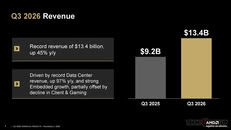
AMD Reports Record $13.4B Third Quarter 2026 Revenue
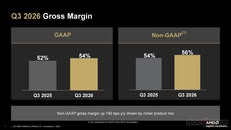
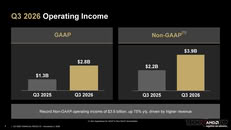
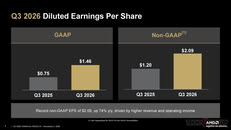
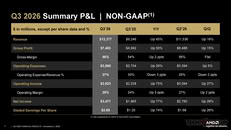
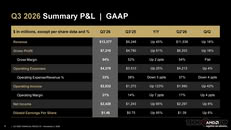
AMD (NASDAQ:AMD) today announced financial results for the third quarter of 2026. Third quarter revenue was $13.4 billion, gross margin was 54%, operating income was $2.8 billion, net income was $2.4 billion and diluted earnings per share was $1.46. On a non-GAAP basis, gross margin was 56%, operating income was $3.9 billion, net income was $3.5 billion and diluted earnings per share was $2.09.
 Recent Highlights
AMD's outlook statements are based on current expectations. The following statements are forward-looking and actual results could differ materially depending on market conditions and the factors set forth under "Cautionary Statement" below.
For the fourth quarter of 2026, AMD expects revenue to be approximately $17 billion, plus or minus 3%. The mid-point of the revenue range represents year-over-year growth of approximately 66% and a sequential increase of approximately 27%. Non-GAAP gross margin is expected to be approximately 55%.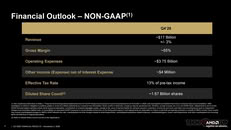
Source:
AMD
Dr. Lisa Su, AMD chair and CEO"We delivered a record quarter with revenue exceeding the high end of our guidance as Data Center segment sales nearly doubled year-over-year. Demand for our Instinct and EPYC products continued to strengthen, and we expect growth to accelerate further in the fourth quarter as we scale Helios and 'Venice' production. With our leadership product portfolio and deep customer and supply chain relationships, we are confident in our ability to sustain very strong revenue growth and expanding profitability over the coming years."


Jean Hu, AMD executive vice president, chief financial officer and treasurer"Third quarter revenue grew 45% year-over-year to a record $13.4 billion, while non-GAAP earnings per share grew 74%, demonstrating the significant operating leverage in our business model as our Data Center business drives scale. Our fourth-quarter outlook reflects accelerating revenue and earnings growth, driven by strong demand across our Data Center portfolio."Segment Summary
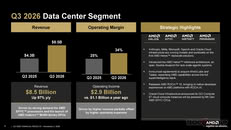
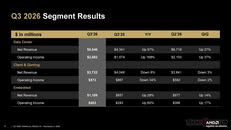
- Data Center segment revenue was a record $8.5 billion, up 97% year-over-year, driven by strong demand for AMD EPYC processors and the launch of AMD Instinct MI450 Series GPUs.
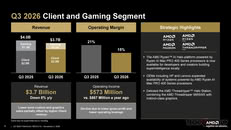
- Client and Gaming segment revenue was $3.7 billion, down 8% year-over-year. Client business revenue was $2.9 billion, up 7% year-over-year, driven by sales of AMD Ryzen mobile processors. Gaming business revenue was $773 million, down 40% year-over-year, due to lower semi-custom and graphics revenue.
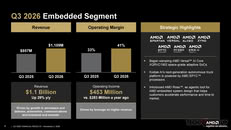
- Embedded segment revenue was $1.1 billion, up 29% year-over-year, led by growth in aerospace and defense, automotive, communications and industrial end markets.


- AMD solutions and software are powering superintelligence infrastructure at scale:
- Anthropic, Meta, Microsoft, OpenAI and Oracle Cloud Infrastructure are running models and workloads on the first AMD Helios rackscale solutions, powered by AMD Instinct MI450 Series GPUs and 6th Gen AMD EPYC CPUs.
- HPE announced that Vultr will deploy the first AMD Helios by HPE systems.
- Oracle Cloud Infrastructure announced its OCI Compute E7 cloud compute instances will be powered by 6th Gen AMD EPYC CPUs, supporting enterprise applications and the CPU services surrounding models.
- AMD introduced the AMD Helion reference architecture, an open, flexible blueprint for building rack-scale agentic systems that lets customers configure the mix of CPUs and GPUs based on their workloads.
- AMD ROCm 10 was released, bringing AI-native developer experiences to AMD platforms with ROCm.AI, along with performance improvements and updated libraries, compilers, frameworks, tools and model support.
- The EuroHPC JU selected AMD Instinct MI430X GPUs and 6th Gen AMD EPYC processors to power the LUMI-AI supercomputer.
- Google Cloud and Microsoft announced general availability of storage-optimized cloud instances powered by 5th Gen AMD EPYC CPUs.
- AMD is expanding its capabilities across the full superintelligence stack through strategic acquisitions:
- AMD announced an agreement to acquire World Labs, bringing leading model research expertise to AMD to help shape superintelligence infrastructure and strengthen the open ecosystem.
- AMD announced an agreement to acquire Taalas, adding specialized inference silicon technology to further differentiate AMD system-level solutions and deliver breakthrough inference performance and efficiency.
- AMD advanced its adaptive and embedded portfolio and expanded its role in physical AI systems:
- AMD began sampling the AMD Versal AI Core XQRVC1902 space-grade adaptive SoC designed to support missions lasting up to 15 years.
- Kodiak AI announced that its next generation autonomous truck platform is powered by AMD EPYC processors.
- AMD introduced AMD Ross, an agentic tool for embedded system design that helps customers accelerate time to market and improve performance for AMD embedded solutions.
- AMD expanded its PC offerings for local agentic superintelligence and gaming:
- The AMD Ryzen AI Halo platform powered by Ryzen AI Max PRO 400 Series processors is now available, bringing the performance, memory and software ecosystem developers and creators need to build and run models locally.
- HP, Lenovo, Framework and GMKtec expanded availability of systems powered by AMD Ryzen AI Max PRO 400 Series processors.
- AMD debuted the Threadripper Halo Station, powered by the AMD Threadripper 9955WX CPU and AMD Instinct MI350p GPU, able to run trillion-parameter models locally.
AMD's outlook statements are based on current expectations. The following statements are forward-looking and actual results could differ materially depending on market conditions and the factors set forth under "Cautionary Statement" below.
For the fourth quarter of 2026, AMD expects revenue to be approximately $17 billion, plus or minus 3%. The mid-point of the revenue range represents year-over-year growth of approximately 66% and a sequential increase of approximately 27%. Non-GAAP gross margin is expected to be approximately 55%.


21 Comments on AMD Reports Record $13.4B Third Quarter 2026 Revenue
Next year, they are most likely to surpass Intel in annual revenues, for the first time ever.
But oof, a client/gaming margin of just 15% now, and gaming revenue down by 40%. AMD might be in trouble if the AI bubble pops, they don't have their own fabs like Intel does.
I wonder how much is due to Nvidia threatening to cut off any provider that dares add AMD hardware.
Why do you think this is a positive point?
Already you have AI solve math problems that mathematicians have spent decades trying to solve in just a few hours: arstechnica.com/ai/2026/06/openais-math-breakthrough-played-to-ais-strengths/
Here is another one: openai.com/index/navier-stokes-solution/
AI is literally solving problems in a fraction of a time it takes humans to do.
Other than that they haven’t made idiotic investments and expenditures that put them in deep debt as the market goes in to the freezer like what happened in 2008 after the ati purchase and their fab buildout.
Like what almost necked intel a couple years ago.
Valuations will drop revenues will drop investors will be pissed they didn’t cash out at the peak.
Which conserns me more as a buyer is pricing and availability..
As for client CPUs, those have been selling consistently well during last eight quarters, like never before. This is reflected in gradually increasing CPU market share across client segments.
Obviously, their data centre segment is the revenue horse right now.
In a word: misinformation.They also have limited TSMC allotment, so even if demand for all their consumer hardware is sky high, if professional stuff is taking most of the orders then AMD will choose the higher profit parts. As any company would. And dGPU sales for gaming have been on a continuous downward trend for over a decade now, so AMD likely isnt all that enthused to shove more of them out the door anytime soon.
But we all knew this. The whole reason we were cheering on AMD in the data center is because data center revenue dwarfs consumer revenue. The monkey paw curls......
It is as you called it, a rumor. The thing is that Nvidia has a long history of doing this, like the GPP or in general to it's partners, so there is reason to believe it's plausible. It isn't much different than Nvidia's claim that there is no GPU smuggling, despite the ever growing evidence to the contrary, or them being raided in france.
that is misinformation. Or worse a straight out lie. Asking someone to disprove an unfalsifiable claim is a logical fallacy.
Feel free to prove it DOES exist, if you insist on it being true. I know crying about nvidia being evil makes people feel better but if I wanted to read random BS someone scoured off of X, I would just read X, or worse, WCCFtech....
With the increasing costs of TSMC manufacturing, Intel is likely saving themselves cost by using their own fabs, with some apparent discussions of AMD using Intel to manufacture chips.I'm not saying AI isn't going anywhere, just that it's a bubble as you point out, the sustainability is already getting very unstable with most tech stocks taking a large drop.
AI is good at certain tasks, however IMO it needs regulations and stricter guardrails since lately bad actors are using it to spread serious vulnerabilities and hack into critical infrastructure like refrigeration systems.Hopefully the AI builout rush slows down, so far nothing is slowing down those selling golden shovels.
But I think AMD is investing too deeply into something that most likely won't pay off for them, unlike Intel, AMD won't get any rescue funding from the US leadership.
The ATI purchase was at the wrong time, although it helped them from completely going bankrupt until Ryzen.Client CPU's and RDNA4 has been doing well, however AMD expects client and gaming sales to keep declining in 2027. I don't expect many to be jumping on $1,500+ consoles, or if Zen 6 ends up being too expensive compared to Nova Lake.Indeed, if or when the bubble pops it's going to hurt companies like AMD, but hurt the everyday person a lot more with AI banking on peoples investments and pension funds.
And I wouldn't be surprised if some of this is due to Nvidia putting pressure on their partners to not sell AMD hardware, despite Nvidia effectively cancelling the 5090 and 5080, and the rest of the stack being massively inflated.So you want to believe it's false misinformation because Nvidia hasn't admitted it themselves. Nvidia has a history and reputation for damaging their own partners for their gain, just see XFX, or EVGA for example. Or the fact that Nvidia's AIB have up to dozens of Geforce SKU's, but only one or a few Radeon variants.
That 5 billion anthropic deal isn't amd just handing them money. Athrophic needs to build that data centre and get it connected before they will see a penny.
I don't see real problems for AMD in the upcoming years
What's more, we've known for a while now that in this industry, these practices are fair game. Nvidia isn't the only one accused of it (and verifiably doing it - GPP being a perfect example).
Of course they are evil. In war and business everything is permissable
You seem to want to brand just this rumor as misinformation but your argument would categorically classify all rumors as misinformation.
You are saying it was a lie but you've no evidence that the source was lying.I'm not asking you to disprove it, that's the bar in order to quality something as misinformation. It has to actively be proven false. The claim isn't proven and therefore can't be called fact but no one is calling it fact, they are calling it a rumor.
Any other source is free to come forwards and put out evidence that the claim isn't true, thus the rumor isn't unfalsifiable. In order for it to be unfalsifiable, it has to be impossible to disprove. For example, the claim "my brother dreams of a space dog named guts flying to mars".I'm not insisting on it being true, I merely pointed out that the rumor had brevity due to Nvidia's past actions supporting their capability and history of doing so. Their past actions speak for themselves as evidence. If you were in court, building a profile that the company has a history of breaking the law and harming consumers, that would be valuable information.