Monday, November 16th 2026

Linux Kernel Gets AMD Capacity-Aware Scheduling for Zen 6 Heterogeneous CPU Architectures

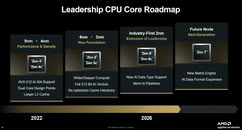
It has long been rumored that AMD is working on new Zen 6 LP cores for its next-gen Zen 6 (see our Zen 6 Technical Deep Dive here) CPU architecture—which has already been unveiled for server applications—and it now appears as though the Linux kernel is being prepared to support that new architecture across the board. A patch series by AMD itself details support for a Capacity-Aware Scheduling, which would effectively allow the Linux kernel to detect the capabilities of each individual CPU core and assign work to that CPU core accordingly.
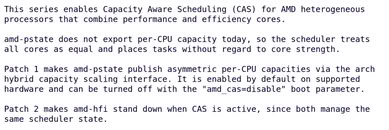
Amd-pstate does not export per-CPU capacity today, so the scheduler treats all cores as equal and places tasks without regard to core strength.
Patch 1 makes amd-pstate publish asymmetric per-CPU capacities via the arch hybrid capacity scaling interface. It is enabled by default on supported hardware and can be turned off with the "amd_cas=disable" boot parameter.
Patch 2 makes amd-hfi stand down when CAS is active, since both manage the same scheduler state.
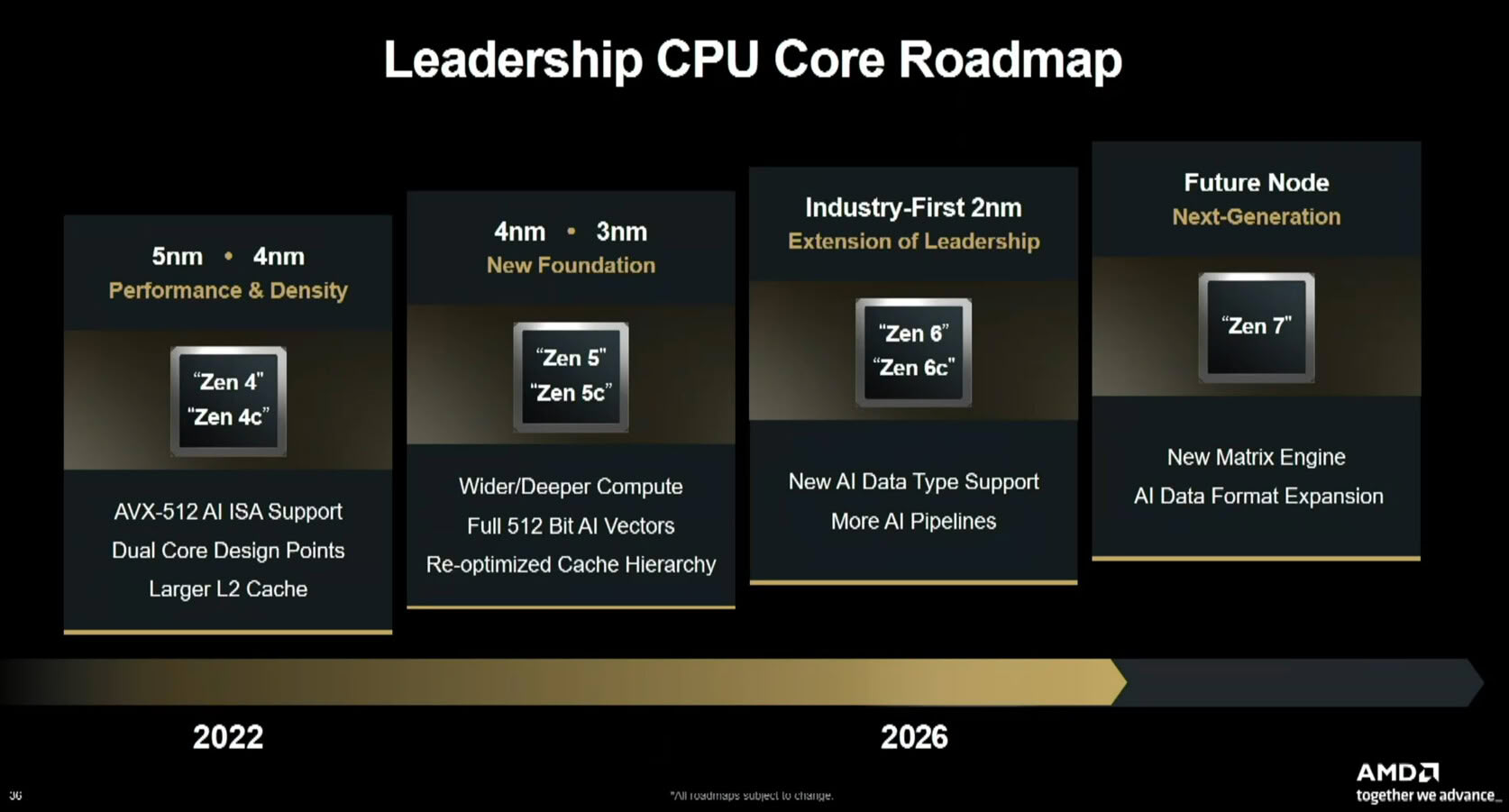
Capacity-aware scheduling would enable Capacity-Aware Scheduling on all AMD heterogeneous CPUs on Linux, which means going back to certain CPUs in the Hawk Point family, which combined Zen 4 and Zen 4c CPUs. The fact that AMD has waited so long to introduce CAS also might suggest that the new Zen 6 LP CPU cores are significantly less capable and thus significantly less power-hungry than the regular Zen 6 cores.
Sources: Linux kernel mailer, via Phoronix
Add your own comment

33 Comments on Linux Kernel Gets AMD Capacity-Aware Scheduling for Zen 6 Heterogeneous CPU Architectures

#1
shuffy_losys
Cpt.JankThe fact that AMD has waited so long to introduce CAS also might suggest that the new Zen 6 LP CPU cores are significantly less capable and thus significantly less power-hungry than the regular Zen 6 cores.
It kind of does suggest that because I thought Ryzen CPUs expose "preferred cores" that schedulers were supposed to use and I imagine if they wanted to keep the P/E core scheduling simple, they'd just throw the E cores on a lower preference.
Posted on Reply
#2
AusWolf
shuffy_losysIt kind of does suggest that because I thought Ryzen CPUs expose "preferred cores" that schedulers were supposed to use and I imagine if they wanted to keep the P/E core scheduling simple, they'd just throw the E cores on a lower preference.
The difference is that c-cores are identical to normal ones in functionality, so the preferred core scheduling works fine. If you introduce cores with different instruction sets, or different cache, ala Intel, you complicate things, which is unnecessary in a desktop PC, imo.
Posted on Reply
#3
Rulumi
AusWolfThe difference is that c-cores are identical to normal ones in functionality, so the preferred core scheduling works fine. If you introduce cores with different instruction sets, or different cache, ala Intel, you complicate things, which is unnecessary in a desktop PC, imo.
AMD Compact (c) cores do have less cache however.
Posted on Reply
#4
user556
This is for laptop APUs. AMD doesn't mix the fat and skinny cores in chiplets.
Posted on Reply
#5
AusWolf
RulumiAMD Compact (c) cores do have less cache however.
No they don't.
Posted on Reply
#6
user556
Everyone note that LP is even smaller than the C cores. So we're talking three groupings of cores in the APUs now.
Posted on Reply
#7
Rulumi
AusWolfNo they don't.
Zen 4c and Zen 5c have less L3 cache per core than normal Zen 4 and Zen 5. It's only with Zen 6 and Zen 6c that both now have the same amount of L3 cache per core (4MB).
Posted on Reply
#8
AusWolf
RulumiZen 4c and Zen 5c have less L3 cache per core than normal Zen 4 and Zen 5. It's only with Zen 6 and Zen 6c that both now have the same amount of L3 cache per core (4MB).
I've been in this discussion with someone once...

Let's be clear, Zen cores don't have any L3 cache. They only have L1 and L2, in which, c cores are identical to normal ones.

L3 cache is added to the CPU as a whole. The 8500G, for example, has 16 MB with a mixed 2x Zen 4 + 4x Zen 4c core config. The 8700G has also 16 MB, but with 8 Zen 4 cores. If you look at it from here, the Zen 4 cores in the 8700G have less L3 than the Zen 4c ones in the 8500G.

L3 to core is a ratio, not attachment.

Look at this block diagram, it'll make sense:


The L3 cache is a separate entity that any and all cores can use. I hope this makes sense.
Posted on Reply
#9
Visible Noise
AusWolfI've been in this discussion with someone once...

Let's be clear, Zen cores don't have any L3 cache. They only have L1 and L2, in which, c cores are identical to normal ones.

L3 cache is added to the CPU as a whole. The 8500G, for example, has 16 MB with a mixed 2x Zen 4 + 4x Zen 4c core config. The 8700G has also 16 MB, but with 8 Zen 4 cores. If you look at it from here, the Zen 4 cores in the 8700G have less L3 than the Zen 4c ones in the 8500G.

L3 to core is a ratio, not attachment.

Look at this block diagram, it'll make sense:


The L3 cache is a separate entity that any and all cores can use. I hope this makes sense.
Cache is always measured per core. Where have you been?
Posted on Reply
#10
AusWolf
Visible NoiseCache is always measured per core. Where have you been?
L1 and L2, yes. L3 is measured per CPU.

Let me reiterate: Zen cores do not have any L3 cache in them.
Posted on Reply
#11
Visible Noise
AusWolfThe difference is that c-cores are identical to normal ones in functionality, so the preferred core scheduling works fine. If you introduce cores with different instruction sets, or different cache, ala Intel, you complicate things, which is unnecessary in a desktop PC, imo.
Tell us you don’t know how computers work…

Did you even read the article you’re posting in?
Posted on Reply
#12
AusWolf
Visible NoiseTell us you don’t know how computers work…
It seems to me like you don't.
Visible NoiseDid you even read the article you’re posting in?
Have you?
Cpt.JankThe fact that AMD has waited so long to introduce CAS also might suggest that the new Zen 6 LP CPU cores are significantly less capable and thus significantly less power-hungry than the regular Zen 6 cores.
The only way c cores differ from regular ones is their size and clock speed, but they're functionally identical. This is probably what's going to change with LP cores.
Posted on Reply
#13
user556
AusWolfThis is probably what's going to change with LP cores.
Good point. The target for LP will be minimal operating like playing media (using dedicated video hardware decoding) and browsing web pages (again dedicated hardware for decoding). The LP's will probably lose everything that involves number crunching. All the SIMD instructions (which there are a lot of now) can be turf'd out for example.
Posted on Reply
#14
silvio3d
AusWolfL1 and L2, yes. L3 is measured per CPU.

Let me reiterate: Zen cores do not have any L3 cache in them.
AMD says something else—namely, that each core has a dedicated L3 cache and can also access the remaining pool—which is quite different from what you claimed. Is AMD lying? They’ve spent years clearly explaining how this mechanism works; you can’t just show up in 2026 and invent the idea that it was all a lie.
Posted on Reply
#15
napata
Visible NoiseCache is always measured per core. Where have you been?
L3 is shared among all cores for Intel and shared per CCD for AMD. Each core has access to the full L3.

Unlike AMD Intel ties L3 to cores so higher core count CPUs have but it's still all shared.

Snark is pathetic in general but doubly so when you're the one who's wrong.
Posted on Reply
#16
outlw
Cpt.JankThe fact that AMD has waited so long to introduce CAS also might suggest that the new Zen 6 LP CPU cores are significantly less capable and thus significantly less power-hungry than the regular Zen 6 cores.
I can see use cases for LP cores, paticularly in the console space, where the OS and hardware are tightly intigrated (e.g. LP cores dedicated to system tasks and UI).
That said, I agree that this looks like they are getting ready for mixed SIMD support (otherwise CPPC2 would already be handling everything fine), which I am not a fan of.
All it takes is one scheduler mistake to cause a pile of headaches, like early days with Adler Lake, where AVX-512 could be enabled on the P-cores, but was not supported on the E-cores...
Posted on Reply
#17
AusWolf
silvio3dAMD says something else—namely, that each core has a dedicated L3 cache and can also access the remaining pool—which is quite different from what you claimed. Is AMD lying? They’ve spent years clearly explaining how this mechanism works; you can’t just show up in 2026 and invent the idea that it was all a lie.
AMD never said this. Look at the CPU block diagram that I posted above, and show me the L3 cache inside each core, please.
Posted on Reply
#18
R0H1T
AusWolfThe difference is that c-cores are identical to normal ones in functionality, so the preferred core scheduling works fine. If you introduce cores with different instruction sets, or different cache, ala Intel, you complicate things, which is unnecessary in a desktop PC, imo.
Zen "c" cores have less cache, and Intel patched the AVX512 available on the 12th gen cores through BIOS updates. But in general the scheduling or computing(?) capacity wasn't much different on AMD's core variants, this however could squeeze out maybe 5% more than the worst case scenarios?
outlwI agree that this looks like they are getting ready for mixed SIMD support
Dunno why that looks like to you? It seems they just want to squeeze out more from their chips especially with Apple being the true/lead competitor!
Posted on Reply
#19
AusWolf
R0H1TZen "c" cores have less cache,
No, they don't. Zen 4c cores have the same 32+32 KB i+d L1 and 1 MB L2 cache as regular Zen 4 ones. The L3 is shared among all the cores. Each core individually has zero, nada, zilch.

Seriously guys, read up on it.
Posted on Reply
#20
outlw
R0H1TDunno why that looks like to you? It seems they just want to squeeze out more from their chips especially with Apple being the true/lead competitor!
:confused:

Because CPPC2 already handles this otherwise?

AMD64 Architecture Programmer’s Manual Volume 2: System Programming

Section 17.6 is dedicated to CPPC, and 17.6.4 describes CPPC Performance Levels and Capabilities.
Assuming the cores offer identical SMID support (same capabilities, not necessarily the same performance!), as I understand the implementation, CPPC2 covers nearly every use case I can think of.
The only thing missing is scheduler hints for mixed SMID support, which is the point of the new CAS.
Posted on Reply
#21
AusWolf
outlw:confused:

Because CPPC2 already handles this otherwise?

AMD64 Architecture Programmer’s Manual Volume 2: System Programming

Section 17.6 is dedicated to CPPC, and 17.6.4 describes CPPC Performance Levels and Capabilities.
Assuming the cores offer identical SMID support (same capabilities, not necessarily the same performance!), as I understand the implementation, CPPC2 covers nearly every use case I can think of.
The only thing missing is scheduler hints for mixed SMID support, which is the point of the new CAS.
Bingo! :)

"C" cores aren't new. If they were any different from normal ones in their functioning, then AMD would have pulled something like this long ago, as CPPC just wouldn't have cut it.
Posted on Reply
#22
outlw
AusWolfNo, they don't. Zen 4c cores have the same 32+32 KB i+d L1 and 1 MB L2 cache as regular Zen 4 ones. The L3 is shared among all the cores. Each core individually has zero, nada, zilch.

Seriously guys, read up on it.
I can understand both arguments, but I feel this argument is more technically correct.

Up until Zen 6/6c, the Compact Cores had identical L1 and L2 cache sizes, but had less (L3 Cache)/(Cores in Complex).
One could argue that, pre-Zen 6c, this means less L3 cache avaliable for each core, which is correct.

The difference is that L1 and L2 are inherent to the core, while L3 is shared between cores.
Put otherwise, a core is not a core without the L1 and L2 caches (which is identical between Standard and Compact cores), with the L3 cache being external to the cores.
Posted on Reply
#23
AusWolf
outlwUp until Zen 6/6c, the Compact Cores had identical L1 and L2 cache sizes, but had less (L3 Cache)/(Cores in Complex).
One could argue that, pre-Zen 6c, this means less L3 cache avaliable for each core, which is correct.
Even that doesn't cover the truth. The 8500G (alias Steam Machine CPU) has 2 Zen 4 and 4 Zen 4c cores with 16 MB L3. The 8700G has 8 Zen 4 cores with the same 16 MB L3. During full CPU load, the Zen 4c cores in the Steam Machine CPU have access to more L3 than the normal Zen 4 cores in the 8700G, as the L3 is shared among 6 instead of 8 cores.
Posted on Reply
#24
outlw
Well, L3/Number of Cores cover this, but I understand what you mean ;)
It is a bit more complex than this, though, as the cores are not limited to a small slice of L3, and a single core under the right conditions could use the full L3.

For those unsure, perhaps you can better see here what is meant.
In the first graphic, you can see that both the Zen 4 and Zen 4c cores have the L1 and L2 caches inherently contained within the individual cores.
In the second graphic, the 16MB shared L3 is clearly shown as being external to the individual cores.


Posted on Reply
#25
AusWolf
outlwWell, L3/Number of Cores cover this, but I understand what you mean ;)
Yes. It's a ratio, not a distribution. :)

Similarly, my car's 4:1 wheel to engine ratio doesn't mean that there are 4 wheels in its engine somewhere.

But yeah, 6 core parts have a higher L3 per core ratio. People: think about it. ;)
Posted on Reply
Add your own comment
Nov 18th, 2026 09:59 CST change timezone

New Forum Posts

Popular Reviews

TPU on YouTube

Controversial News Posts