Monday, November 16th 2026

Linux Kernel Gets AMD Capacity-Aware Scheduling for Zen 6 Heterogeneous CPU Architectures
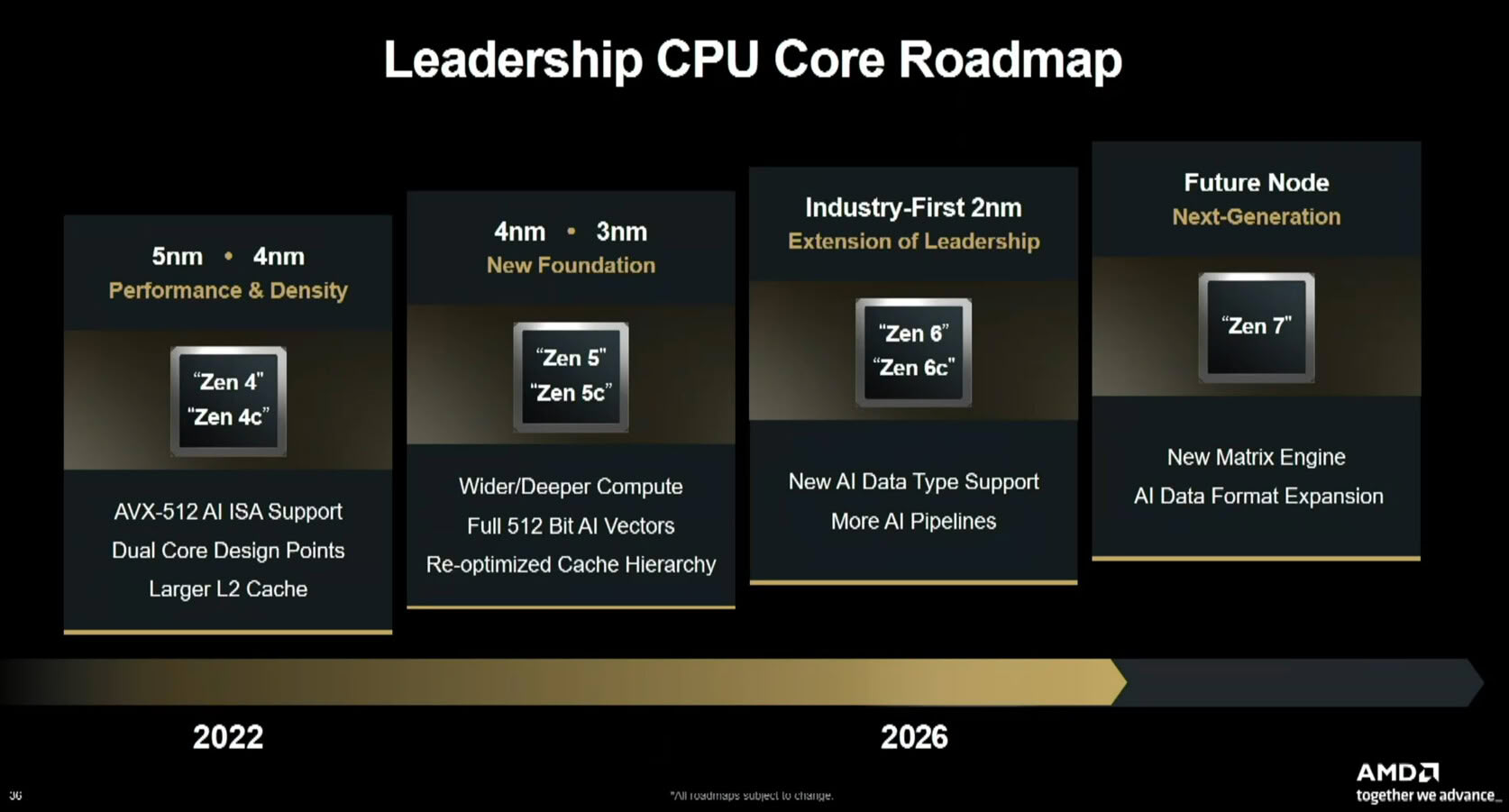
It has long been rumored that AMD is working on new Zen 6 LP cores for its next-gen Zen 6 (see our Zen 6 Technical Deep Dive here) CPU architecture—which has already been unveiled for server applications—and it now appears as though the Linux kernel is being prepared to support that new architecture across the board. A patch series by AMD itself details support for a Capacity-Aware Scheduling, which would effectively allow the Linux kernel to detect the capabilities of each individual CPU core and assign work to that CPU core accordingly.
 Capacity-aware scheduling would enable Capacity-Aware Scheduling on all AMD heterogeneous CPUs on Linux, which means going back to certain CPUs in the Hawk Point family, which combined Zen 4 and Zen 4c CPUs. The fact that AMD has waited so long to introduce CAS also might suggest that the new Zen 6 LP CPU cores are significantly less capable and thus significantly less power-hungry than the regular Zen 6 cores.
Sources:
Linux kernel mailer, via Phoronix
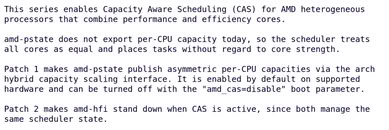
Amd-pstate does not export per-CPU capacity today, so the scheduler treats all cores as equal and places tasks without regard to core strength.
Patch 1 makes amd-pstate publish asymmetric per-CPU capacities via the arch hybrid capacity scaling interface. It is enabled by default on supported hardware and can be turned off with the "amd_cas=disable" boot parameter.
Patch 2 makes amd-hfi stand down when CAS is active, since both manage the same scheduler state.

33 Comments on Linux Kernel Gets AMD Capacity-Aware Scheduling for Zen 6 Heterogeneous CPU Architectures
Amusingly, the Zen 6C chiplets that have been flogged to AI data centres in the last few months have the L3 cache ratio the same 4 MB per core as the fat Zen 6 chiplets. And given there is 32 6C cores on each chiplet, that makes 128 MB of L3 per chiplet.
Note that is for the server chiplets; it will be interesting to see if AMD keeps those minor changes on the laptop APU chips that use both Zen 6 and Zen 6c cores.
I am pretty sure AVX-512 support was completely removed by Intel from later BIOS releases.
Given the many newer parts to chose from, but no others without E-cores, I read that as an indictment on E-cores. Whether that also mean AVX-512 is used, I can't really say. I guess it's more chosen for decent gaming at low price.