Friday, November 27th 2026
Limited Demand Visibility and Growing Supply Chain Caution Heighten Risk of DRAM Contract Price Declines in 2028
TrendForce's latest memory industry findings indicate that supply chain participants have been reassessing their production and sales plans for 2027 and 2028 since early 4Q26, resulting in a slight slowdown in overall DRAM procurement momentum.
This growing caution stems from concerns that the outcome of the U.S. midterm elections could affect the pace of future data center development, potential changes to NVIDIA's financing policies for neocloud providers, and geopolitical restrictions affecting the flow of advanced-node chips and access to leased computing resources.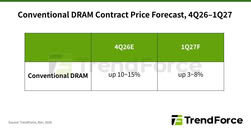 Given the uncertainty surrounding the extent to which these developments will affect demand, TrendForce has outlined two scenarios—a base case and a bear case—for DRAM contract price trends over the next two years.
Under the base case, conventional DRAM contract price increases are expected to narrow progressively throughout 2027, with prices potentially leveling off in the second half of the year before declining in 2028.
The base case takes several demand-side factors into account. Consumer electronics manufacturers are facing mounting sales pressure and have limited capacity to absorb further price increases. Additionally, Chinese CSPs began scaling back their server DRAM demand in early 4Q26, although North American CSPs have largely absorbed the resulting supply availability.
Following the U.S. midterm elections, market participants expect a more cautious policy stance toward domestic data center development. Combined with power supply constraints, this could reshape data center construction demand in 2028. Overall server procurement and related DRAM demand could also be affected indirectly if NVIDIA scales back its financing support for neocloud providers.
Adding to these uncertainties, the U.S. Department of Commerce's Bureau of Industry and Security (BIS) recently introduced new regulations limiting access to advanced AI chips for data centers that provide substantial computing resources to Chinese companies. Semiconductor foundries must also obtain BIS approval before manufacturing advanced-node chips for Chinese IC design houses. These restrictions could further weigh on DRAM demand growth in Asia.
On the supply side, TrendForce expects global DRAM bit supply to maintain strong growth from 2026 through 2028 as manufacturers bring additional production capacity online and migrate to more advanced process technologies. If overall server shipments growth slows in 2028 as currently projected, DRAM supply shortages are expected to ease, with contract prices declining across all product categories beginning in 1Q28.
Under the bear case, TrendForce assumes that server OEMs will further scale back procurement following downward revisions to demand, triggering widespread inventory reductions across the supply chain. Additional downside risks include reduced investment and potential consolidation among neocloud providers, as well as the introduction of more stringent and comprehensive export controls by BIS.
Under these conditions, overall server shipment growth could begin decelerating as early as 2027, causing conventional DRAM contract prices to reverse course and begin declining in 4Q27, with price declines widening in 2028.
Source:
TrendForce
This growing caution stems from concerns that the outcome of the U.S. midterm elections could affect the pace of future data center development, potential changes to NVIDIA's financing policies for neocloud providers, and geopolitical restrictions affecting the flow of advanced-node chips and access to leased computing resources.
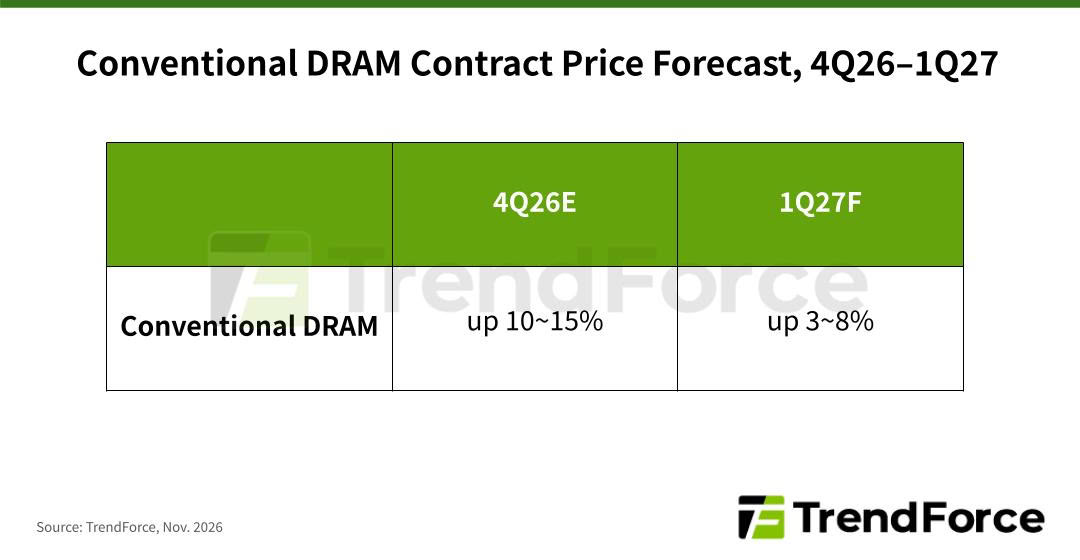
Under the base case, conventional DRAM contract price increases are expected to narrow progressively throughout 2027, with prices potentially leveling off in the second half of the year before declining in 2028.
The base case takes several demand-side factors into account. Consumer electronics manufacturers are facing mounting sales pressure and have limited capacity to absorb further price increases. Additionally, Chinese CSPs began scaling back their server DRAM demand in early 4Q26, although North American CSPs have largely absorbed the resulting supply availability.
Following the U.S. midterm elections, market participants expect a more cautious policy stance toward domestic data center development. Combined with power supply constraints, this could reshape data center construction demand in 2028. Overall server procurement and related DRAM demand could also be affected indirectly if NVIDIA scales back its financing support for neocloud providers.
Adding to these uncertainties, the U.S. Department of Commerce's Bureau of Industry and Security (BIS) recently introduced new regulations limiting access to advanced AI chips for data centers that provide substantial computing resources to Chinese companies. Semiconductor foundries must also obtain BIS approval before manufacturing advanced-node chips for Chinese IC design houses. These restrictions could further weigh on DRAM demand growth in Asia.
On the supply side, TrendForce expects global DRAM bit supply to maintain strong growth from 2026 through 2028 as manufacturers bring additional production capacity online and migrate to more advanced process technologies. If overall server shipments growth slows in 2028 as currently projected, DRAM supply shortages are expected to ease, with contract prices declining across all product categories beginning in 1Q28.
Under the bear case, TrendForce assumes that server OEMs will further scale back procurement following downward revisions to demand, triggering widespread inventory reductions across the supply chain. Additional downside risks include reduced investment and potential consolidation among neocloud providers, as well as the introduction of more stringent and comprehensive export controls by BIS.
Under these conditions, overall server shipment growth could begin decelerating as early as 2027, causing conventional DRAM contract prices to reverse course and begin declining in 4Q27, with price declines widening in 2028.
2 Comments on Limited Demand Visibility and Growing Supply Chain Caution Heighten Risk of DRAM Contract Price Declines in 2028
And it's handy they have the Democrats winning the midterms as an excuse now for the inevitable correction in AI, even though they won't have any control for at least two months, and a lot of downturn has nothing to do with government opposition to new servers...