

Computex 2026 News Coverage

Jun 2 - 5

Computex is the world's leading technology trade show, especially for computer hardware enthusiasts like us. It is held annually in Taipei, Taiwan, and brings together the whole tech industry to unveil the latest innovations in hardware, computing, and AI.

Just like every year, we're reporting from Computex, live with our on-site team, backed by editors at home, to keep you informed with the fastest and most detailed updates.

On this page you can find all of our news coverage for the event.

The Intel Arc G3 Series Inside Story: How Intel Created a Purpose-built Gaming Handheld Silicon That Isn't a Hamstrung U-Segment Chip

During the Q&A session with Intel detailing its new Arc G3 series processors for handheld game consoles, we've learned some of the interesting design choices Intel had to make in order to create the perfect chip for the form-factor that doesn't compromise in areas where it's most needed to shine in. For starters, Intel doesn't believe that the Arc G3 is a "processor with integrated graphics," but rather a "GPU with an integrated CPU." Such a philosophy was needed to serve as a bedrock for this chip. Beyond the marketing shift, the session revealed fascinating, previously under-the-radar engineering workarounds Intel is using to challenge AMD's dominance in the portable space.

Fitting Panther Lake into a handheld thermal design power (TDP) required more than just tweaking clock speeds. Intel is employing an aggressive silicon harvesting strategy, utilizing "fallout" dies that don't validate for the full Panther Lake specification. To hit the required power and thermal constraints of a handheld device, Intel has systematically disabled key IP blocks. The Arc G3 cuts the P-core count from four down to just two, drops the number of display engines from three to two, and halves the Thunderbolt capability from four ports to two. This surgical reduction brings the die into a manageable TDP, prioritizing GPU performance and securing supply for the burgeoning handheld market.
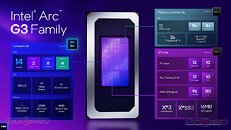


Arc G3 Processor Series Detailed: Purpose-built for Gaming Handhelds, Packs the Best of Intel

Intel today formally launched the Arc G3 series, a series of fully-integrated SoCs for gaming handhelds out to compete with AMD Ryzen Z-series. Intel felt the need for such a product line when it observed OEMs using U-segment mobile processors for handheld consoles. The Arc G3 features a tailored balance of CPU compute, and graphics muscle, generally favoring the latter, with power management that's fine-tuned for typical handheld gaming use-cases. This time around, Intel also made the effort to co-engineer devices with OEMs so their battery-life and thermals have knowhow from Intel.

Intel tapped into its latest "Panther Lake" microarchitecture to create the Arc G3 series. The company claims performance up to 42% higher than the competition (being AMD Ryzen Z2 Extreme based on "Strix Point"); with as much as 11 hours of gameplay on battery, and support for XBOX mode. It also brings the full stack of Intel Arc innovations such as XeSS 3 upscaling, frame-generation, and low-latency, the GPU provides full DirectX 12 Ultimate acceleration. Also on the software side, the console gets day-0 game optimization from Intel, along with pre-compiled shaders. Intel also brings segment-first connectivity features such as Thunderbolt 4 and Wi-Fi 7.

Intel Showcases first Gaming Handhelds Powered by Arc G3 SoCs

Intel at Computex 2026 showcased some of the first partner-branded gaming handhelds powered by its new Arc G3 series processors that are purpose-built for devices of this form-factor. These chips are derivatives of the "Panther Lake" microarchitecture, and feature the latest "Coyote Cove" and "Darkmont" CPU core types. The Arc G3 Extreme features a 2P+8E+4LPE CPU core configuration along with a powerful iGPU based on the Xe3 "Celestial" graphics architecture that has 12 Xe cores. There's also the full suite of XeSS, XeLL, and XeFG software-side readiness. Among the models we've seen are a OneXPlayer 3 handheld powered by the Arc G3 Extreme, MSI Claw 8 EX AI+, and Acer Predator Atlas 8.

MSI Claw 8 EX AI+
Acer Predator Atlas 8

Intel Makes "Bartlett Lake" More Accessible to End-users as a Xeon 6300 Series Server CPU

Intel debuted "Bartlett Lake" last year as exclusive to the IoT and Embedded markets. Today, it launched the silicon as a Xeon 6300 series entry-level server processor. The series now offers "Bartlett Lake" with all 12 "Raptor Cove" P-cores, and 36 MB of cache, along with support for ECC memory. The chip is drop-in compatible with all Xeon 6300 series LGA1700 server platforms, with a firmware update. The company hasn't detailed processor model numbers, yet. Its availability as a server processor makes it more accessible to end-users to buy one and toy with the elusive processor.

Intel Puts Agentic AI to Work with Xeon 6+, Networking, and AI Systems

Intel today announced a series of data center advancements, including new Intel Xeon 6+ processors, an expanded 800 Series Ethernet portfolio featuring the Intel Ethernet E835 controllers and network adapters, and continued progress on its AI accelerator roadmap, including updates on Crescent Island. Together, these developments highlight a clear industry shift: as AI becomes more agentic, the CPU is re-emerging at the center of modern AI infrastructure. With Xeon serving as the control plane, Intel is taking a systems-level approach to performance and efficiency at scale—delivering platforms designed for increasingly agentic AI workloads, where orchestration, data movement, and sustained inference are critical across data center and network environments.

"AI doesn't scale as a collection of parts—it scales as a coordinated system," said Kevork Kechichan, executive vice president and general manager of Intel Data Center Group. "As AI becomes more agentic, the constraints shift to orchestration, concurrency, and data movement. That shift reinforces a core reality: the CPU remains the control plane for the modern AI infrastructure. With Xeon 6+ and Ethernet E835, we're tightly coupling compute and networking to reduce bottlenecks and enable efficient, secure scaling of real-world agentic workflows."

Intel Arc G3 CPU Family Officially Released for Handheld Gaming PCs

Following a series of leaks about an upcoming Intel Panther Lake CPU for gaming handhelds, the hardware giant has officially announced the Intel Arc G3 CPU series, which features the powerful Arc B390 iGPU and optimizations for the Windows Xbox mode that started rolling out to gaming handhelds and Windows PCs alike not too long ago. Both new CPUs are based on the same 14-core CPU design—with 2 P-Cores, 8 E-Cores, and 4 LP E-Cores—but the Arc G3 CPU has a 100 MHz lower max Turbo frequency and a less powerful Arc B370 iGPU. The Arc G3 Extreme and the Arc G3 have already been confirmed as coming to the new Acer Predator Atlas 8 gaming handheld, slated to launch in October 2026.

The Arc G3 Extreme tops out at 4.7 GHz, while the Arc G3 is capable of 4.6 GHz max Turbo frequency. The base frequencies on both CPUs are the same 1.9 GHz on the P-Cores and 1.5 GHz on the E-Cores and LP E-Cores. The Arc B370 iGPU is built on the same Xe3 architecture as the B390, but it features 10 Xe cores instead of the 12 in the B390 iGPU. The cores in the Arc B370 iGPU are clocked at 2.2 GHz, and Intel claims the cut-back iGPU is capable of 90 TOPs of Int8 performance, compared to 113 TOPs on the G3 Extreme. In TechPowerUp's prior testing of the Arc B390, the iGPU was significantly faster than the AMD Radeon 890M that has become ubiquitous in so many gaming handhelds, suggesting that the B370 should at least be on-par with the 890M, if not slightly faster. Both new CPUs also have the same 25 W base power, with a maximum turbo TDP of 80 W and a minimum assured power of 15 W.
Nov 14th, 2026 01:16 CST change timezone

New Forum Posts

Popular Reviews

TPU on YouTube

Controversial News Posts